Boomtown Dice Odds and Corner Selection | Playgridia
Everything in Boomtown hangs on the sum of two dice — and that sum is nowhere near evenly distributed. A player who can read the number discs picks an opening corner that out-produces their rival several times over. This guide gives you exactly that maths.
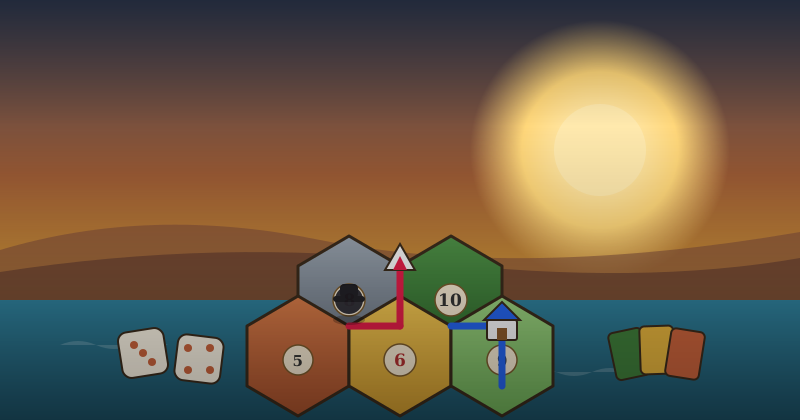
The real distribution of two dice
Two dice have 36 possible outcomes. How many combinations make a given total is that number's frequency:
- 2 → 1 in 36 (2.8%) · 12 → 1 in 36 (2.8%)
- 3 → 2 in 36 (5.6%) · 11 → 2 in 36 (5.6%)
- 4 → 3 in 36 (8.3%) · 10 → 3 in 36 (8.3%)
- 5 → 4 in 36 (11.1%) · 9 → 4 in 36 (11.1%)
- 6 → 5 in 36 (13.9%) · 8 → 5 in 36 (13.9%)
- 7 → 6 in 36 (16.7%) — no tile produces; the Bandit fires instead
So 6 and 8 come up five times as often as 2 and 12. A tile sitting on 12 pays out roughly once every 36 rolls — once or twice in an entire match.
How many numbers are on the board?
The island is 19 tiles and one of them is wasteland: it produces nothing, carries no number disc, and the Bandit starts there. The remaining 18 tiles draw numbers from the classic 18-token bag — which contains no 7. The layout also tries not to place two 6/8 tiles side by side, so "a corner where two super-tiles meet" is a rare gift.
How to compute a corner's expected income
A corner touches three tiles. Its strength is the sum of those three probabilities. Example: a corner on 6 + 8 + 5 → 5 + 5 + 4 = 14 in 36. That is roughly a 39% chance of being paid something on any given roll, and an average of 0.39 goods per roll over time. Upgrade the same corner to a city and that doubles: 0.78 goods per roll.
Scale it to a round: with 4 players there are 4 rolls per round, so that village averages ~1.6 goods per round and the city ~3.1. Since a village costs a road plus four different goods while the upgrade costs only 2 Grain + 3 Ore, this is exactly why upgrading is so strong.
Number quality, ranked
- First class: 6 and 8 (5/36 each). Their discs carry a red ring — the game is telling you.
- Second class: 5 and 9 (4/36).
- Acceptable: 4 and 10 (3/36).
- Weak: 3 and 11 (2/36).
- Trap: 2 and 12 (1/36). If a corner's third tile is a 12, that corner is effectively a two-tile corner.
How often does a 7 land?
7 is the single most frequent total: 6 in 36, about one roll in six. It produces nothing; instead everyone over 7 cards discards half, then the Bandit moves and a robbery happens. With 4 rolls per round at a four-player table, a 7 lands roughly every 1.5 rounds. Holding more than 7 cards is therefore not a style choice — it is a calculable loss.
Probability alone is not enough
Two caveats stop you applying this table blindly:
- Variety beats probability. A corner on 8 and 6 that produces the same good twice is usually worse than a humbler corner producing three different goods — because the good you don't produce is the one you overpay for in trade.
- The Bandit can erase probability. An economy resting on one high number stops the moment a rival parks the Bandit there. Income spread over two good numbers is much harder to switch off.
For the full rules see the how-to-play guide; to convert these numbers into wins, the tactics guide. Test the maths live: play Boomtown free.
Any third-party brand and game names mentioned are trademarks of their respective owners. Playgridia is an independent platform, not affiliated with or endorsed by them.