Gold Miner High Score Tips: Combo Guide | Playgridia
The fastest way to a Gold Miner high score is to stack the game's own multipliers instead of grabbing whatever the lamp lights up first — an escalating catch combo, a bonus for digging deep, and a comeback bonus that pays you more while you're behind. Gold Miner is a two-player claw duel over one shared shaft: twelve turns, six each, and whoever has banked the most cash by the end wins.
Steer the lamp, then commit
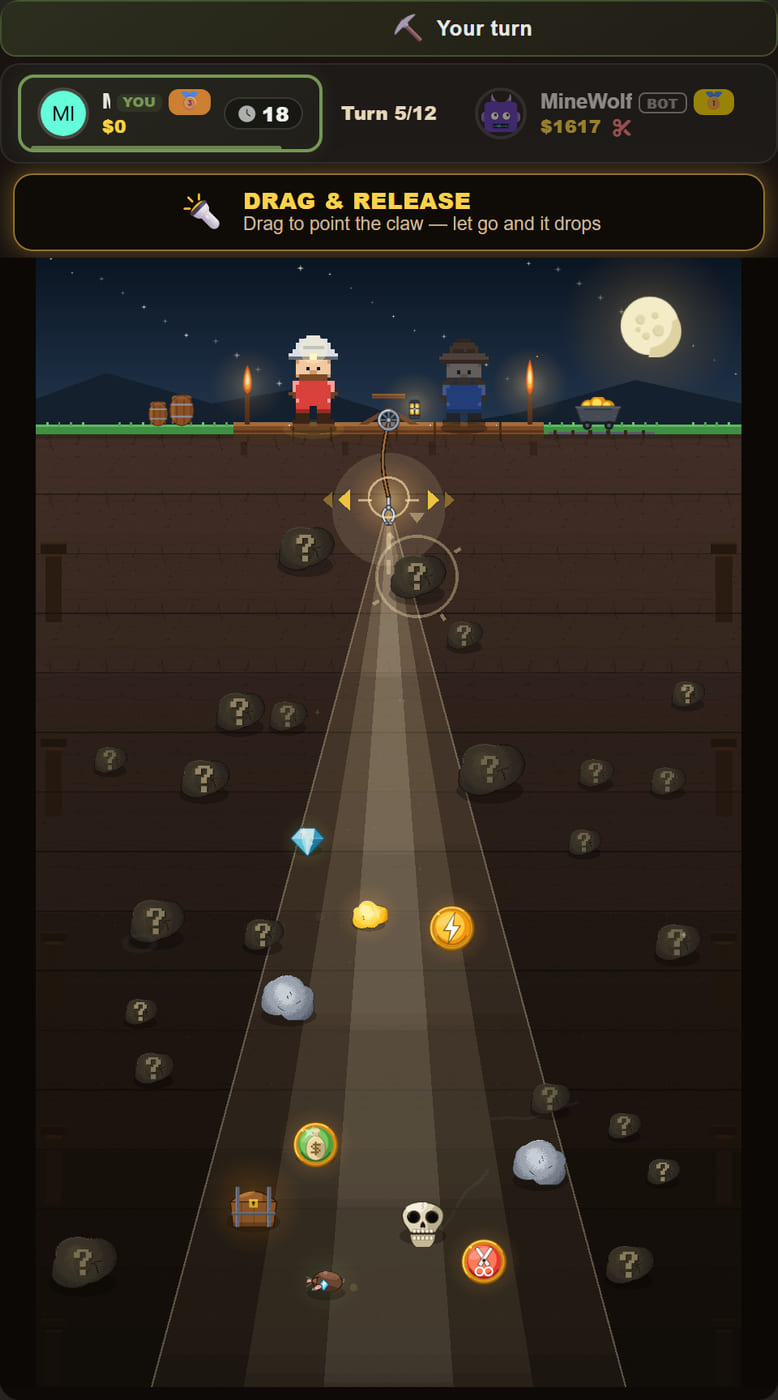
The shaft is pitch dark, and the lamp is mounted right on the claw — there is no separate scan step anymore. Steering costs nothing: drag, tap the arrow buttons, or use the arrow keys to swing the claw anywhere inside its 80-degree arc on either side of straight down, and it holds wherever you leave it for as long as your turn clock allows. Whatever the beam points at lights up, and look away and it goes straight back to being an unlit, anonymous lump — nothing about a mineral is remembered once the light leaves it. Only releasing does anything: the game then casts an instant, straight-line shot at the exact angle you dropped at, and it checks every mineral's real position at that moment, so a moving target like the mole or the speed pickup is only caught if you actually led it, not where it happened to be when you last looked.
One thing costs you more than it looks: nothing stops you from firing again immediately, even while a previous catch is still mid-haul. Doing that discards whatever you were reeling in — no score banked for it, and any power-up you had just used on that haul is wasted along with it — so treat a second shot mid-reel as a genuine mistake, not a free extra try.
Stack the combo — the first two catches don't count
Every gold nugget, diamond or the roaming mole you land builds a streak, and the payout escalates the longer it runs: the first two value catches of a fresh streak still pay face value, the third pays ×1.5, the fourth pays ×2, and the fifth catch — and every one after it — pays ×3, which is the cap. A miss, a junk catch (a rock, a bone or a skull), a TNT hit, or having your rope cut by your rival's scissors all reset the streak back to zero. The mystery chest is the one neutral catch: landing one neither builds the combo nor breaks it, so it is a safe way to use a turn without risking the streak either way.
Dig deep for a bonus, but budget the clock
Anything within roughly 90 pixels of the surface earns no depth bonus at all. Past that band the payout scales up the deeper the mineral sits, in theory as high as +60% right at the bottom of the shaft — the real ceiling any placed mineral can actually reach works out closer to +53–55%, since nothing spawns flush against the very edge. The trade-off is time, not risk: a deeper catch is a longer haul, because reel duration scales with distance, so the same greed that pads a single score also eats into the seconds you have left for the rest of that turn.
Let a losing position pay you back
Falling behind is not purely bad news. If your rival's total is ahead of yours, every value catch and any chest loot you deliver earns a comeback bonus — up to +40% once you are 1500 points back — and it fades away completely the moment you are tied or ahead. It never applies to junk, to the flat gold-bag pickup, or to the flat $50 you get from a maxed-out speed power-up. In practice, that means the same diamond worth $600 to a player who is ahead is worth up to $840 to one who is far enough behind, so a rough start is genuinely recoverable, not just a comforting idea.
What every catch is actually worth
Every mineral's value is fixed and known to the game the whole time — the darkness is a rendering choice, not a hidden number — so once the lamp shows you what's there, the comparison is straightforward:
| Catch | Value | Worth knowing |
|---|---|---|
| Diamond | $600 | Highest-paying catch in the game, and light enough to haul in fast |
| Mole | $260 | Roams the shaft on its own; scores like any other value catch once caught |
| Large gold | $350 | Heavy — the slowest of the three gold sizes to reel in |
| Mystery chest | ~$327 on average | Loot is hidden until delivery and can range from nothing to a $1200 jackpot; hauls as slowly as a rock |
| Medium gold | $150 | The middle tier — a dependable combo-keeper |
| Small gold | $50 | Light and quick to haul |
| Skull | $35 | Junk — breaks your combo, and the heaviest single haul in the game |
| Bone | $20 | Junk — breaks your combo |
| Rock | $10 | Junk — breaks your combo |
| TNT | $0 | Destroys everything within reach on contact; nobody scores |
Spend the power-ups, and use TNT on purpose
Speed does not help forever: it doubles the reel time on your very next haul, hit or miss, and it is spent the moment you launch again, so do not grab one and then take your time lining up the next shot. Only your first two speed pickups of the match get that full doubling — a third and any after it instead pay a flat $50 consolation. Scissors has no cap at all: it is a re-armable charge, so pick one up, cut a rival's rope while they are mid-haul to drop their catch and reset their combo, then grab another and do it again later in the match. The gold bag is the simplest of the three — a flat $200 every time, with no multiplier attached and no limit on how many you collect.
TNT is not only something to dodge. It detonates only on direct contact — nothing happens until the claw actually reaches it — and when it goes off, every mineral within reach is destroyed and scores nobody anything, including a second TNT barrel caught in the same blast. If your rival has spent their turn lighting up a rich cluster right next to a barrel, dropping your claw straight onto it can be a deliberate strike as much as an accident to avoid — just remember it resets your own combo too.
None of this replaces reading the shaft — you still have to steer the lamp and choose a target — but the numbers are what turn "I grabbed something" into an actual plan: push the streak past its first two freebies, take the deep shot when the clock can still afford the longer reel, and lean on the comeback bonus instead of panicking when you are behind. New to the controls? Our Gold Miner tips guide covers steering and target choice from turn one, and playing Gold Miner online walks through a full match if you have not started one yet. Then put the numbers to work and chase your own high score.
Frequently Asked Questions
How does the combo multiplier work in Gold Miner?
Every gold, diamond or mole you land builds a streak. The first two catches of a fresh streak still pay face value, the third pays ×1.5, the fourth pays ×2, and the fifth catch and every one after it pays ×3, which is the cap. A miss, a junk catch, a TNT hit, or having your rope cut all reset the streak to zero, though landing the mystery chest does neither.
Does digging deeper actually pay more?
Yes. Anything within about 90 pixels of the surface gets no depth bonus at all, but past that the payout scales up toward roughly +60% near the very bottom of the shaft, in practice closer to +53-55% once you account for a mineral's own size. The catch is time: a deeper haul takes longer to reel in, which eats into the clock you have left for the rest of that turn.
What is the comeback bonus in Gold Miner?
If you are behind on total score, every gold, diamond or mole catch, plus any mystery chest loot, pays up to 40% extra once the gap reaches 1500 points, and it disappears completely once you are tied or ahead. It never applies to junk, the flat gold-bag pickup, or the flat $50 you get once your speed power-ups are used up. It means a slow start is genuinely recoverable, not just something to hope for.
Is the mystery chest worth grabbing?
Its loot is hidden until it is delivered: 12% of the time it is worth nothing, 30% of the time it pays $120, 34% pays $300, 18% pays $650, and there is a 6% shot at a $1200 jackpot. On average it is worth around $327, which sits between a medium and a large gold nugget, but it hauls as slowly as a rock, so weigh that extra turn time before you commit to it.
How many turns does a Gold Miner match last, and how do you win?
Twelve turns total, six for each player, and a turn is a time box rather than a single shot, so you can drop the claw as many times as your clock (20 to 90 seconds, chosen by the host) allows. Whoever has banked the most cash after turn 12 wins, and an exact tie is scored as a draw.
What do the Gold Miner power-ups actually do?
Speed doubles the reel time on your very next haul, but only your first two pickups in a match get the full doubling; after that, each one instead pays a flat $50. Scissors lets you cut a rival's rope while they are mid-haul, dropping their catch and resetting their combo, and you can pick up and use as many charges as you find. The gold bag is a flat $200 with no cap and no multiplier attached.