How to Play Royal Whispers: Full Guide | Playgridia
How to play Royal Whispers: every round each courtier is dealt one secret figure, then on your turn you draw a second and play one of the two. Clear the court, or hold the highest figure when the deck runs dry, and the monarch pays you Favor. 2-4 players against bots or friends, free in your browser with no download — a short, sly deduction card game that takes two minutes to learn.
How a round works
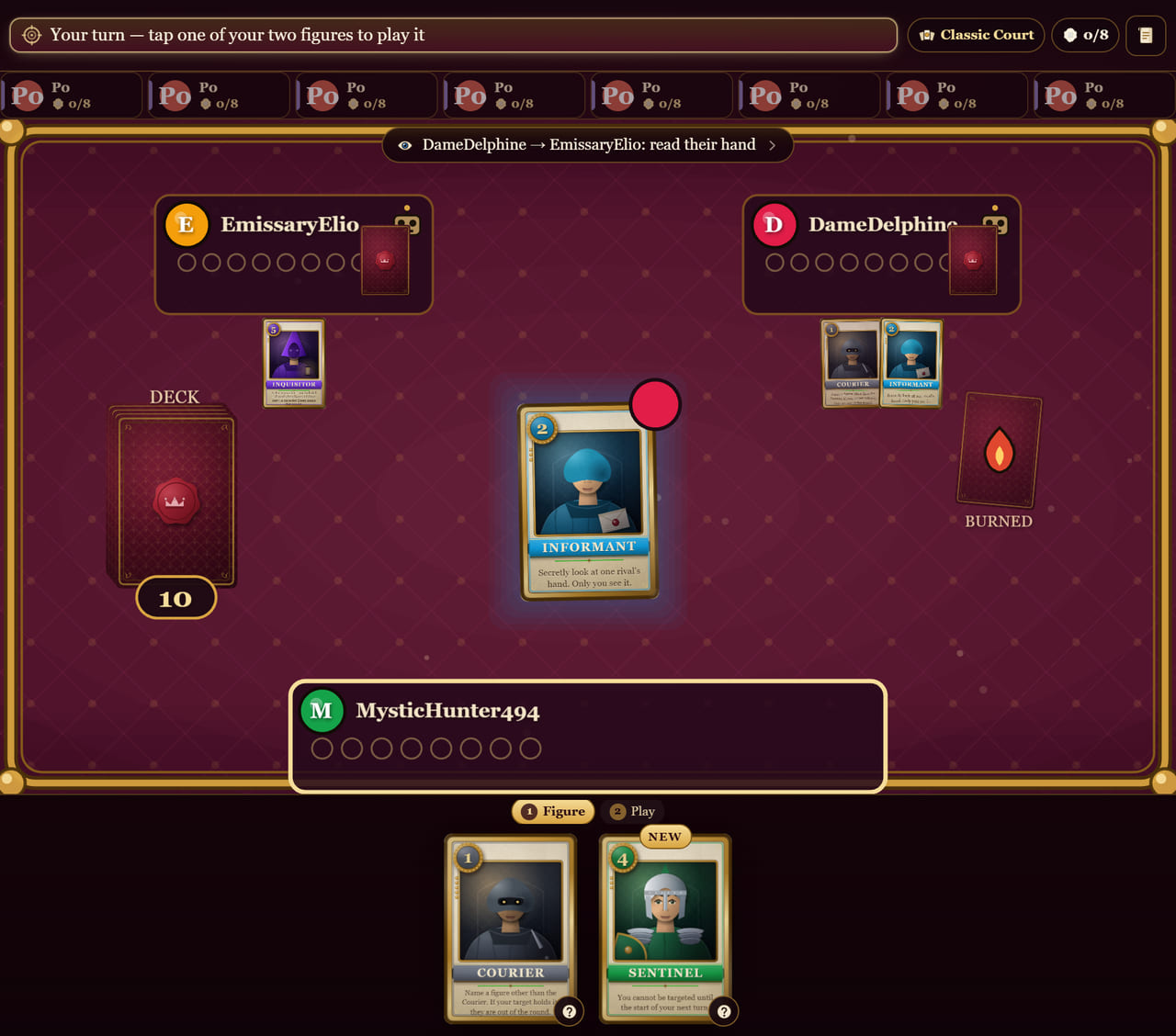
The deck is shuffled, one figure is buried face down, and everyone is dealt a single secret figure. A two-player round also turns three more figures face up (two in Blitz) as shared deduction fuel.
On your turn you draw a second figure and play one of the two, resolving its scheme. That is one decision per turn, and it settles two things at once: which effect you use, and which figure you are left holding.
A round ends in one of two ways:
- You clear the court — everyone else is out and you are the last courtier standing.
- The deck runs dry — the highest figure among the survivors takes the round. In the modes that include the Archivist, each Archivist in your own played pile adds 1 to that value; a tie is broken by the sum of the values in your discard pile.
The round winner leads the next round.
Favor is paid by HOW you won the round
This is the rule at the centre of the game, and the one new players miss most.
- Clearing the court pays 2 Favor. It is the harder, riskier, more expensive route, so it is worth double.
- Winning the deck-out showdown pays 1 Favor. Hiding behind a Sentinel and waiting still works — it is simply worth half price now.
- The Crowning edict adds one more Favor on top of the clearing payout that round.
Favor can also arrive independently of the result: the Shadow (if you are the sole survivor who played one), the Minstrel (if the rival you bet on wins the round, even when you were knocked out), the Loyalist (paid the moment you are eliminated), the Oracle (a correct naming) and the Bounty edict. One of those bonuses can carry you over the target line.
Measured on 19 August 2026 over 200 Classic bot matches: 75% of rounds ended with the court cleared and 25% at the deck-out showdown — so the two-Favor route is the norm, not the exception.
The four courts and their Favor targets
The room's mode option changes the deck completely. The pace option (Full or Quick) only lowers the target; it never touches the deck.
| Mode | Figures | Values | Favor target (2/3/4 players) | Quick pace | Typical rounds |
|---|---|---|---|---|---|
| Classic Court | 18 | 1-8 | 10 / 8 / 6 | 6 / 5 / 4 | ~7-8 |
| Grand Court | 24 | 0-9 | 9 / 7 / 6 | 6 / 5 / 4 | ~5-6 |
| Masquerade | 25 | 0-10 | 9 / 7 / 6 | 6 / 5 / 4 | ~5 |
| Blitz | 13 | 1-7 | 5 / 4 / 3 | 3 / 3 / 2 | ~4 |
The round averages were measured on 19 August 2026 across 150-200 bot matches per mode with 2, 3 and 4-seat tables mixed. Being knocked out costs you the round only, never the match: the next round starts fresh with a new deal.
The Classic Court: 18 figures
Classic Court is the default. The higher the value the stronger the figure at the showdown — and the weaker its effect. The top figures barely do anything; they are simply precious:
- 1 · Courier (×5) — pick a rival and name any figure outside the Courier's own rung; if they hold it, they are out.
- 2 · Informant (×3) — privately look at one rival's figure.
- 3 · Duelist (×2) — compare hands in secret; the lower figure is out, a tie does nothing.
- 4 · Sentinel (×3) — you cannot be targeted until the start of your next turn.
- 5 · Inquisitor (×2) — a chosen courtier (you included) discards and draws anew. If they discard the Queen, they are out.
- 6 · Chancellor — trade hands with a rival; both sides learn what they handed over.
- 7 · Duchess — no effect, but you must play her if you also hold the Chancellor or the Inquisitor.
- 8 · Queen — no effect, but discarding her for any reason at all knocks you out.
Three Sentinels and three Informants is deliberate: at two copies each, a four-seat table spent half of every round with the shield already spent and no way to read a hand.
The Edict: from round two the rules move
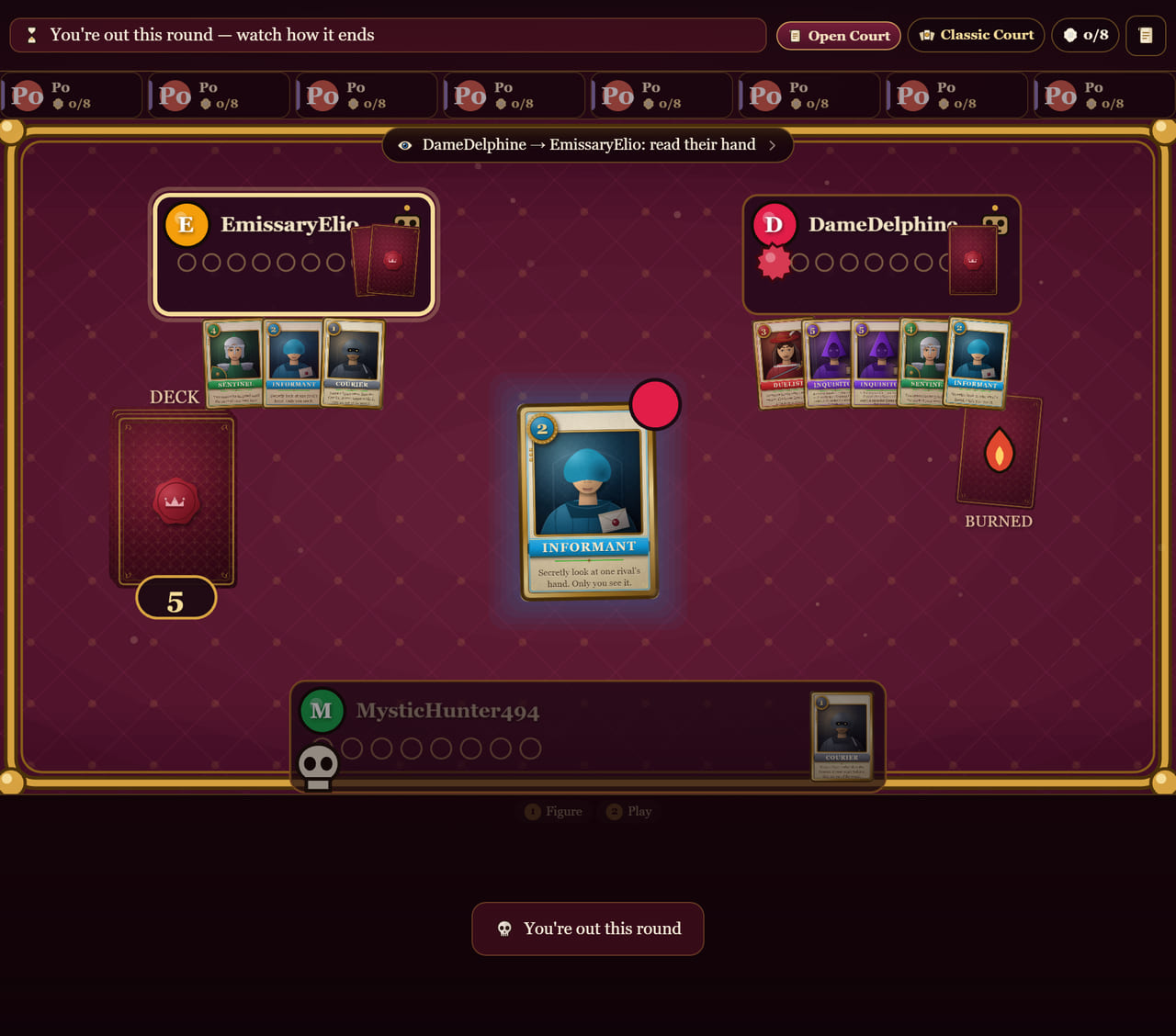
Round one is always plain. From the second round on, the monarch issues one face-up Edict before a single figure is dealt, and it rules that round alone. The same edict never comes twice in a row.
- Open Court — the buried figure lies face up all round; one unknown fewer for everybody.
- Bounty — every courtier you knock out pays you 1 Favor the moment they fall.
- Crowning — clearing the court is worth one extra Favor (so 3).
- Swift Court — three figures are buried instead of one: a shorter round and a murkier count.
- Deep Court — nothing is buried; the deck plays out to its very last figure.
- Masks — an accusation may not name a figure already lying face up in a played pile. If everything is masked, the Courier is played with no effect.
The edict is public, so it is planning material rather than a surprise: under Deep Court your discard count is perfect, under Swift Court you are two figures further behind than usual.
Five rules that surprise everyone once
- An accusation names a figure, not a number. Two different figures share a value in some modes, so we never say "play the 5", we say "play the Inquisitor". And what is forbidden is a rung, not a name: no figure sitting on the Courier's own rung may be named.
- A figure's value depends on the mode. The Chancellor is 6 in Classic and 7 in the Grand Court. Do not memorise it — the table shows the live values.
- What you saw persists, but a swap erases it. A figure learned through the Informant or a duel stays valid even when its holder draws; it only expires when that figure actually leaves the hand. A Chancellor or Confessor swap, however, invalidates everyone else's read of both hands — while handing the two swappers certainty about each other.
- The Steward buries to the BOTTOM of the deck. You draw two, keep one of the three, and the rest go under the deck rather than out of the game — in a long round, or under Deep Court, they can come back around.
- The Poisoner turns an accusation around. Accuse a courtier holding the Poisoner and it does not matter which figure you named: the accuser is out, and the holder discards her and draws anew.
A courtier protected by the Sentinel also cannot be targeted; when too few legal targets remain, a targeting figure is played with no effect.
The clock, and what the table tells you
The move clock is 120 seconds by default (the room can set 60, 90, 120, 180 or 300; there is no unlimited option) and it is identical in all four modes. A seat that runs out of time or disconnects is played by a bot, and the player reclaims it on their return — the match carries on from where it stood.
Nothing needs memorising: a coach line, a step rail above your hand (Figure → Target → Name → Play) and a plain-language preview state every step — including which figure you will be left holding. Legal targets glow, and the accusation grid shows how many copies of each figure are still unseen.
Next: the tactics that win rounds and the complete guide to all 19 figures. Or just play Royal Whispers free.
Any third-party brand and game names mentioned are trademarks of their respective owners. Playgridia is an independent platform, not affiliated with or endorsed by them.
Frequently Asked Questions
How many cards are in a Royal Whispers deck?
It depends on the mode. Classic Court is 18 figures with values 1-8, the Grand Court 24 (values 0-9), Masquerade 25 (0-10) and Blitz 13 (1-7). The host picks the mode when the room is opened, and a figure can sit at a different value in a different mode, so always read the live values at the table.
How many Favors do I need to win a match?
In Classic Court at full pace it is 10 Favor at two players, 8 at three and 6 at four. The Grand Court and Masquerade use 9/7/6 and Blitz 5/4/3. Choosing the Quick pace in the room lowers it to 6/5/4 in the first three modes and 3/3/2 in Blitz.
How much is a round worth?
Clearing the court as the last courtier standing pays 2 Favor; winning the deck-out showdown pays 1. Under the Crowning edict the clearing payout becomes 3. The Shadow, Minstrel, Loyalist and Oracle figures and the Bounty edict can also pay Favor independently of who won the round.
What is an Edict?
From the second round on, one public Edict is drawn before the deal and rules that round alone. There are six: Open Court, Bounty, Crowning, Swift Court, Deep Court and Masks. Round one is always plain, and the same edict never rules two rounds in a row.
If I am knocked out, am I out of the match?
No. Being knocked out costs you the current round only. The next round starts fresh with a new deal and all your Favor stands. The Minstrel and the Loyalist can even earn you Favor after you have been eliminated.
How long do I get for a move?
The default is 120 seconds, and the room can be set to 60, 90, 120, 180 or 300 — there is no unlimited option. The clock is the same in all four modes. If you run out of time or disconnect, a bot takes your seat and you reclaim it when you come back.