Royal Whispers Figure Guide: All 19 Figures
Royal Whispers defines 19 figures in total, but no single match uses them all: the mode you pick in the room builds the deck. More importantly, a figure's value depends on the mode — the Chancellor is 6 in Classic Court and 7 in the Grand Court. That is why the game never says "play the 5", and why an accusation always names a figure rather than a number.
19 figures across four decks: the value table
This table answers one question: what is this figure worth in the deck I am playing right now? A dash means the figure is not in that deck at all.
| Figure | Classic Court | Grand Court | Masquerade | Blitz |
|---|---|---|---|---|
| Shadow | - | 0 | 0 | - |
| Poisoner | - | 0 | 0 | - |
| Minstrel | - | - | 0 | - |
| Courier | 1 | 1 | 1 | 1 |
| Informant | 2 | 2 | 2 | 2 |
| Confessor | - | - | 2 | - |
| Duelist | 3 | 3 | 3 | 3 |
| Apothecary | - | - | 3 | - |
| Sentinel | 4 | 4 | 4 | 4 |
| Flatterer | - | - | 4 | - |
| Inquisitor | 5 | 5 | 5 | 5 |
| Archivist | - | 6 | 5 | - |
| Steward | - | 6 | 6 | - |
| Loyalist | - | - | 6 | - |
| Chancellor | 6 | 7 | 7 | 6 |
| Matriarch | - | - | 7 | - |
| Duchess | 7 | 8 | 8 | - |
| Oracle | - | - | 9 | - |
| Queen | 8 | 9 | 10 | 7 |
Watch the shared rungs: in the Grand Court the Steward and the Archivist both sit on 6, and in Masquerade three different figures share rung 0. Knowing a number is not the same as knowing the figure.
Classic Court — 18 cards (default)
- 1 · Courier ×5 — name any figure outside the Courier's own rung; a rival holding it is out.
- 2 · Informant ×3 — privately view a rival's figure.
- 3 · Duelist ×2 — secretly compare hands; the lower figure is out.
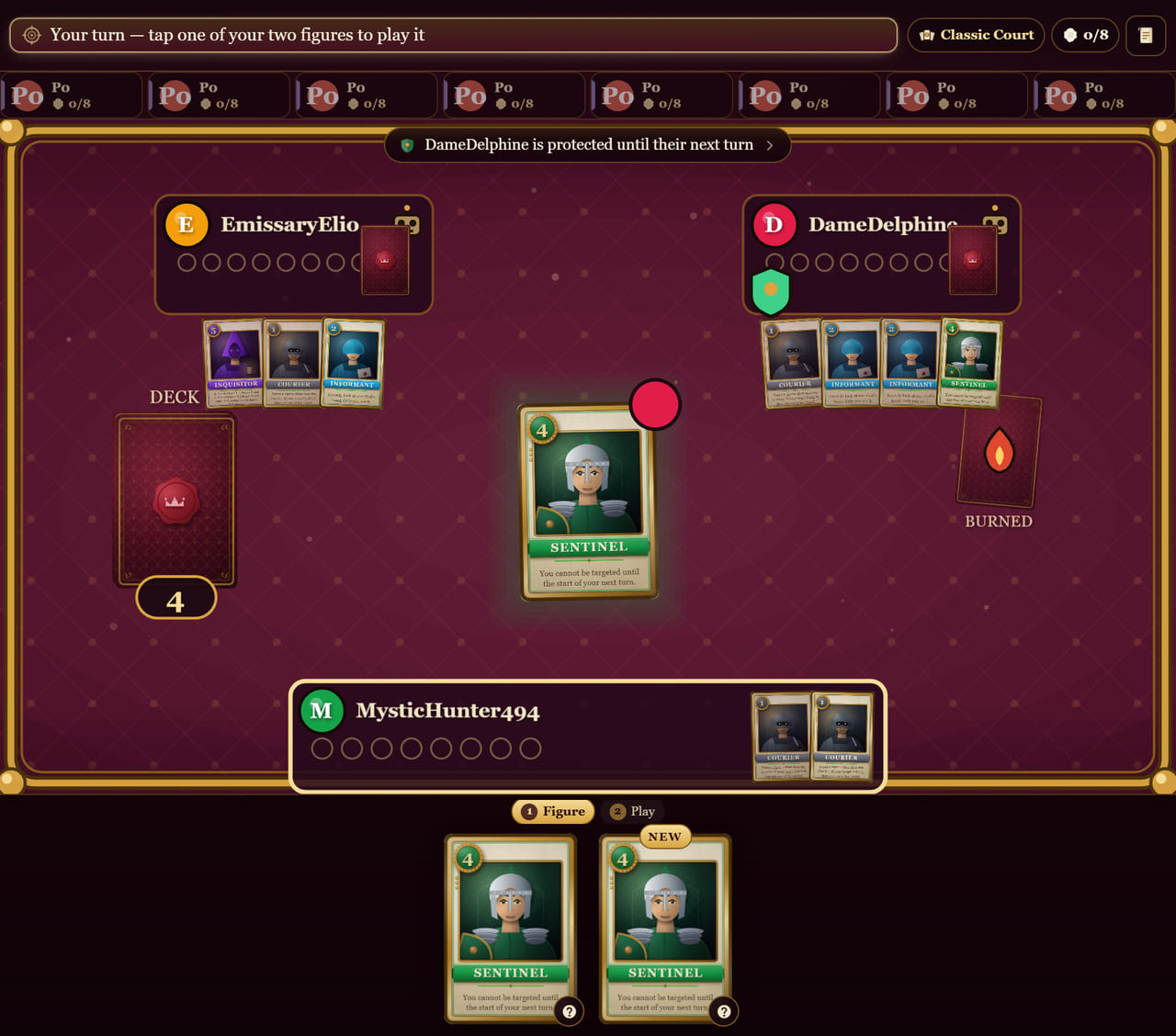
- 4 · Sentinel ×3 — you cannot be targeted until the start of your next turn.
- 5 · Inquisitor ×2 — a chosen courtier (you included) discards and draws anew; a discarded Queen knocks them out.
- 6 · Chancellor — trade hands with a rival; both sides learn what they handed over.
- 7 · Duchess — no effect; forced when held with the Chancellor or the Inquisitor.
- 8 · Queen — no effect; discarding her knocks you out of the round.
Three Sentinels and three Informants is a deliberate balance call: at two copies each, four-seat tables spent half of every round with no shield and no way to read a hand.
Grand Court — 24 cards
Four new figure types join the classic deck and the top rungs shift up one (Chancellor 7, Duchess 8, Queen 9). The Courier rises to six copies, the Informant drops back to two, and the Sentinel stays at three.
- 0 · Shadow ×2 and 0 · Poisoner ×1 — the bottom rung is shared by two figures.
- 6 · Steward ×2 and 6 · Archivist ×1 — this is the mode's design note: the upper-middle rung is a contested zone rather than one named card.
Masquerade — 25 cards
Every variant courtier is in play at once. Three figures share rung 0 and two share most of the rest; the Courier runs ×6, the Sentinel ×2, and everything else is a single copy.
- 0 · Poisoner + Minstrel + Shadow
- 1 · Courier ×6
- 2 · Informant + Confessor · 3 · Duelist + Apothecary
- 4 · Sentinel ×2 + Flatterer · 5 · Inquisitor + Archivist
- 6 · Steward + Loyalist · 7 · Chancellor + Matriarch
- 8 · Duchess · 9 · Oracle · 10 · Queen
Blitz — 13 cards
A tight deck: no Duchess, the Queen drops to 7 and values run 1-7. Courier ×4, Informant ×1, Duelist ×2, Sentinel ×2, Inquisitor ×2, one Chancellor and one Queen. The Favor target is 5/4/3 at full pace and 3/3/2 at Quick, and a match averages 4 rounds. The move clock is the same as every other mode (120 seconds by default) — what is short here is the deck, not the timer.
What the variant figures do
- Shadow (0) — no effect now. At round end, if you are the sole survivor who played a Shadow, you gain a Favor.
- Poisoner (0) — a passive trap: a Courier who accuses you is out instead, whichever figure they named; you discard her and draw anew.
- Minstrel (0) — bet on a rival. If they win the round you take a Favor — even if you were knocked out.
- Confessor (2) — two courtiers (you may be one) trade hands, then you privately read one of them.
- Apothecary (3) — secretly read one or two rivals' hands.
- Flatterer (4) — the next targeting figure MUST target the courtier you pick, if it legally can.
- Archivist (6 in the Grand Court, 5 in Masquerade) — a quiet power: at the deck-out showdown, add 1 to your figure for each Archivist in your own played pile.
- Steward (6) — draw 2, keep 1 of the 3, and put the rest under the deck; they are not removed from the game.
- Loyalist (6) — no effect now; if you are knocked out while it lies in your played pile, you gain a Favor.
- Matriarch (7) — secretly compare hands; this time the higher figure is out, the Duelist's mirror.
- Oracle (9) — name a figure and a rival; if you are right you gain a Favor and they change hands. It never eliminates — even a Queen discarded this way is simply replaced.
Which figures may be named
An accusation names a figure, but not every name is available — and what is forbidden is a rung, not a name.
- The Courier may not name any figure on its own rung. In Classic, the Grand Court and Blitz that is only the Courier itself; in Masquerade the rung-0 trio (Poisoner, Minstrel, Shadow) stays nameable, because they are not on rung 1.
- The Oracle may name any figure except itself — and since it never eliminates, being wrong with it is cheap.
- Under the Masks edict, no figure already lying face up in a played pile may be named. If everything is masked, the Courier is played with no effect.
Why memorising numbers does not work
Three reasons: values shift with the mode; in Masquerade a rung is shared by two figures and sometimes three; and figures like the Archivist change your effective value in a showdown. The right habit is to open the figure reference panel at the table and read the accusation grid's unseen-copy counts — the game hands you both.
For the full rules see the how-to-play guide; to win, the tactics. Then take a seat and play Royal Whispers free.
Any third-party brand and game names mentioned are trademarks of their respective owners. Playgridia is an independent platform, not affiliated with or endorsed by them.
Frequently Asked Questions
How many different figures are there in Royal Whispers?
Nineteen figures are defined in total, but no single match uses them all. Classic Court builds 18 cards from 8 figure types, the Grand Court 24 from 12, Masquerade 25 from all 19, and Blitz 13 from 7.
Is a figure worth the same in every mode?
No — the value belongs to the mode. The Chancellor is 6 in Classic Court and Blitz but 7 in the Grand Court and Masquerade; the Queen is 8, 9, 10 and 7 respectively. That is why an accusation names a figure rather than a number, and why you should read the live values at the table.
Which figure is the strongest?
The Queen wins any deck-out showdown, so on paper she is the strongest — but discarding her for any reason at all knocks you out of the round. In practice the Courier and the Duelist decide most rounds: across 200 measured bot matches those two caused the great majority of eliminations.
How many figures share rung 0 in Masquerade?
Three: the Poisoner, the Minstrel and the Shadow. That is the mode's whole design idea — the bottom of the ladder becomes as unreadable as the top. Most other rungs hold two figures, while the Courier holds rung 1 alone with six copies.
What does the Archivist actually do?
Nothing at the moment it is played. If the round reaches the deck-out showdown, each Archivist in your own played pile adds 1 to the value of the figure in your hand. It sits on rung 6 in the Grand Court and rung 5 in Masquerade.
Does Blitz have a shorter move clock?
No. The move clock is identical in all four modes: 120 seconds by default, with 60, 90, 120, 180 or 300 available in the room. What makes Blitz fast is the 13-card deck and the 5/4/3 Favor target — a match averages about 4 rounds.