Grid-Based Tactical War Game: No Dice, Free | Playgridia
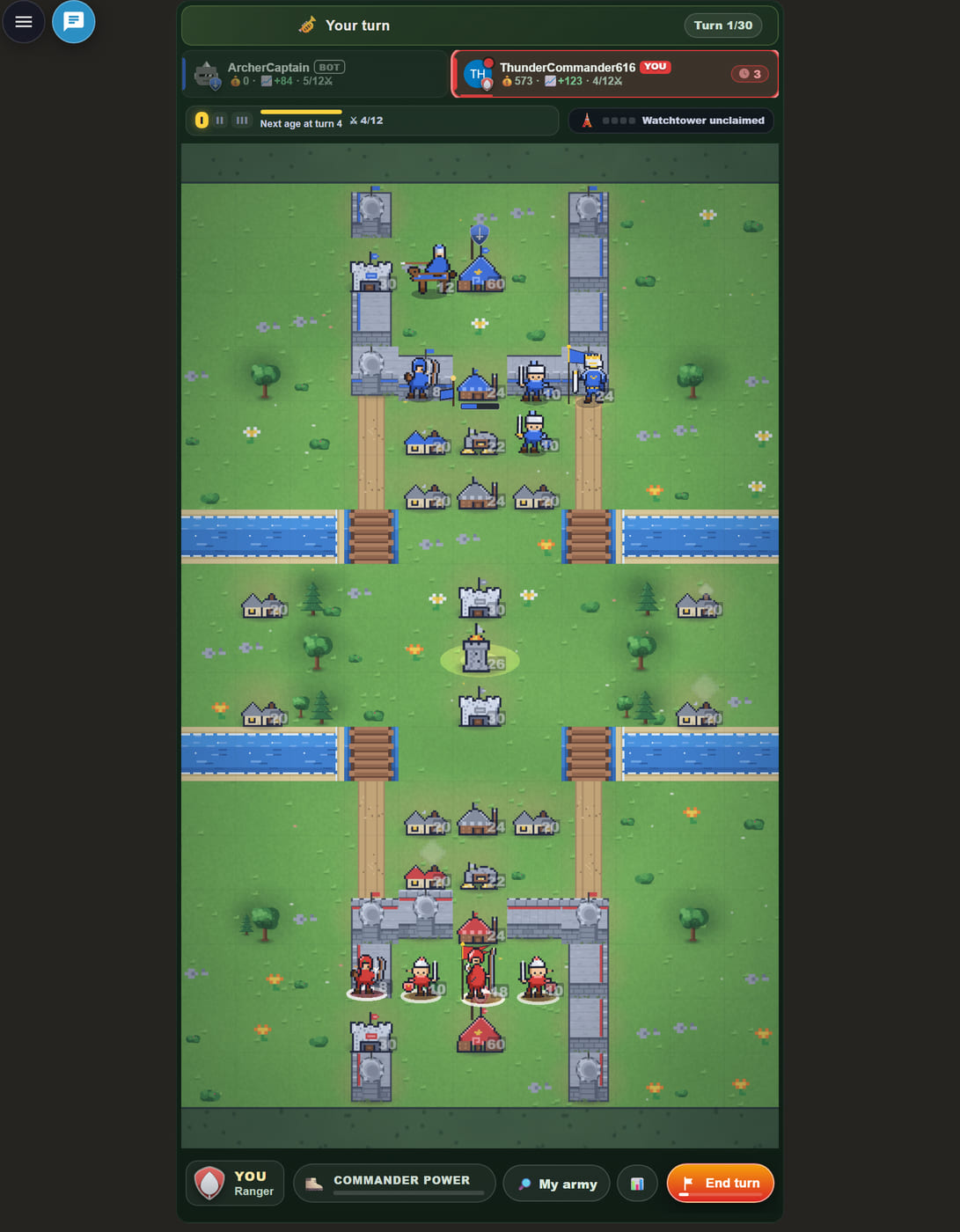
If you are looking for a grid-based tactical war game, you probably want three things: a square-tile map, turns taken in order, and combat with no luck in it. Warfront does exactly that, in the browser, free and with no download. There are no dice here: before you press attack you see the exact damage you will deal and take, which means every fight you lose is a planning error rather than bad luck.
What a tile is changes everything
There are six terrain types, and each one sets both how many movement points it costs and how well you are protected while defending on it:
| Terrain | Foot | Horse | Heavy | Flying | Defence |
|---|---|---|---|---|---|
| Plain · Road · Bridge | 1 | 1 | 1 | 1 | 0 |
| Forest | 2 | 3 | 3 | 1 | +2 |
| Mountain | 3 | impassable | impassable | 1 | +4 |
| Water | impassable | impassable | impassable | 1 | — |
So the mountain is the strongest cover in the game at +4, and it is completely closed to cavalry and siege engines; an infantryman falling back into forest gains +2 but pays two movement points to get there. Water is open to flyers alone, which is why bridges decide entire matches on river maps. Flying units spend 1 per tile but get no terrain defence bonus at all.
Movement, range and the "stand still to fire" rule
- Every unit moves differently: spearman 2, swordsman 3, dragon 4, cavalry 5, gryphon 6.
- Archers and musketeers cannot shoot an adjacent enemy (range 2–3): a swordsman that steps next to them catches them defenceless.
- Catapults and cannons cannot fire on a turn they moved (range 2–4): siege positions first and speaks afterwards.
- The cavalry charge: ride 3 or more tiles and attack in the same turn for ×1.3 damage plus a second action.
No dice: damage is a number
Against a target you counter, damage is ×1.75; against one that counters you, ×0.6, and the counter-attack comes back at 75% strength. Terrain bonus and unit defence are folded into the same sum, and the result is printed on screen. The game asks for arithmetic rather than reflexes: which tile you attack from matters as much as which unit you send.
Walls are a layer on top of the grid
Every headquarters starts pre-ringed with walls at Chebyshev radius 2, with gate-towers wherever a building sits on the ring. Your own team walks through, enemy infantry is blocked, and flyers pass over but can never land on a wall. Your own foot units may stand on your own walls for +3 defence. The ring never expands, it upgrades: 350 gold at Age II, 650 at Age III, each a full-HP rebuild. Catapults hit walls at ×2 and cannons at ×2.5 — that is what a siege is for.
What you are fighting over
The Watchtower sits dead centre. While you hold it your whole army hits +1 harder, and if you still hold it at the start of four of your own turns in a row you win the match outright (the count does not start before turn 6, and an adjacent enemy freezes it). The other two paths: kill a player's hero, or take their headquarters — either one eliminates that seat completely. The last side standing wins, and if the turn limit runs out, score decides. Meanwhile villages pay 60 gold a turn, a castle 55 and the neutral gold mine 110, and every building you own raises your army capacity by 1 (base 8, ceiling 16).
It genuinely plays on a phone
Six maps come in two shapes. Twin Rivers (the default) and Golden Plains are portrait 11×17 and fit a phone screen whole. The Citadel, Sunken Vale, Iron Crossing and Eagle Pass are wide 21×13 and deliberately do not: the camera starts on your own fortress and you drag and pinch your way toward the enemy. The controls live in the bottom command dock, and the turn is yours until you press END TURN.
Five practical grid rules
- Defend from terrain. Forest is +2, mountain is +4; the same unit on open plain is a different unit entirely.
- Never leave an archer adjacent. Its range is 2–3, so it cannot answer an infantryman who steps beside it — screen it with a spearman or a swordsman.
- Hold the bridge and the pass. Ground armies cannot enter water and only foot units climb a mountain: those two rules create every chokepoint on the map.
- Put the standard bearer in the middle of a line. Its bonus only reaches adjacent friendlies, so the centre touches more of them.
- Keep siege behind the line. A catapult or cannon cannot fire on a turn it moved, so it needs an infantry screen to survive.
How many players, and how long
2–4 players. At three and four seats the default mode is free-for-all; in team mode four players fight 2v2 and three play an asymmetric 2v1 where the solo commander is compensated with more starting gold and more hero HP. The move clock defaults to 2 minutes, and running it out is not a defeat — a bot plays that one turn. The match turn limit is chosen from 15 to 40 (default 30), and "Ruin" means no limit.
For the numbers, read the unit guide; for openings and economy, the strategy guide. Commanders and the age race are covered in our turn-based strategy piece. Play free now.
Any third-party brand or game names mentioned are trademarks of their respective owners. Playgridia is an independent platform and is not affiliated with or endorsed by them.
Frequently Asked Questions
Is there any luck in Warfront?
No. Damage is fully deterministic: no dice, no hit chance, no critical roll. You see the exact damage you will deal and take before you attack, so every outcome comes down to the plan.
Which terrain gives the best defence?
The mountain, at +4, and it is completely impassable to cavalry and siege engines. Forest gives +2 but costs 2 movement points for foot units and 3 for horse and heavy units. Flying units get no terrain defence bonus at all.
Why will my siege engine not fire?
Catapults and cannons cannot fire on a turn in which they moved, and they cannot hit an adjacent tile either (range 2–4). They have to position first and shoot the following turn. In exchange they hit walls at ×2 and ×2.5.
How do I cross a river?
Ground units cannot enter water at all; only bridges and flying units cross. That is why holding a bridge on a river map means holding the front — the default map, Twin Rivers, has six of them.
Does it work on a phone?
Yes. The two portrait maps fit a phone screen whole, and the four wide maps are played with a drag-and-pinch camera. No download and no sign-up needed.