Warfront Strategy Guide: Hold the Watchtower, Win
This Warfront strategy guide starts with one fact: damage in this game is fully deterministic. No dice, no hit chance, no surprises — you see the exact damage before you commit, which means every fight you lose was a planning error. In this free browser-based turn-based tactics war game, 2–4 commanders share one map, train troops, capture villages and fight over the Watchtower at the centre. Every number below comes from the game engine itself.
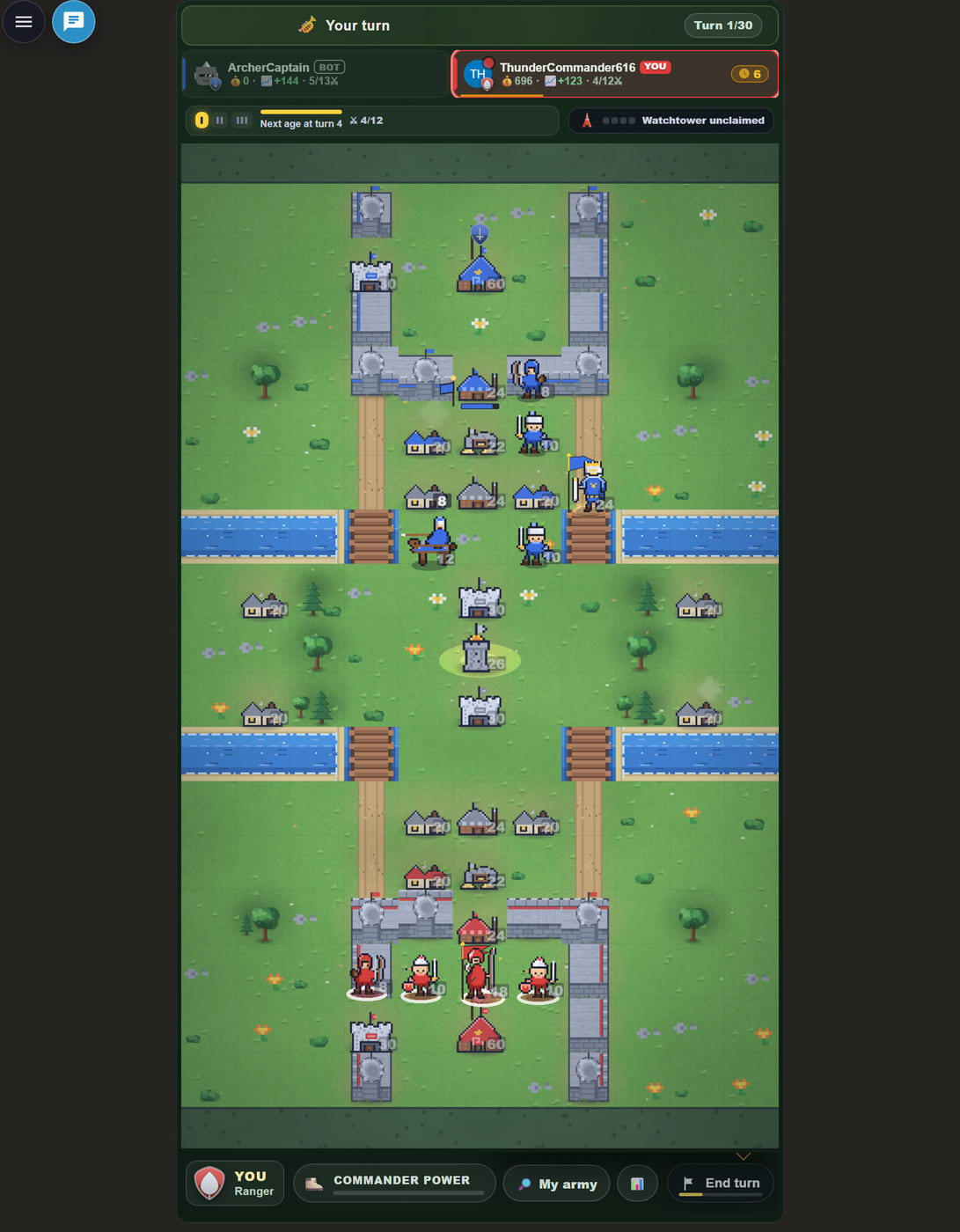
Three ways to win — and the tower is the fastest
Capturing a headquarters does not end the match, it only eliminates that seat. There are three win paths:
- The Watchtower: the dead-centre tile. While you hold it your whole army hits +1 harder and it pays 35 gold a turn. Hold it at the start of 4 of your own turns in a row and you win the match outright.
- Killing a commander: if a seat's hero falls, that player is eliminated and every unit they own is removed from the board. It is the harshest rule in the game.
- The headquarters: capturing an enemy HQ — or dispersing it with war machines — eliminates that seat the same way. The last team standing wins; if the turn limit runs out, score decides.
The tower countdown does not start before global turn 6, an enemy unit standing beside the tower freezes it (it does not reset), and losing the tile resets it to zero. The tower needs 40 capture points and an infantry unit banks its current HP per capture action — four turns for a full-health Swordsman. That slowness is deliberate: the rest of the table always has time to march on it.
Six maps in two shapes
| Map | Shape | Identity |
|---|---|---|
| Twin Rivers (default) | Portrait 11×17 | Two rivers, six bridges — hold a bridge, hold the front |
| Golden Plains | Portrait 11×17 | No cover: open ground, long charge lanes, pure tempo |
| The Citadel | Wide 21×13 | A ring of rock around the centre with four gates |
| Sunken Vale | Wide 21×13 | Two lakes squeeze the field into a single corridor |
| Iron Crossing | Wide 21×13 | A moated island reached by four bridges |
| Eagle Pass | Wide 21×13 | Two rock walls and three passes |
The two portrait boards fit a phone screen whole. The four wide boards deliberately do not: spawns run west↔east, the camera parks on your own fortress, and finding the enemy becomes a direction you travel. Drag to pan, pinch to zoom.
Economy: villages are not the whole story
| Holding | Gold per turn | Capture points |
|---|---|---|
| Headquarters (base income) | 60 | 20 |
| Village | 60 | 20 |
| Castle | 55 | 24 |
| Gold Mine | 110 | 24 |
| Watchtower | 35 | 40 |
The richest prize on the board is the Gold Mine at roughly two villages, and it always sits neutral in the middle. Upkeep eats 13% of every fielded unit's cost at the start of each turn, so net income = base + buildings − upkeep. A player holding well under 80% of the table's best building count earns +35% gross income, and every fight you win refunds 22% of the dead unit's cost as gold (250 for a hero). Attacking is cheaper than waiting.
Army capacity: not richer, wider
There is a hard ceiling on how many units you may field: 8 with nothing but your own fortress, +1 for every non-wall building you own, capped at 16. You do not buy a bigger army — you take ground for it. Every village and mine is a soldier slot as well as gold.
An age-up is a power spike
- Age II — Kingdom: 450 gold, from turn 4. Your whole army gains +2 attack and +1 defence, all income becomes ×1.25, every fielded unit is patched for 35% of max HP, and your wall ring upgrades free. Gryphon, dragon and field medic unlock.
- Age III — Gunpowder: 950 gold, from turn 9. +4 attack, +2 defence, income ×1.55. The musketeer replaces the archer, the cannon replaces the catapult, and the castle can build a tankette.
- The first seat to reach each age claims the pioneer purse: 150 gold (II) and 300 gold (III).
Falling an age behind is supposed to hurt. Your HQ's wall ring sits at Chebyshev radius 2 permanently — it never expands, it upgrades: 350 gold at Age II, 650 at Age III, each a full-HP rebuild. Your own foot units may stand on your own walls for +3 defence.
Commander Power: the comeback valve
A 260-point meter fills from the fighting itself: 1 per point of damage dealt, 2 per point taken, and a flat 8 for every unit you lose. The player who is behind reaches it first, by design. It buys one army-wide turn and depends on the commander you picked:
- Warlord — War Cry: your whole army gets +3 attack and +3 healing.
- Archmage — Starfall: 3 damage to every enemy unit on the board.
- Ranger — Forced March: every one of your units acts again this turn.
- Sky Marshal — Dragonwind: the army heals 45% and gains +2 defence.
A plan for the first ten turns
- Turns 1–3: pump cheap infantry from the barracks (Swordsman, 100 gold) and take the nearby villages. Only foot units can raise a flag.
- Turns 4–5: if you have 450 gold, take Age II — your army heals instantly and hits harder the same turn.
- Turn 6: the tower clock is live. Aim at the mine and the neutral centre castle, and send a healthy infantry unit at the tower, because capture speed is its HP.
- Turns 7–10: march the Standard Bearer with the army (+1 attack to every friendly beside it) and keep the Field Medic next to your starred veterans. Never push your hero out alone.
How a turn works, and the modes
The turn is yours until you end it: move as many units as you like, recruit, advance an age — then press END TURN in the bottom command dock. The move clock defaults to 2 minutes, and running it out is not a defeat: a bot plays that single turn and play moves on. The turn limit is chosen from 15 up to 40 (default 30), and "Ruin" means no limit. At 3–4 seats the default mode is free-for-all: no allies, last commander standing, and killing a unit belonging to the score leader pays ×1.6 loot, so the table polices whoever is ahead. Team mode gives four players 2v2 and three players an asymmetric 2v1, where the solo commander is equalised with ×1.4 starting gold, slightly higher income and +25% hero HP.
For per-unit HP, attack and cost, read the Warfront unit guide; for where it sits in the genre, see our turn-based war games roundup. Ready? Play Warfront free.
Any third-party brand or game names mentioned are trademarks of their respective owners. Playgridia is an independent platform and is not affiliated with or endorsed by them.
Frequently Asked Questions
What is the fastest way to win Warfront?
The Watchtower. Hold the dead-centre tile at the start of four of your own turns in a row and you win the match outright, whatever the score says. The countdown does not start before global turn 6, and an enemy unit standing beside the tower freezes it, so keeping the surroundings clear matters as much as taking the tile.
Does capturing the enemy HQ end the game?
No — it eliminates that seat only. In a 3–4 player match the game continues until one team is left. The same applies to heroes: if a commander dies, that seat is eliminated and all of its units are removed from the board.
How many unit types are there?
Twelve recruitable units — swordsman, spearman, archer, musketeer, standard bearer, field medic, cavalry, catapult, cannon, gryphon, dragon and tankette — plus four hero commanders. Barracks train the infantry line; the castle trains cavalry, siege, flyers and armour.
Why has my army stopped growing?
Army capacity. You may field 8 units with only your own fortress, +1 for every non-wall building you own, capped at 16. A bigger army needs more ground, not more gold.
Do I lose if my move clock runs out?
No. If the move clock (2 minutes by default) expires, a bot plays that one turn and control passes to the next seat — you are not kicked from the match. The match turn limit is separate: 15 to 40, default 30, and "Ruin" means unlimited.