Turn-Based War Games Compared: Free in Your Browser
Turn-based war games promise one thing: the right to think without rushing. Every war game on Playgridia runs in the browser, free and with no download, all of them are server-authoritative (so winning comes from the better plan, not the faster click), and every one can be played against bots at the difficulty you choose. Below is which one suits you, in one table.
All of them in one table
| Game | Players | Kind of war | Luck |
|---|---|---|---|
| Warfront | 2–4 | Grid tactics: recruit, counter, hold the tower | None |
| Crownfall | 2–4 | Map conquest: muster, clash, march | Dice |
| Naval Battle | 2 | Hidden-fleet duel, one signature skill per ship | None |
| Seven Sails | 2–6 | Age-of-sail warfare plus trade and island conquest | None (card deck) |
| Thornwood | 2–4 | Seasonal area control: muster, march, raid, root | Bounded (thorn deck) |
Warfront — grid tactics in its purest form
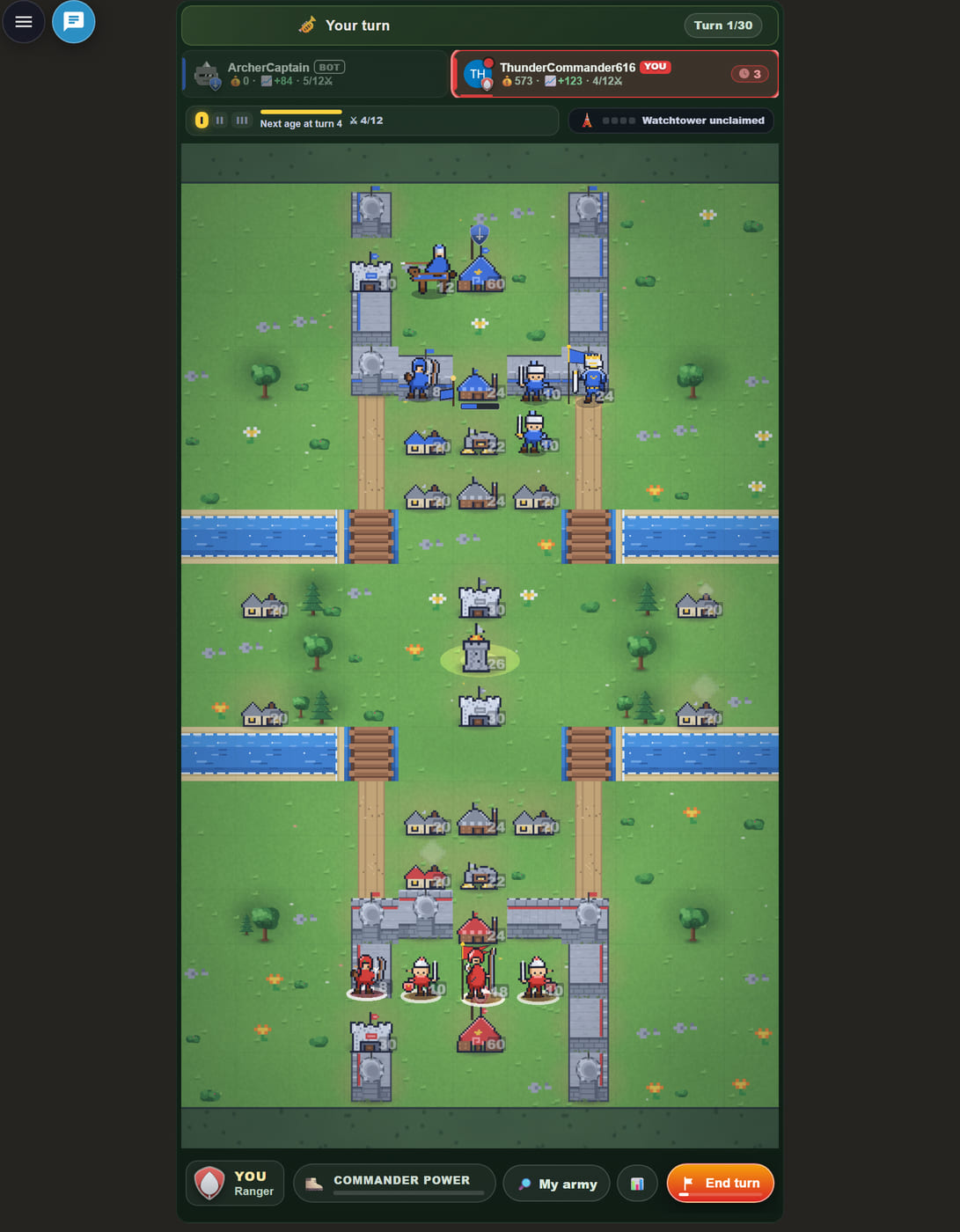
A square-tile map, twelve recruitable units, four hero commanders and no dice at all: you see the exact damage you will deal and take before you attack. You capture villages and gold mines to grow your economy, and every building you own raises your army capacity by 1. The fastest way to win is to hold the Watchtower at the dead centre of the map at the start of four of your own turns in a row; the other two are killing a rival's hero or taking their headquarters. Details in our strategy guide and unit guide.
Crownfall — muster, clash, march
Crownfall is a map-conquest game: your turn splits into muster, clash and march, holding a whole region pays extra troops every turn, and an assault resolves in one exchange with a die for each side. Unlike Warfront there is luck here, and that is exactly what makes it a faster, looser evening. Five boards, 2–4 players.
Naval Battle — the sharpest two-player duel
Naval Battle arms the hidden-fleet duel with real tactics: you arrange your fleet on a fogged grid and fire according to ship class, because every ship carries its own signature ability. Two players, short, and entirely about managing information.
Seven Sails — war and trade on the same sea
Seven Sails turns naval war into a voyage: your ship carries a heading, the wind colours your reachable range, and you hire and promote crew in port. Your guns are drawn from a battery deck rather than rolled, so variance is bounded and the composition is printed for everyone to see. 2–6 players, two boards.
Thornwood — a calendar, not a race
Thornwood is the one game here that is not a race to N points: a match runs four seasons, each one ends in a harvest, and the highest score after the winter harvest wins. A turn is three actions from four verbs — muster, march, raid or root — and combat variance is bounded by a twelve-card thorn deck whose remaining composition is public.
Which one to pick
- You want no luck at all: Warfront or Naval Battle.
- You want a short two-player duel: Naval Battle.
- You want a crowded table: Seven Sails, up to six.
- You want classic map conquest: Crownfall.
- You want a match with an ending rather than a score race: Thornwood.
What a good turn-based war game gets right
We picked this list against four criteria, and each one has a measurable answer in the games themselves:
- Information has to be readable. Warfront prints the damage forecast as a number before you commit; Seven Sails and Thornwood replace dice with decks whose composition is visible, so "I got unlucky" becomes "I miscounted".
- It must not snowball. Warfront gives the trailing player +35% income and a Commander Power meter that fills faster from damage taken, and every kill refunds 22% of the dead unit's cost as gold.
- It has to fit a phone. All of them are designed for a phone screen, and the maps that deliberately do not fit are played with a camera.
- A match needs an ending. The turn limit, the tower countdown and the seasonal calendar all do the same job: a match that runs forever is a match nobody finishes.
Where to start: if you have played none of them, open Warfront on the default map (Twin Rivers) against a Medium bot — it fits one screen, there are no dice, and the rules land inside two turns.
What they all share
All of them run in the browser: no download, no install, no sign-up, and you can play as a guest. All of them are designed for a phone. The move clock is chosen when the room is opened, and running it out is not a defeat — a bot plays that turn and play moves on. If a player drops, their seat is temporarily handed to a bot and reclaimed when they come back, so the table never dies mid-match.
If you want to know how the grid itself works, read our terrain and range rules; for commander picks and the age race, our turn-based strategy piece. Play Warfront free now.
Any third-party brand or game names mentioned are trademarks of their respective owners. Playgridia is an independent platform and is not affiliated with or endorsed by them.
Frequently Asked Questions
Which turn-based war game has no luck at all?
Warfront and Naval Battle. In Warfront damage is fully deterministic and printed on screen before you attack. Crownfall resolves a clash with dice, while Seven Sails and Thornwood use card decks whose remaining composition is public instead of dice.
What is the best option for two players?
Naval Battle for a short, sharp duel; Warfront if you want a longer match where you build an army. Both are perfectly balanced at two seats and neither uses dice.
Can I play against bots?
Yes, every one of them supports Easy, Medium and Hard bots, so you can start a full match immediately without waiting for an opponent. Bot matches still count towards your daily quests and streak.
Do they work on a phone?
Yes, all of them are designed for a phone screen. Warfront's two portrait maps fit the screen whole, and its four wide maps are played with a drag-and-pinch camera.
What happens if I disconnect mid-match?
Your seat is temporarily handed to a bot and you reclaim it when you return, so the match carries on without you. Running out the move clock is not a defeat either — a bot simply plays that one turn.