How to Play Crownfall: A Beginner’s Guide | Playgridia
Crownfall is a free browser war game about taking a map one border at a time, and how to play Crownfall fits in one sentence: build more Might than the defender, then both sides roll a die. This guide walks a first match end to end — the setup, the three beats of a turn, exactly how a battle is worked out, and all three ways a match can end.
What you are playing, in one paragraph
You are a marshal, not a king. Two to four marshals share one board and empty seats fill with Easy, Medium or Hard bots. The whole map is dealt at setup — no neutral ground, no placement phase, no opening land grab to lose. Every holding opens with one Spearline unit, and the rest of your starting force is spread over your FRONTIER territories in the arm of whichever region it lands in: open in horse country and you genuinely open holding horses. Crowns are dealt round-robin in REVERSE turn order, and the seats that act later start with one extra unit each.
Setting up a room: five boards, a pace and a banner
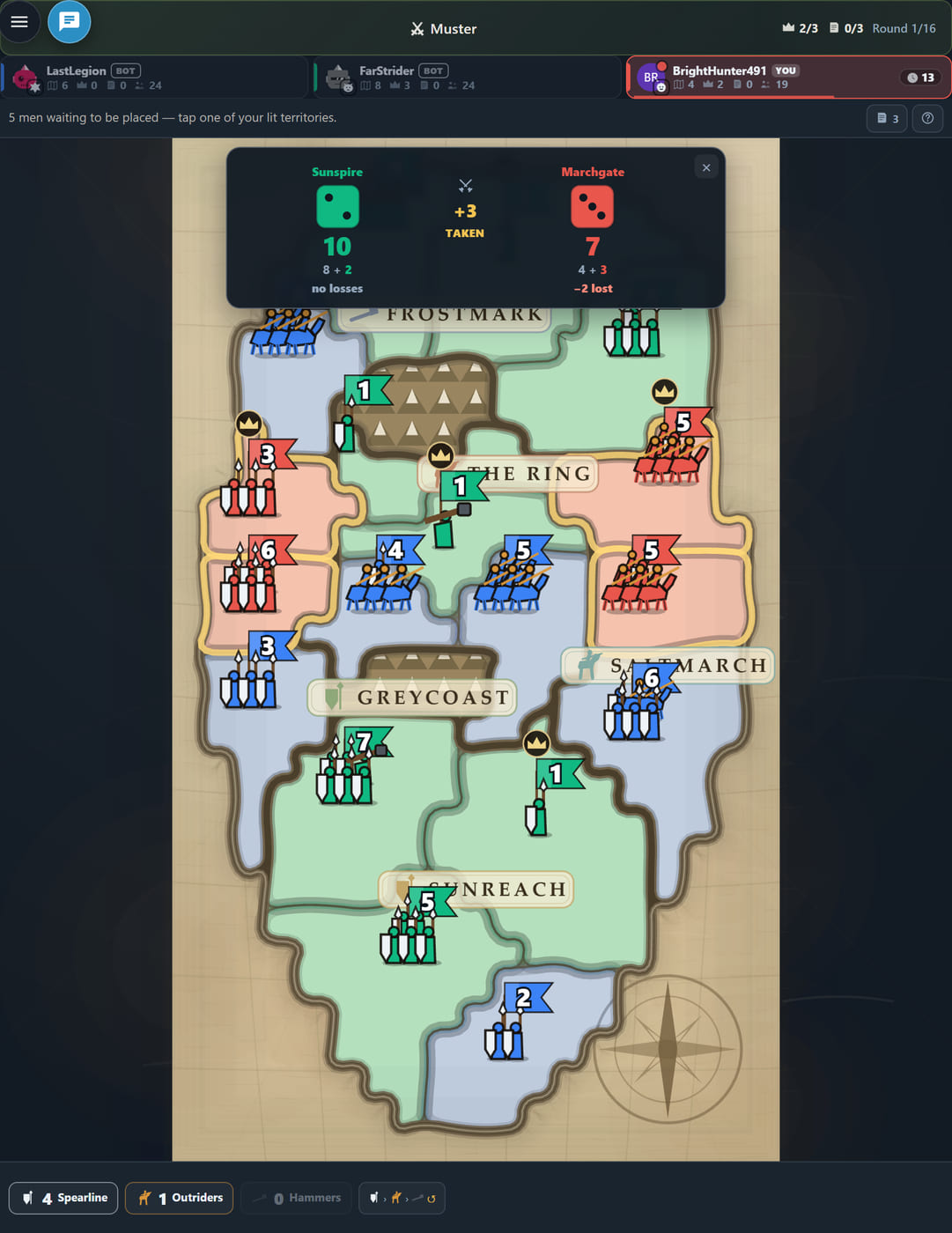
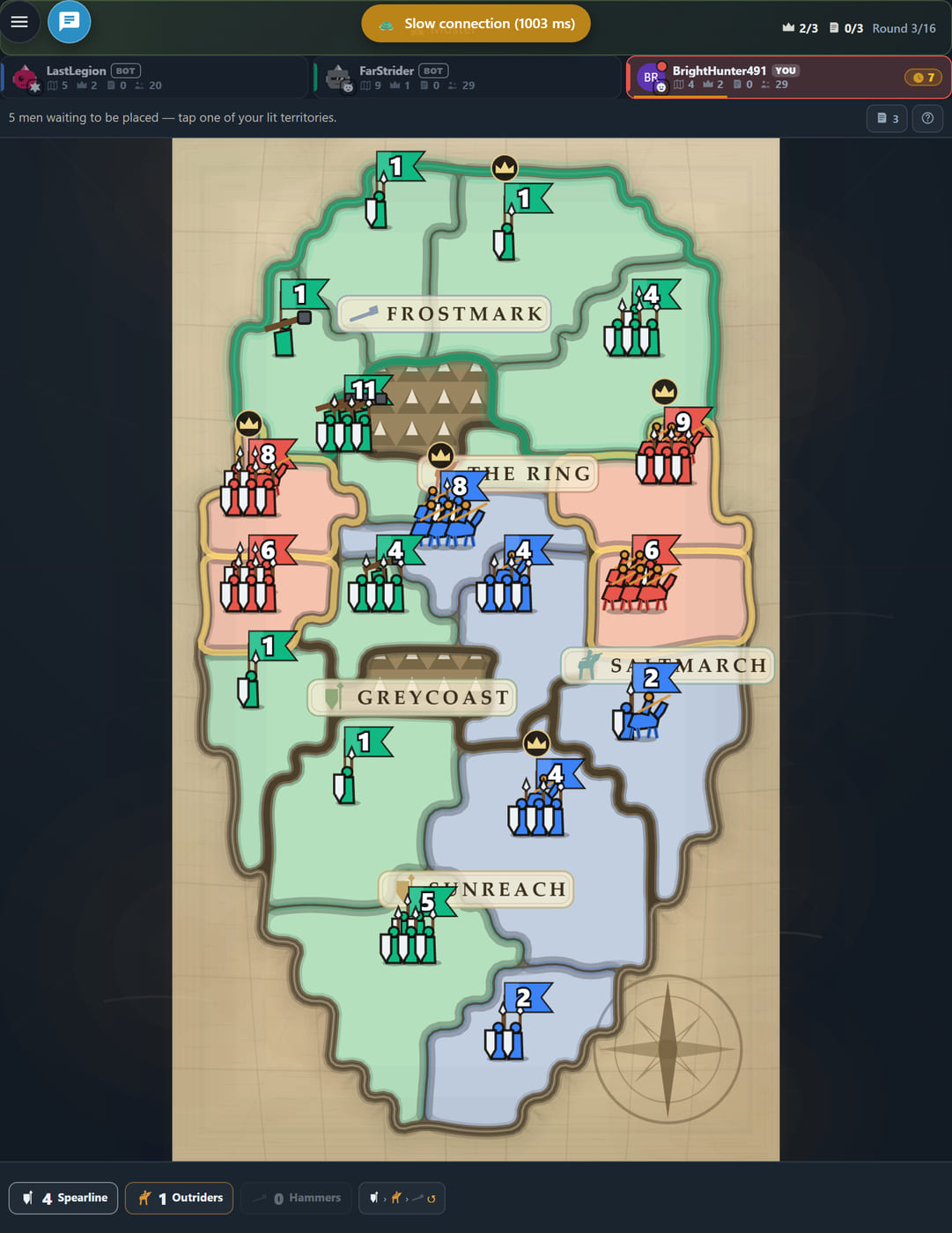
The board. Heartland is the default and the one to learn on: it is drawn in portrait, so it fits a phone screen whole with nothing to pan. The other four are real geography and deliberately bigger than the screen.
| Board | Territories | Rounds | What makes it different |
|---|---|---|---|
| Heartland | 18 | 16 | Five regions, five crowns, portrait — fits a phone whole |
| Europe | 30 | 20 | Islands, a mountain spine and two passes |
| North America | 28 | 20 | A mountain wall in the west, indefensible grass in the middle |
| Asia | 34 | 24 | One impassable wall with two gates; crowns are not checked until three rounds are done |
| Anatolia & the Mediterranean | 30 | 20 | The sea makes the rules and every crossing costs Might |
The pace. Classic uses the board’s own round cap; Quick cuts it by 40%, so Heartland finishes in 10 rounds instead of 16 — which pushes more matches onto the end-of-match score sheet and away from outright conquest. Your banner (lion, falcon, boar or stag) is colour and emblem only: every marshal plays the same rulebook.
The move clock is one budget for the whole turn — 120 seconds by default covers your muster, every assault and your march together. If it runs out your turn is passed, not played: the levy is placed and the phases end out, so no bot ever fights a campaign in your name.
A turn is three beats: Muster, Clash, March
| Beat | What you do |
|---|---|
| MUSTER | New troops arrive and you place them, arm by arm, on ground you already hold. |
| CLASH | As many assaults as you like. Each one is a single exchange unless you press To the End. |
| MARCH | One move between two of your own territories. The turn then ends by itself. |
The host: three arms instead of one number
A territory here does not hold "seven armies". It holds a host of three arms, counted separately.
| Arm | Attack | Defence | What only it can do |
|---|---|---|---|
| Spearline | 1 | 2 | Counts DOUBLE toward digging in — it is the wall |
| Outriders | 2 | 1 | A column of pure Outriders marches two steps instead of one |
| Hammers | 2 | 1 | Cancels the defender’s Ground bonus outright |
Spearline stops Outriders, Outriders ride down Hammers, Hammers smash Spearline. Whichever arm is most numerous in the force you actually commit is your leading arm — ties break Outriders first, then Hammers, then Spearline — and winning that matchup is worth +2 Might. Nine Spearline genuinely lose to six Hammers.
Muster: where your troops come from
Your Levy arrives every turn and is always Spearline: 2 plus your territory count divided by four, with a floor of 3. Twenty territories pays seven, so the leader’s income grows far more slowly than their map does.
Everything better than a spear comes off the map, because every region breeds its own arm. Hold a region’s Seat — its one named capital — and it pays one of that arm every turn; hold the region in full and it pays three instead and unlocks its Edict. There is nothing in between: the region bonus is all or nothing, and a region you complete does not pay until your next Muster begins. The receipt button breaks the total down line by line and states what the next territory would be worth.
The clash: one die each, rolled at the assault
Tap one of your own stacks, then a rival neighbour, and the assault bar opens. You set the charge arm by arm — you decide who rides out, not merely how many — and both Mights are printed before you commit to anything.
Might adds up like this. Each side totals its units by attack or defence value. The defender adds Ground: +1 if the garrison is dug in at four weighted units, where Spearline counts double, and +3 for a keep — every region Seat and every crown is one. A charge containing a single Hammer cancels that Ground outright. The attacker pays 2 for crossing a sea lane, and whichever leading arm wins the ring adds 2. Then, at the moment of the assault and in full view, both sides roll one six-sided die and add it. The report prints all three numbers — the Might before the roll, the die, and the total: "9 + 5 = 14".
The higher total wins, and the margin decides the damage. The loser loses 1 + margin ÷ 3, rounded down and capped at six. A win by two or less costs the winner a unit as well. On a tie both sides lose one and the assault may continue. Empty the garrison and the ground falls and your survivors ride in; lose, and the charge comes home — and you may attack the same border again in the same turn, as long as the origin can still send somebody out. Somebody always holds the door: no charge may empty its own ground, and a clash the attacker did not win can never wipe out the defender.
The certainty rule is the one promise a die can make. The widest swing two dice can produce is five, so if your Might leads by six or more before the roll, that clash is already won — the dice only decide by how much. A deficit of six or more is equally hopeless. The bar’s capture percentage is not an estimate either: it is an exact enumeration of all 36 outcomes.
Two buttons commit. One Clash resolves a single exchange, and the percentage on the bar is exactly its odds. To the End sends wave after wave at the same border until the ground falls, the origin drops to the single unit that holds the door, or six waves are spent. Only the first wave is the charge you set — after that it is everything that can still ride out, so you have stopped metering it. Each wave is told separately, with its own dice.
The Edicts: what a whole region buys
Each of the five Edicts is one sentence and one rule. They are free, callable once per turn, and open only while you hold that entire region.
| Edict | What it does | Where it lives on Heartland |
|---|---|---|
| Call the Banners | Your next assault rolls two dice and keeps the higher | The Ring |
| Undermine | A keep’s +3 is cancelled all turn, even with no Hammers in the charge | Frostmark |
| Ride Ahead | Any march this turn may cross two territories | Saltmarch |
| Longboats | One assault ignores the sea-lane cost — hold two such regions and you get two | Greycoast |
| Second Levy | +2 Spearline immediately, during Muster | Sunreach |
Every board carries all five somewhere, and where they sit is a real reason to prefer one board. Call the Banners — worth close to a whole point of Might on average — belongs to The Ring on Heartland, the region everybody must cross to reach anybody else; elsewhere it sits in Gallia, The Lakes, Sunthrone and Levantis.
Three ways to win
Crowns. Five crowns sit on every board, and they are checked at the start of your turn — so you must survive a full round wearing them. Three of the five wins at three or four seats; a duel needs all five, because five crowns dealt between two marshals is already 3–2. Crown wins are ignored until two full rounds are done, three on Asia.
Decrees. Three stand posted on the Ferman Track at all times, public and shared, and the first marshal to satisfy one claims it — at most one per turn, so three marks costs three turns however far ahead you are. They ask for concrete things: hold both ends of a crossing, wear two crowns, field five of one arm (or seven Outriders) in one host, muster a host of nine, hold ground in several regions, win two or three clashes in a turn. A claim pays the mark, three units of a fitting arm on your most pressed border, and +1 to your Levy for the rest of the match. A decree a living marshal already satisfies is never posted, so everything on the track is genuinely still open.
Conquest. Be the last marshal standing; lose your last territory and you are out. If the round cap arrives first the match is scored instead: 1 per territory, 3 per crown, 4 per decree and 2 per region Seat. Armies score nothing, so a doom-stack in one corner can never out-score a marshal who spread.
For a first match take Heartland, add two bots, and do three things: keep Spearline at home so your borders dig in, put a Hammer in any charge aimed at a keep, and read both Mights on the bar before you commit — a lead of six is a win before the dice touch the table. When that stops being enough, the follow-up is our Crownfall strategy guide. Play Crownfall free in your browser — no download and no account needed to start.
Any third-party brand or game names mentioned are trademarks of their respective owners. Playgridia is an independent platform and is not affiliated with or endorsed by them.
Frequently Asked Questions
How do you play Crownfall?
Every turn has three beats: Muster (new troops arrive and you place them arm by arm on ground you hold), Clash (as many assaults as you like, each a single exchange) and March (one move between two of your own territories, after which the turn ends by itself). You win by holding the crowns, by claiming three decrees, or by being the last marshal standing.
Does Crownfall use dice?
Yes. In every clash both sides roll one six-sided die at the moment of the assault, in full view, and add it to the Might they built. The report prints the Might before the roll, the die and the total separately — "9 + 5 = 14" — so you can check the arithmetic with your eyes. Nothing is pre-rolled, pre-picked or hidden.
How is a battle calculated in Crownfall?
Each side totals its units by attack or defence value. The defender adds +1 for being dug in and +3 for a keep, the attacker pays 2 to cross a sea lane, and whichever leading arm wins the matchup adds 2. Then both sides roll a die and add it. The higher total wins and the loser loses 1 plus a third of the margin, capped at six. A single Hammer in the charge cancels the defender’s Ground outright.
What does the Call the Banners Edict do?
Hold a whole region and you may call it: your next assault rolls two dice instead of one and keeps the higher. That is worth close to a full point of Might on average, and it is public — a banner the table can see, not a hidden card. It is spent by that one assault. Exactly one region per board carries it; on Heartland it is The Ring.
How many players can play Crownfall?
Two to four. Empty seats fill with Easy, Medium or Hard bots, so you can start a full match on your own straight away. For a crown victory three or four marshals need three of the five crowns, while a two-player duel needs all five.
Which Crownfall map should a beginner start on?
Heartland, which is also the default: 18 territories across five regions, a 16-round cap, and a portrait board that fits a phone screen whole with no panning. Europe, North America, Asia and Anatolia & the Mediterranean are larger boards you drag across.