How to Play Minesweeper: What the Numbers Really Mean
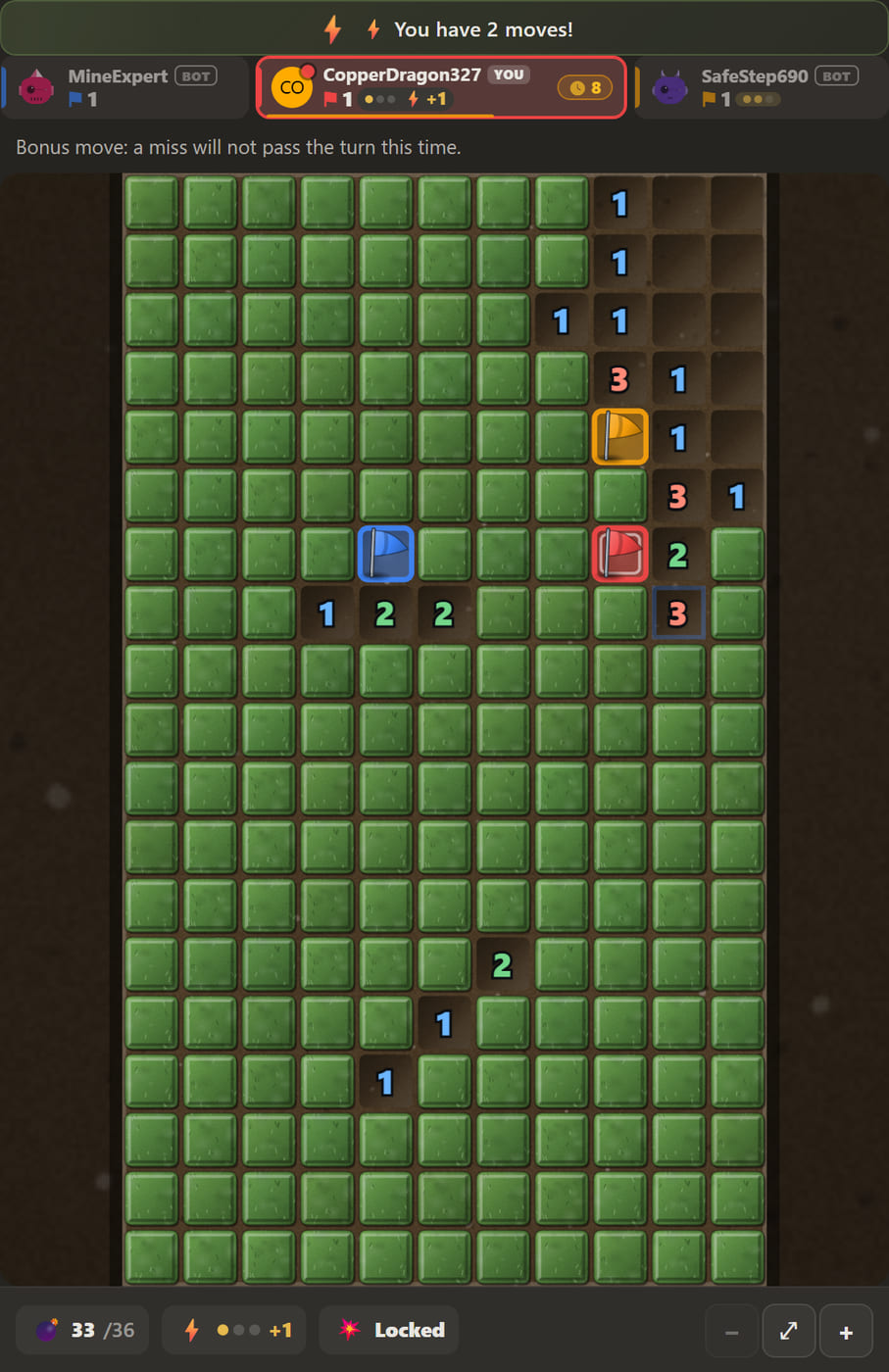
In Minesweeper, a number on an opened cell counts the mines hidden in the eight cells touching it — the four sides and the four diagonals. A 3 means exactly three of those eight neighbours are mined; a 1 means exactly one is. That single rule is the entire puzzle.
This guide starts there, then covers the competitive two-player version you can play free on Playgridia, where everyone hunts the same minefield in turns and hitting a mine is a good thing: it plants your flag, scores a point and keeps the turn yours.
What the numbers mean
Every cell on the field has up to eight neighbours, and a revealed number is a count of how many of them are mined. It never tells you which ones — only how many. How many neighbours a cell has depends on where it sits:
- A cell in the middle of the field touches 8 cells.
- A cell against the edge touches 5.
- A cell in a corner touches only 3.
That geometry does a lot of the work for you. A 3 in a corner touches only three cells, so all three are mines — flag every one. A 1 against the edge touches five cells; if four of them are already open and clear, the fifth is a mine with no guessing involved.
A cell that opens with no number at all is a blank: zero mines around it. Blanks are why the board opens in large patches — tap one and the game automatically clears everything connected to it, stopping at the first ring of numbered cells. On the fields that contain rock, rock is not a cell at all: it never holds a mine, it cannot be tapped, and it stops a cascade dead.
Two rules that turn a number into certainty
You never have to guess while either of these applies to a number on screen:
- The all-mines rule. If a number equals the count of still-covered cells around it, every one of those cells is a mine. A 2 with exactly two covered neighbours left: both are mined.
- The all-clear rule. If a number equals the count of flags already planted around it, that number is satisfied — every other covered cell touching it is safe ground.
Work them alternately. Each flag you place satisfies neighbouring numbers, which frees up safe cells, which reveal new numbers, which arm the first rule again. Most of a solved board comes out of that loop, not out of luck.
Comparing two numbers: the 1-2-1
When one rule alone is not enough, compare neighbours. Two adjacent numbers usually share some covered cells while each also sees cells the other cannot; the difference between them belongs to the cells only one of them touches. The classic case is the 1-2-1: three revealed cells in a row reading 1, 2, 1 with a straight wall of covered cells running along them. The middle cell of that wall is guaranteed clear and the two outer ones are mines. The reason is simple — if the middle one were mined, both 1s would already be satisfied and the 2 could never reach two. The same reasoning solves 1-2-2-1 and every longer chain, and these patterns surface fastest along the edges.
How a turn works in a two-player duel
The solo game punishes a mine with instant defeat. Here it is the only way to score, and that inverts everything.
- On your turn you tap one covered cell.
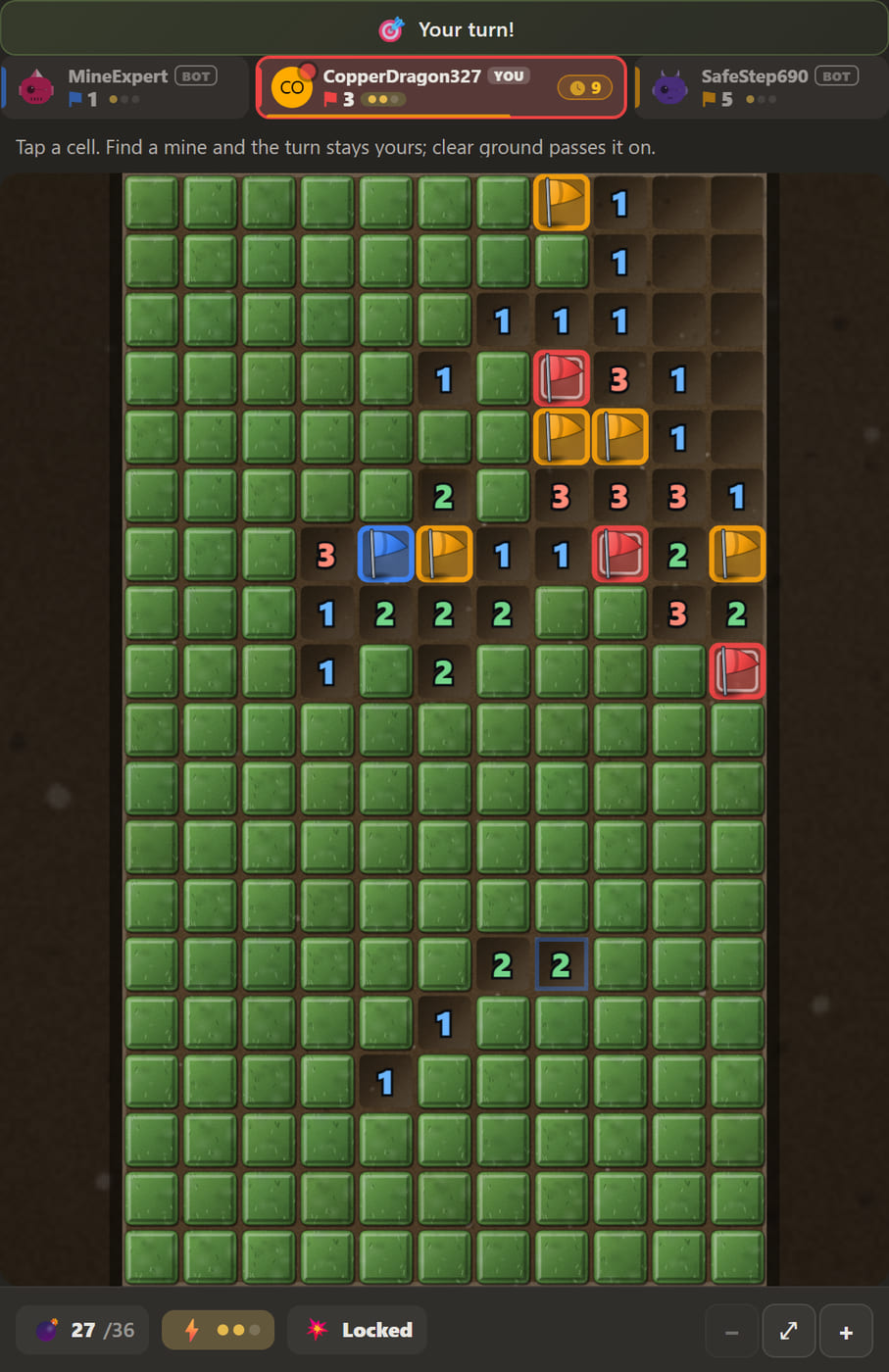
- Hit a mine and your flag goes in, you score +1, and the turn stays yours — so a run of proven mines is a scoring chain.
- Hit clear ground and it opens (cascading outward if it is a blank) and the turn passes to the next player.
- 2 players, everyone for themselves. There are no teams and no third seat.
Two consequences matter more than any pattern. First, order your taps: flag every mine you have proved before you spend a clear cell, because the clear cell is what ends your turn. Reversing that order throws away points you had already earned. Second, information is shared. Every cell anyone opens is on screen for the whole table, so a huge cascade can hand your rival the exact deduction you were saving.
The two comeback rules
Both of them work for the player who is losing ground, which is what keeps a match live down to the last flag.
The bonus move
Miss three turns in a row — three taps that all land on clear ground — and the player who goes next is handed one extra move. The table seats two, so that is always your opponent. Finding a single mine resets your miss counter to zero, and there is no limit on how many times the bonus can trigger in one match. The yellow pips beside each name are that player's miss streak, so you can always see who is one bad tap away from giving a move away.
The Square Bomb
It unlocks for the player who is behind, not ahead. The moment the best rival leads you by 5 points or more, a one-shot 3×3 blast becomes available — once per player, per match. The gap is re-checked after every action, so if you close it back to 4 before you spend the bomb, it locks again.
It takes two taps: pick the target and a 3×3 preview appears, then tap the same cell again to confirm. Every mine inside those nine cells is flagged for you and scores; clear cells open normally and a blank among them still cascades. If it found at least one mine, the turn stays yours. If it finds nothing, it counts as a miss — and you have just opened up to nine cells of free information for everyone else. Save it for the densest cluster you can prove: on Hot Zone, which deliberately gathers mines into pockets, a well-aimed bomb can be worth three or four points in one move.
The five fields
The room picks the field, and a field is exactly two dials: where the rock sits, and how the mines are distributed — evenly, hugging the rock, never touching one another, mirrored between quarters, or clumped into pockets. Every other rule is identical on all five, which is what makes a board you have never played predictable. All five are tall portrait boards, so on a phone the field fills the screen and the cells stay thumb-sized.
| Field | Board | What makes it different |
|---|---|---|
| Open Field | 9×16 · 144 cells · 25 mines | The default. No rock, mines spread evenly. |
| Canyon | 10×16 · 138 · 26 | Rock ridges cut vertical lanes; mines lean on the rock. |
| Quarry | 9×16 · 124 · 24 | No two mines ever touch — every flag clears its neighbours. |
| Crossroads | 9×17 · 133 · 24 | Four mirrored quarters; the crossing is always clear ground. |
| Hot Zone | 9×16 · 144 · 24 | The lowest density (16.7%), gathered into a few pockets. |
Crossroads deserves one extra note: because the mines are mirrored across four quarters, their count is always rounded to a multiple of four, so every quarter holds exactly the same number — 6 apiece. Finding one mine hands you its three twins, and "how many are left in my quarter" becomes arithmetic instead of a feeling.
How a match ends
- The leader becomes unbeatable. The moment the leader's score is higher than the runner-up's score plus every mine still buried, nobody can catch up and the board stops.
- No mines are left. Every mine on the field has been flagged.
- No tappable cell is left.
The highest score wins, and a shared top score is a draw. The number on your end-of-match card is simply your flag count, and it is the same number that goes into your match history. A table counts as a rated match as soon as two human players are sitting at it, however many bots fill the remaining chairs; one human against bots is unrated practice.
The clock, and what happens if someone drops
The move clock is a per-turn budget chosen when the room is created: 60 seconds by default, with 20, 30, 40, 90, 300 and 600 as the other options. There is no unlimited setting. The budget belongs to the turn rather than the tap, so chaining four flags does not buy you four fresh clocks — and running out does not cost you your seat: one legal move is played for you and the match continues.
If a player disconnects, a bot takes over their seat so the match keeps moving instead of freezing. That handover is reversible: come back inside the two-minute window and you reclaim your own seat, with your score and your flags exactly where the bot left them.
On a phone, press and hold instead of tapping: the highlighted cell follows your thumb so you can correct before letting go, and dragging further turns the gesture into a camera pan. The − ⤢ + buttons in the dock zoom the field.
Start your first match
If you know what the numbers mean, you already know how to play. Play Minesweeper free on Playgridia — no download and no sign-up. Start on Open Field against a Medium bot to learn the turn rhythm, then read the tactics guide for the patterns that decide close matches, or the 2-player guide if you are bringing exactly one friend.
Any third-party brand or game names mentioned are trademarks of their respective owners. Playgridia is an independent platform and is not affiliated with or endorsed by them.
Frequently Asked Questions
What do the numbers mean in Minesweeper?
A number on an opened cell tells you how many mines are hidden in the eight cells touching it — the four sides and the four diagonals. It never says which ones, only how many. A cell in the middle of the board has 8 neighbours, a cell on the edge has 5 and a corner cell has only 3, which is why a 3 in a corner means all three of its neighbours are mines. A cell that opens with no number at all has zero mines around it.
How do you know for certain which cell has a mine?
Two rules. If a number equals the count of still-covered cells around it, all of those covered cells are mines. If a number equals the count of flags already around it, that number is satisfied and every other covered cell touching it is safe. When neither applies, compare two adjacent numbers: in the classic 1-2-1 pattern the middle cell of the covered wall is clear and the two outer ones are mines.
How many players is Minesweeper for?
Two. The version on Playgridia is a duel: two players share one field and take turns on it, everyone for themselves. There is no team mode, no third seat and no fourth — so the cell you read the numbers for is still there when the board comes back to you. The other chair can be filled with an Easy, Medium or Hard bot.
Who unlocks the 3x3 Square Bomb?
The player who is behind. It becomes available once the best rival leads you by 5 points or more, and it can be used once per player per match — so pulling ahead arms the bomb for your opponent, not for you. The gap is re-checked after every action, so closing it back to 4 before you spend the bomb locks it again. If the nine cells contain no mine at all, the bomb counts as a miss and the turn passes on.
How long is a turn in Minesweeper?
The default move clock is 60 seconds per turn. The room host can choose 20, 30, 40, 90, 300 or 600 seconds instead, and there is no unlimited option. The budget belongs to the turn rather than the tap, so chaining flags does not reset it. If you run out you do not lose your seat — one legal move is played for you and the match continues.
Can I play Minesweeper free without downloading anything?
Yes. It runs in the browser with no download and no sign-up, and plays the same on a phone as on a desktop. The boards are tall portrait layouts, so on a phone the field fills the screen; press and hold instead of tapping and the highlighted cell follows your thumb, so you can correct your aim before letting go.