Minesweeper Tips and Tricks: Strategy Guide | Playgridia
The Minesweeper tip that changes everything here is this: hitting a mine is good. In the competitive 2-player Minesweeper on Playgridia a mine plants your flag, scores +1 and keeps your turn, while clear ground opens a number and passes the turn on. Every trick below follows from that one inversion: how to turn a certainty into a chain, and what you give away the moment you are forced to guess.
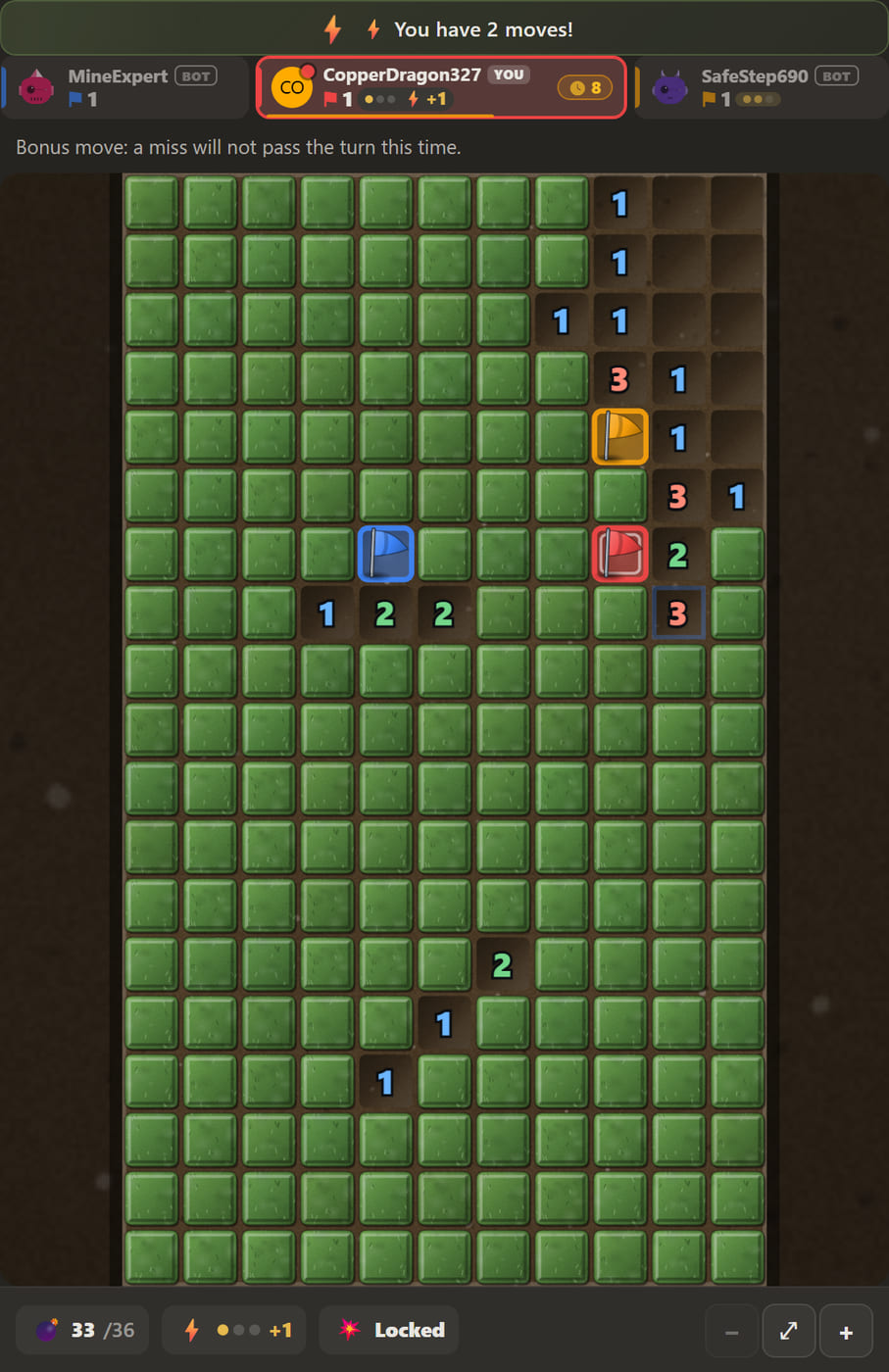
The rules every tip depends on
- Tap a covered cell. A mine plants your flag, scores +1 and the turn stays yours. Clear ground reveals a number and the turn passes to the next seat.
- A number counts the mines in the 8 cells touching it. A 0 cascades outward until it runs into numbers, rock or the edge.
- Rock never holds a mine, can never be tapped, and stops a cascade dead.
- 2 players, everyone for themselves — no teams and no third seat. Most mines at the end wins, equal is a draw, and the score on your end card is simply your flag count.
So a proven-safe cell is not a reward here, it is the end of your go. Certainty is the currency, and the whole skill is spending it in the right order.
Read the numbers before you touch anything
Two pieces of arithmetic solve most of a board. Subtract the flags: a 3 that already touches two flags has exactly one mine left among its covered neighbours. Then count the unknowns: if that remainder equals the number of covered cells the clue still touches, every one of them is a mine, and you can take them all without a single guess. If the remainder reaches 0, every remaining covered neighbour is proven clear.
Where you start matters as much as what you read. A corner touches only 3 cells, an edge cell 5, and a cell pressed against rock fewer still. Fewer unknowns means faster certainty, so open along the edges and the rock ridges rather than in the middle of open ground.
The 1-2-1 and 1-2-2-1 patterns pay double
1-2-1. Three revealed cells reading 1, 2, 1 in a line, with three covered cells along one side of them and nothing else unknown nearby: the mines sit under the two 1s, and the middle cell is clear. That is two guaranteed flags, so two points, and the turn is still yours after both.
1-2-2-1. Four clues in a line over four covered cells: the mines are under the two 2s, and the outer two cells are clear. Two more free points, and the two safe cells become your parachute for later.
In the solo game you mark those cells and move on. Here you tap them, and each tap buys you another tap.
Chain first, guess last
- Cash every certainty before you touch anything uncertain. A miss ends your turn instantly, so a guess played first can cost you three points you had already proved.
- Never open a proven-clear cell while an unspent certainty is still on the board.
- The turn clock is a per-turn budget and does not reset when you chain, so a ten-flag run has to fit inside the turn you started. The default is 60 seconds; the room host can pick 20, 30, 40, 90, 300 or 600 instead, and there is no unlimited setting. Running out does not cost you the seat — one legal move is played for you.
Spend a tap on information, but know what it costs
A miss is not only a lost point, it is a gift. The number you reveal is public, and the player who gets to use it first is the one you just handed the turn to. A cell that turns out to be a 0 can cascade twenty squares open in a single tap.
Early in a match that is a fair trade: there is plenty of board left and you need the map. Late, with a handful of mines still buried, take the smallest opening you can find. Prefer a cell you already expect to read 1 or 2, ideally hemmed in by rock or the board edge so the cascade cannot run.
Watch the miss meter. Three misses in a row and the next player earns two moves. Finding a mine resets your counter to zero, and the rule can trigger any number of times in a match. That makes the decision at two misses concrete: a genuine coin flip at a mine is often better than a certain-safe tap, because a hit resets the meter while a safe tap hands the seat after you a double turn.
Time the Square Bomb, because it can lock again
Fall 5 or more points behind the best rival and a one-shot 3x3 Square Bomb unlocks — so it is the player who is behind who gets it, never the leader. It takes two taps: pick the centre cell, check the 3x3 preview, then tap the same cell again to set it off. Every mine in the blast is yours and the turn continues, exactly like a flag.
- Never fire it as a scout. A bomb that finds nothing counts as a miss and still opens up to nine cells, cascading from any 0 among them. It is the largest free gift you can hand a rival in one action.
- Aim where the numbers already promise two mines or more. A neighbouring 3 with three covered cells left is a far better centre than a hunch about a quiet corner.
- It is only live while you are 5 or more points behind. Claw a point back to a 4-point gap and the bomb locks again until you fall behind. If you are 5 down and can already read a cluster, use it now.
The five fields, and what each one is for
The room picks the field. Every board keeps identical rules and moves only two dials: where the rock sits, and how the mines are scattered. Every mask is also portrait by rule — its columns-over-rows ratio has to land between 0.50 and 0.70 or the board is rejected — which is why the field fills a phone screen instead of shrinking into a strip.
| Field | Board | Mine density | Turns per seat |
|---|---|---|---|
| Open Field | 9×16 · 144 cells · 25 mines | 17.4% | 28.9 |
| Canyon | 10×16 · 138 · 26 | 18.8% | 31.5 |
| Quarry | 9×16 · 124 · 24 | 19.4% | 36.0 |
| Crossroads | 9×17 · 133 · 24 | 18.0% | 29.5 |
| Hot Zone | 9×16 · 144 · 24 | 16.7% | 21.6 |
The turn counts are averages over 60 bot matches per row.
- Open Field — the default and the purest deduction board, with the biggest cascades. A miss here can open twenty cells at once, so it punishes a careless information tap harder than anywhere else.
- Canyon — rock ridges cut the ground into vertical lanes with staggered gaps, and the mines lean against the rock: measured, 64-73% of them touch a rock cell. Hunt the lane walls, and never assume one cleared lane says anything about the next.
- Quarry — no two mines ever touch. One rule, enormous consequences: every flag you plant proves up to eight neighbours clear. It is also the longest board, because a miss opens one to three cells instead of twenty, so the pool never collapses.
- Crossroads — the mines are laid in one quarter and mirrored across both centre lines, so their count is always a multiple of four and every quarter holds exactly the same number: 6 apiece. Find one mine and its three twins are pure reflection. The crossing itself is always clear ground, which is why this is the provably fair board.
- Hot Zone — the lowest density, but the mines clump about twice as tightly as an even spread. Most of the field is dead ground and one pocket is worth four or five flags in a single turn. The fastest board, the swingiest, and the best one for the Square Bomb.
Count the ending, then pick your board
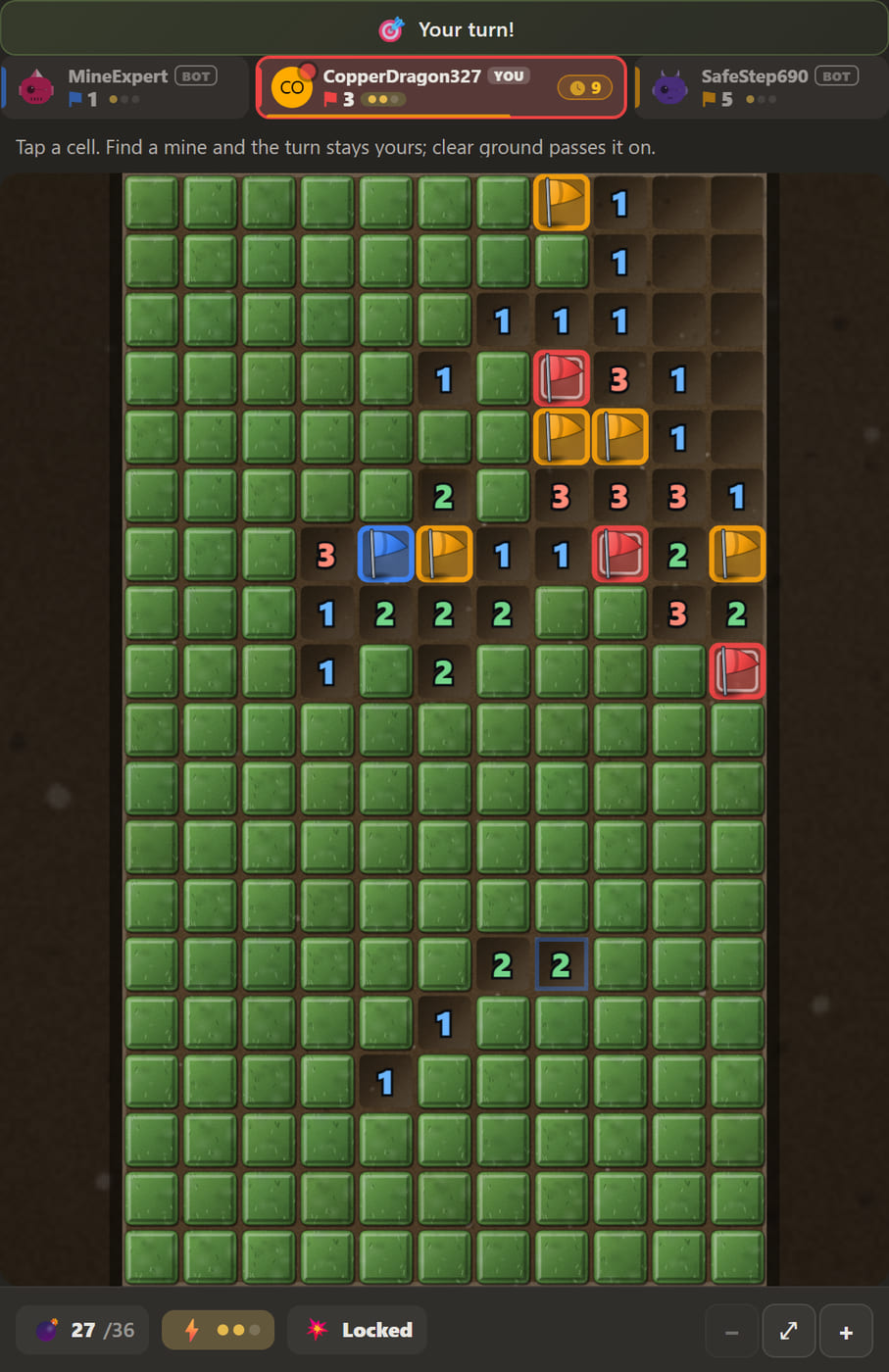
The match stops the moment the leader is ahead of the runner-up by more than the number of mines still buried, because the rest is unreachable and nobody should have to tap it out. On Open Field's 25 mines that means 13-5 with 7 still buried ends it, since 13 is more than 12, while 12-5 with 8 buried does not, since 12 is not more than 13. A match also ends when no mine or no playable cell is left.
The dock shows how many mines are still buried, so read it before every risky tap. Six points behind with three mines left is not a deficit you can grind back, and that is a position where the Square Bomb should already have been fired.
Two more things worth knowing: a table is a rated match as soon as two human players are sitting at it, however many bots fill the rest, and if somebody drops, a bot covers their seat temporarily — they reclaim it, score intact, if they return inside two minutes.
Learn the numbers on Open Field against an Easy bot, then move to Quarry once you want deduction to actually pay, Crossroads for a duel where the field can never be blamed, and Hot Zone when you want a short, violent match. On a phone, press and hold rather than tapping: the highlighted cell follows your thumb and you can slide a little to correct before you release, and the dock's zoom controls fit the whole field back on screen.
If you want the rules from scratch, start with the full how-to-play guide, or read the 2-player guide if you are bringing exactly one friend. Play Minesweeper free on Playgridia, with no download and no account needed, and try the 1-2-1 read on your very first turn.
Any third-party brand or game names mentioned are trademarks of their respective owners. Playgridia is an independent platform and is not affiliated with or endorsed by them.
Frequently Asked Questions
Is hitting a mine good or bad in this version of Minesweeper?
It is good. This is the competitive 2-player version, so a mine plants your flag, scores you +1 and keeps the turn. Clear ground is what ends your go: it reveals a number and passes the turn to the next player. Whoever has found the most mines when the field runs out wins, and an equal score is a draw.
What does the 1-2-1 pattern mean in Minesweeper?
When three revealed cells read 1, 2, 1 in a line with three covered cells along one side, the mines are under the two 1s and the middle cell is clear. The 1-2-2-1 pattern is the mirror idea over four covered cells: the mines are under the two 2s and the outer cells are clear. Both give you two guaranteed mines, which here means two points and the turn still in your hands.
When does the Square Bomb unlock, and how do I use it?
It unlocks when you are 5 or more points behind the best rival, and you get one per match — so pulling ahead arms it for your opponent, not for you. Pick the centre cell, check the 3x3 preview, then tap the same cell again to confirm. Every mine inside the square is credited to you and the turn continues. It locks again if you close the gap to 4, and a bomb that finds nothing counts as a miss while still opening up to nine cells for your rivals.
How long is a turn in Minesweeper?
The default is 60 seconds per turn. The room host can choose 20, 30, 40, 90, 300 or 600 seconds instead, and there is no unlimited option. The budget belongs to the turn, not the tap, so chaining flags does not reset it — a ten-flag run has to fit inside the turn you started. Running out does not cost you your seat: one legal move is played for you.
How does a competitive Minesweeper match end?
It ends as soon as the leader is ahead of the runner-up by more than the number of mines still buried, because the result can no longer be caught. It also ends when no mine or no playable cell is left. The highest score wins and an equal score is a draw, so counting the remaining mines is part of the strategy.
Which Minesweeper field is best for a beginner?
Open Field, the default, because it is the classic layout with no rock and mines spread evenly. Quarry is the best next step, since no two mines ever touch there and every flag proves its neighbours clear. You can practise any field against Easy, Medium or Hard bots before playing real opponents, free in the browser and on a phone.