Name Place Animal Thing Tips: 9 Ways to Win More Points
Categories tactics rest on two rules: a valid answer you write alone in a category scores 10, while an answer you share with another player scores 5. The first player to press STOP also earns a +5 bonus if they have at least three scoring answers. The nine tactics below revolve around these two rules, and every one of them comes straight from the game's actual rules. If you want to learn the rules from the start, read how to play Categories first.
Scoring math: a solo answer is worth twice a shared one
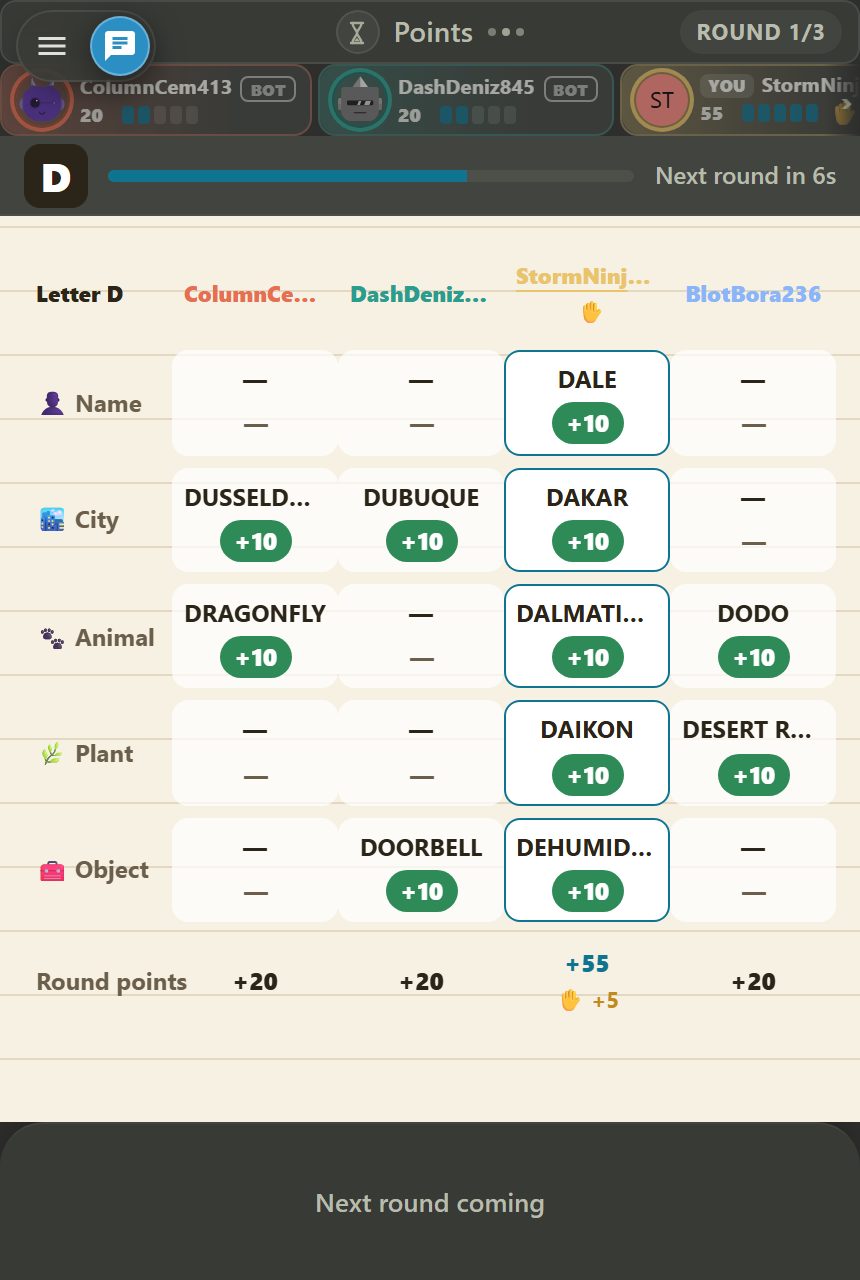
Each round has five fixed categories, and every box is scored separately. Here is what each situation is worth:
| Situation | Points | Details |
|---|---|---|
| You are the only one who wrote a valid answer in that category | 10 | An answer on the list, or one that passed the table vote |
| Someone else in the same category wrote the same answer | 5 (to everyone who wrote it) | Whether two people or five wrote it, it is 5; capitalization, spacing and hyphen differences do not break a match |
| The answer does not start with the round's letter | 0 | Shows as ✗ on the table |
| Empty box | 0 | Shows as — on the table |
| Answer rejected in a vote | 0 | Explained in the seventh tactic |
| First to press STOP, with at least 3 scoring answers | +5 | Solo, shared, or vote-approved answers count |
| Perfect round | 55 | 5 × 10 + 5 bonus |
The lesson in one line: the most valuable answer in a box is not the most familiar one, but the valid one nobody else will write. A perfect round means being the only writer in all five boxes and pressing STOP first; 55 is a ceiling, not a target. A realistic goal is to leave no box empty and to score 10 instead of 5 in as many boxes as you can.
While writing: tactics for filling your sheet
1. Start with the boxes you are sure about
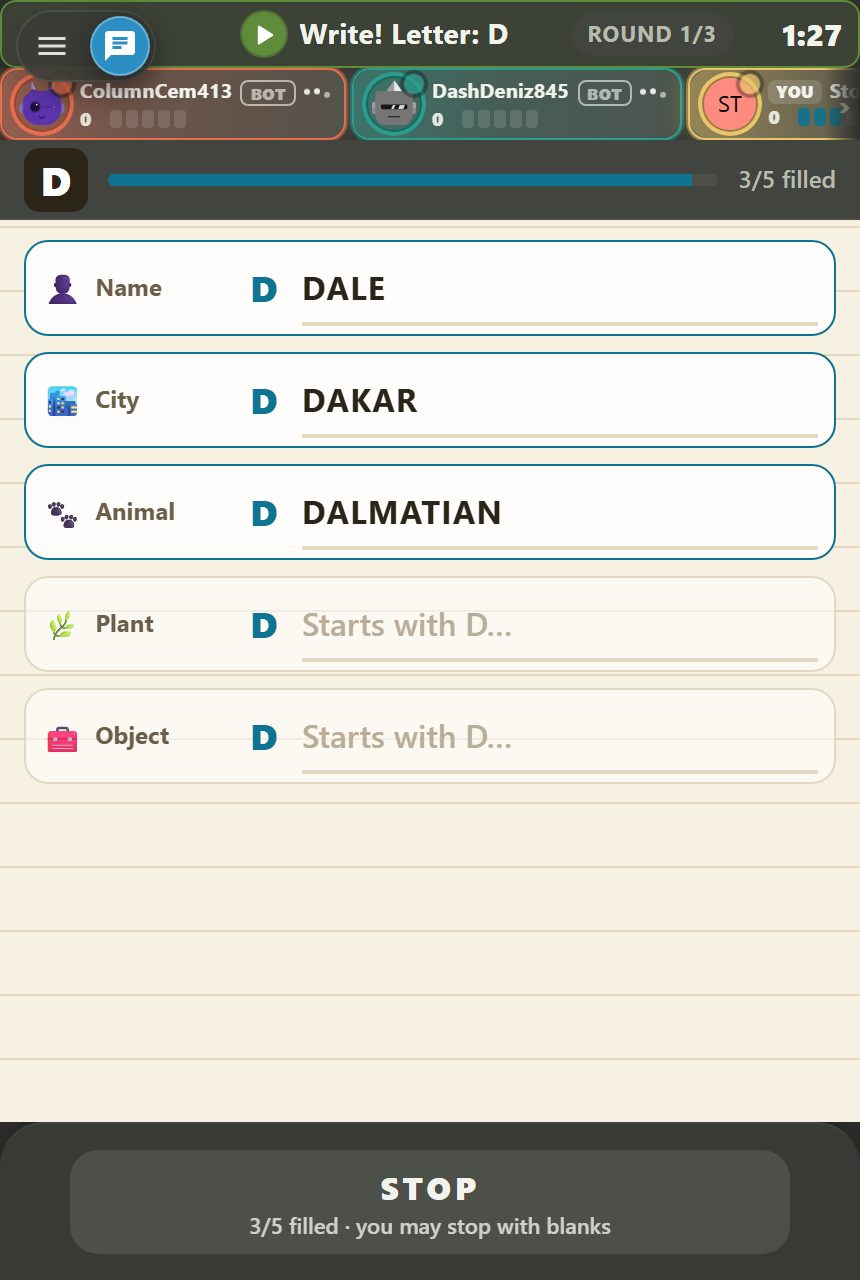
As soon as writing time starts, fill in the boxes you know: the Enter key moves you to the next box, so you can type the answers you are sure of one after another. You can change a box as many times as you like until someone presses STOP. If time looks tight, write a short backup answer first, and swap in a more original one if you still have time. An empty box is always a sure 0; a valid answer is worth 5 even if it is shared.
2. Go one step beyond your first thought
The first answer that comes to your mind is most likely the first one that comes to the others at the table too, so if you collide in a category, you all get 5. Once you have an answer, pause and look for a second option: if it is also valid and nobody has written it, that box is worth double. The matching rule helps here: capitalization, spacing and hyphens do not separate answers, so spelling the same word differently will not make you original; being original takes a different word. You can find what kind of answer each category expects in the table and categories guide. If the clock is running, a shared answer still scores 5, and that is always better than an empty box.
3. Keep an answer bank for the hard boxes
In every category, some letters bring nothing to mind. The table below lists, for each category, the three hardest letters, with one valid answer from the list for each. An answer from the list is accepted instantly, with no vote, so when a hard letter comes up you have at least a safe backup. You do not need to memorize them; reading them once is enough to bring a backup to mind when that letter comes up. For more examples, see the answers guide.
| Category | Hardest letters and an answer that saves you |
|---|---|
| Name | Q: Quinn · X: Xavier · U: Ursula |
| City | X: Xi'an · Q: Quebec City · E: Edinburgh |
| Animal | Q: Quail · U: Urchin · Z: Zebra |
| Plant | Q: Quinoa · U: Umbrella plant · Z: Zucchini |
| Object | X: X-ray machine · Z: Zipper · Y: Yacht |
STOP: when, and for whom
4. STOP locks your own sheet
With the default rule, the first STOP cuts the remaining time on the table to 10 seconds at most. The "at most" matters: if you press STOP in the last 10 seconds of the clock, the time does not extend, it stays as it is. The real trap is this: the moment you press it, your own sheet locks too, and in the seconds that follow only your rivals are still writing. Pressing while you still have a box you could fill means forbidding yourself the 5 or 10 points in that box. Once all five boxes are full, the button turns red and pulses like a heartbeat; the game is telling you "stop now." The host can set the STOP Rule to "Until time runs out"; then STOP cuts nobody's time and only locks your own sheet.
5. Work out the bonus: at least three scoring answers
The first STOP earns a +5 bonus, but only if at least three of your own answers scored; solo, shared, and vote-approved answers count, while invalid and empty ones do not. The bonus goes only to the first player to press; anyone who presses later just locks their own sheet. The bonus is worth as much as a shared answer, so pressing early with two empty boxes only makes sense if you know you cannot fill those boxes. Once you have written at least one answer, you can press STOP even with empty boxes, but empty boxes score 0.
6. Watch your rivals' dots
The five dots on each player card show how many boxes a rival has filled, but never show what they wrote. Your dots are visible to rivals too. If someone has reached four or five dots, STOP can come at any moment: spend your time on the box you can fill fastest, not the hardest one. With the default rule, once STOP is pressed the clock turns red and you have 10 seconds at most left; in that window originality is a luxury you cannot afford. A shared answer scores 5 and an empty box scores 0, so write the first valid word that comes to mind.
Votes, crowds and bots
7. Take the risk on a real word that is not on the list
If your answer starts with the round's letter but is not on the list, it goes to a 14-second table vote: the players other than the author tap 👍 or 👎, and a tie goes in the answer's favor. An answer that passes the vote earns the same points as a listed one (10 alone, 5 if shared); one that fails scores 0. So a real, rare word you know is usually worth the risk: a word nobody else writes scores 10. The vote is a safety net for real words that are not on the list; trying to get a made-up word past the table is both against the spirit of the game and a bad bet against human players.
8. Be rarer at a crowded table
A table seats 2 to 6 players (in a room you open as a guest, the maximum is 4). The bigger the table, the more likely someone else writes the same word in the same category; since a shared answer gives everyone who wrote it 5 points, however many that is, in a crowd familiar answers get stuck at 5. At a two-player table a clash is unlikely, so a familiar answer is enough; at a four- or six-player table, go one step rarer. If you are thinking of setting up a room with friends, also take a look at the guide to online games with friends.
9. Practice against bots
Bots come in three levels, and each teaches a different rhythm:
| Level | Sheet filling | STOP | Average points per round (game simulation) |
|---|---|---|---|
| Easy | About half of the boxes | Never presses | ~19 |
| Medium | Most of the boxes | Presses sometimes | ~34 |
| Hard | Almost all of them | Presses as soon as its sheet is full | ~44 |
Because the easy bot never calls STOP, the clock never shortens; it is ideal for trying out your timing at a relaxed pace. The hard bot, though, presses STOP as soon as its sheet is full, so your goal should be to finish your own sheet before then, or to press first with three solid answers.
Put the tactics into practice
In short: do not leave a box empty, go one step beyond your first thought, do not press STOP while you still have a box you can fill, and be rarer at a crowded table. The easiest way to try all of this is to open a room with bots; you can start from the Categories page. If you enjoy word games, Word Duel might interest you too.
Frequently Asked Questions
Is it smart to press STOP early in Categories?
With the default rule, the first STOP cuts the table's remaining time to 10 seconds at most, and the first player to press earns a +5 bonus if they have at least three scoring answers. But the moment you press, your own sheet locks too, and pressing while you still have an empty box you could fill often costs you points. The smartest time to press is when your sheet is full, or when you know you cannot fill the remaining boxes.
How many points does each player get when two people write the same answer?
Everyone who writes the same word in the same category gets 5 points each, whether it is two people or five. A valid answer written alone is worth 10 points. Differences in capitalization, spacing and hyphens do not break a match; the same word written in a different category does not count as shared.
Is it risky to write a word that is not on the list?
A word that starts with the round's letter but is not on the list goes to a 14-second table vote: the other players tap 👍 or 👎, and a tie lets the answer through. If it passes, it earns the same points as a listed answer; if it does not, it scores 0. Risking a real, rare word is reasonable; writing a made-up word goes against the spirit of the game.
How can I practice against bots in Categories?
Open a room and add a bot; bots come in three levels: easy, medium and hard. The easy bot fills about half the boxes and never calls STOP, the medium bot fills most of them and sometimes calls STOP, and the hard bot fills almost all of them and calls STOP as soon as its sheet is full. Start with the easy bot to try out your timing, then work on finishing your sheet before the hard bot's STOP.
Does strategy change at a crowded table?
Yes. The bigger the table, the more likely someone else writes the same word in the same category, and a shared answer gives 5 points however many people write it. That is why at a four- or six-player table it is smarter to look for a word one step rarer, while at a two-player table it makes more sense to trust a familiar answer.