How to Play Thornwood: Full Rules Guide | Playgridia
How to play Thornwood, in one line: every clearing has exactly one owner, shown plainly on the map, and the match itself is a calendar rather than a race to a score - four seasons, a harvest at the end of each, and the highest total after the winter harvest wins. Thornwood is a free 2-4 player area control game played in the browser. You pick a clan before the match starts, but a clan is one signature power and one harvest bonus, not a separate rulebook - learn one and you know all four.
What is on the board when you sit down
Every board here is twelve clearings cut from a painted wood and joined by paths, each beside a carved sign with a single number: its bounty - the one figure worth tracking all match.
- It is what the clearing pays you at every harvest.
- It is how many Roots the clearing can hold - a bounty-3 glade can be developed until it pays 6.
You start on a home clearing with three warriors: a sanctuary, never raided and never changing hands, so nobody is ever knocked out of a match - bounty 1 on every board. Every other clearing starts wild, guarded by warriors equal to its own bounty, so the richest ground is never free. Nothing is hidden here: no cards, no fog of war, and what is left in the thorn deck is public too.
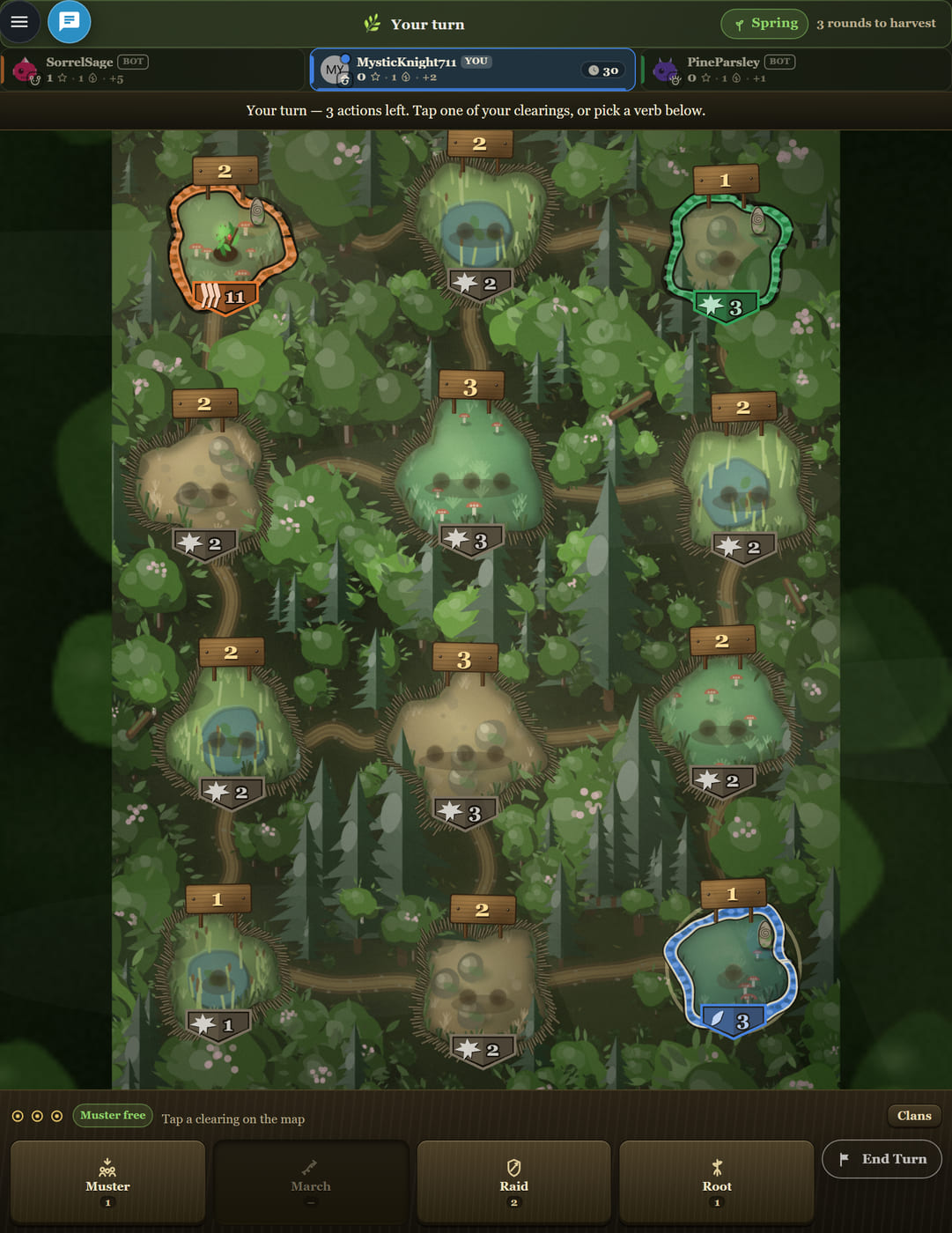
A turn is three actions from four verbs
On your turn you get three actions, spent on any mix of these four verbs:
| Verb | What it does | Where you can do it |
|---|---|---|
| MUSTER | Places 2 new warriors (3 in spring) | Your sanctuary, or any clearing where you have planted a Root |
| MARCH | Moves warriors from one clearing to another | Between two adjacent clearings you already own |
| RAID | Attacks with the warriors you choose to send | An adjacent clearing that is not yours and is not a sanctuary |
| ROOT | Plants a Root in the ground | Any clearing you own that still has a free root slot |
Your clan draws from a shared supply of 18 warriors; a lost warrior just frees up supply for a fresh Muster. Marching only moves warriors between clearings you already own - entering ground you do not own is a Raid instead. Tap a clearing or a verb, either way landing on the same confirm row with nothing committed. End Turn closes it, or the game closes it for you once nothing legal remains.
The Root is the piece the whole game runs on
ROOT looks like the boring verb, and it is the most important: a single Root does three jobs at once.
- +1 bounty, permanently - that clearing pays one more at every remaining harvest.
- +1 defence - developed ground is genuinely expensive to take.
- A muster point - you can place new warriors there instead of walking them out from home.
Planting one also scores an instant point. A clearing holds as many Roots as its printed bounty - a bounty-2 clearing takes two and tops out at 4. A capture pays once; a Root pays at every harvest still to come, so an early Root is worth far more than a late one.
The raid: two numbers and one comparison
Combat is one line of arithmetic, the same for both sides:
- Power = warriors committed + season bonus + clan bonus + one thorn card
- Losses = half the other side's power, rounded up (capped at what it actually has)
- Whoever still has warriors standing holds the clearing
The only figure you do not know in advance is the thorn: twelve cards, four each of +1, 0 and -1, drawn without replacement and dealt face up, with what is left printed on screen. Before you confirm, the board previews the power on both sides and whether the ground changes hands, for the likely draw and the extremes. You also choose how many warriors to send: too few feeds the defence, everything leaves the ground empty.
Clear the defenders and you score two points, and - the single most important rule here - the Roots stay in the ground and become yours, making the leader the most attractive target on the board, not a rubber-band rule. A failed raid is a sortie: survivors walk home, so a misjudged fight costs soldiers, never your position.
The harvest, and what each season changes
Everybody scores the same way, at the end of every season:
Harvest = (the bounty of every clearing you hold + your clan bonus) x the season multiplier
Each season moves one dial - small enough for a banner chip, not a rules panel:
| Season | The one thing it changes |
|---|---|
| Spring | Muster brings one extra warrior |
| Summer | +1 power to the attacker |
| Autumn | The harvest pays double this season |
| Winter | +1 power to the defender, and its harvest ends the match |
A season is three rounds at three or four players, four in a two-player duel, and the banner shows how many turns remain. Autumn pays double, so peaking late throws away your best scoring moment. After the winter harvest the highest score wins outright - or sooner, if second place can no longer catch the leader.
The four clans
A clan is two sentences: a signature power, and a harvest bonus for a different shape of empire - capped at 3, so nobody wins on it alone.
| Clan | Signature | Harvest bonus |
|---|---|---|
| Ironclaw | Muster brings 3 warriors, not 2 | Warriors standing in your fullest clearing |
| Skyplume | Musters anywhere it holds, one free Muster a turn, and March crosses two paths | Different terrain types you hold |
| Thistle | One free Root a turn, and +1 power whenever it defends | Your clearings that touch a rival |
| Mistmane | One free Raid a turn | Clearings you took this season |
Four different questions, not four different amounts: how tall, how varied, how exposed, how fast. A free action costs no action point, once a turn.
Three boards, and how long a match runs
The room offers two settings, both picked before the match starts.
- Fernvale (default) - a 3x4 lattice; two rich glades sit on opposite flanks with no path between, forcing an army to commit to one.
- Winterhold - eight outer clearings around four inner ones on twenty-four paths; the whole inner ring is bounty 3, with no quiet corner to farm.
- Lakeland - a ring around an impassable lake with only two fords, whose heads are the bounty-3 clearings; one stack can cork an entire flank.
Match length is the second setting: Classic, or Quick, which trims one round off every season. All three boards are portrait and fit a phone screen whole - no camera to lose the map in. For board-by-board tactics, see the Thornwood tactics guide.
Three things to do in your first match
- Take the wild ground near home first. Its guards never fight back, and every clearing you hold pays at the next harvest.
- Plant Roots early. One planted in spring pays out four times over; one planted in winter pays out once.
- Do not fear a failed raid. Survivors walk home, so a bad attack costs warriors you can muster again, never a clearing.
That is the whole rulebook. Pick a clan and open a board: play Thornwood free on Playgridia, against bots at any difficulty or with 2-4 friends, no download or account needed.
Any third-party brand or game names mentioned are trademarks of their respective owners. Playgridia is an independent platform and is not affiliated with or endorsed by them.
Frequently Asked Questions
How long does a game of Thornwood take?
The match is a calendar rather than a race to a score: four seasons, with a harvest at the end of each. A season is three rounds at a three or four player table and four rounds in a two player duel, so at a three player table everybody plays twelve turns in total. The Quick setting in the room takes one round off every season. The banner always shows how many turns are left until the harvest, so you always know how much is left.
Do I have to learn four different rulebooks?
No. All four clans play by exactly the same rules: three actions a turn, chosen from four verbs. A clan is only two sentences - one signature power (Ironclaw musters 3 warriors instead of 2, for example) and one harvest bonus. Learning one clan teaches you all four.
Are there dice in combat?
There are no dice. Power is the warriors you send plus the season, your clan bonus and one thorn card, and each side loses half the other side's power, rounded up. The thorn deck is twelve cards - four each of +1, 0 and -1 - drawn without replacement. Both cards are dealt face up and what is left in the deck is printed on screen, so luck is bounded and countable.
Can I be eliminated in Thornwood?
No. Your home clearing is a sanctuary: it can never be raided and never changes hands, so you always have ground to muster onto. Survivors of a failed raid walk back to the clearing they came from, so a misjudged attack costs you warriors, not your position.
Can I play against bots, or on a phone?
Yes. Thornwood is for 2-4 players and any empty seat can be filled with an Easy, Medium or Hard bot, so you can play a full match immediately without waiting for anyone. All three boards are portrait and fit a phone screen whole, with no camera to pan around.