Thornwood Tactics: How to Win Across Four Seasons | Playgridia
Thornwood tactics come down to one idea: the harvest bell decides the match, not army size, so WHEN you plant a Root or send a Raid matters more than how many warriors you have. Three actions a turn, four verbs, one owner per clearing — if that part is still new, the full rules are here. This is about winning: where the points come from, what a Raid costs, and why a smaller army that Rooted early keeps beating a bigger one that didn't.
A turn is three actions from MUSTER, MARCH, RAID and ROOT. Every clearing has one owner and one printed bounty, and a harvest at the end of each season pays whatever you hold then — autumn pays double. After the winter harvest the highest score wins; there is no draw.
Count your turns before you spend them
At three or four players a season is three rounds, so the match is twelve rounds — twelve turns each, thirty-six action points. At two players a season is four rounds: sixteen turns. The quick option shaves one round off every season. Round two has four harvests still ahead of it; the match's last round has none.
A Root planted in spring is worth six points; the same Root in winter is worth two
ROOT scores 1 point on the spot and permanently raises that clearing's bounty by 1. Plant one before the spring harvest and it pays 1 at spring, 1 at summer, 2 at autumn (the doubled season) and 1 at winter — six points for one action. Plant the same Root in winter and it pays two. Nothing else compounds like that, which is why a strong opening is Root-heavy and a strong endgame is not.
A clearing holds as many Roots as its printed bounty, so a bounty-3 glade can carry three and pay six a harvest, while a bounty-1 home is full after one. A Root is also a muster point: without one, every warrior you raise at home needs a MARCH just to reach the front, and one forward Root turns that two-action trip into a one-action arrival.
How many attackers you need is set by their warriors; how many you lose is set by their power
Each side loses half the other side's power, rounded up, capped at what it has standing — the part most players get backwards.
- To take a clearing you must remove every defender. Against the worst thorn draw that means roughly double their number: four attackers clear two defenders, six clear three. Summer gives the attacker +1, so one fewer is enough.
- Roots, winter and a clan's defence bonus raise your bill, not the number you need. Three warriors in the open and three behind two Roots in winter both take about six attackers — but you lose two in the first fight, four in the second.
That power includes one thorn card a side from a twelve-card deck (four +1, four 0, four -1, no replacement, both revealed, what is left printed beside the raid) — the game's entire randomness, and countable. The raid preview shows both sides' power at best and worst; plan against the worst row, and hold your ground once the +1s are gone until the reshuffle brings them back.
Open on wild ground — the guards tell you the price
Every unowned clearing is garrisoned by its own bounty: three defenders on a bounty-3 glade, one on a bounty-1 corner. Wild defenders keep the season bonus and any Roots but never a clan bonus, so unclaimed ground is the cheapest on the board.
You start with three warriors on a bounty-1 home that can never be raided and is never worth sitting on. A strong first season: muster, take the cheap ground next door, then Root the first clearing worth more than 1 you can genuinely hold. Raiding a rival in spring is usually the costlier version of the same move, since owned ground typically carries more warriors and sometimes a clan bonus too. Losses return to your shared supply of eighteen and can be mustered again, so losing warriors costs tempo; losing position costs tempo and points.
Your clan bonus caps at three, so go and get exactly three
All four clans play the same four verbs, then add one signature and one harvest bonus capped at 3 — a target, not a ceiling to chase past:
- Ironclaw musters 3 instead of 2 (4 in spring) and scores its fullest clearing — three warriors there already maxes it, so nine buys defence, not points.
- Skyplume musters anywhere it holds, gets one free MUSTER a turn, marches two paths on its own ground, and scores terrain variety — one Marsh, one Grove, one Ridge maxes it.
- Thistle gets one free ROOT a turn, +1 defending, and scores clearings touching a rival — three contested borders maxes it; a quiet corner scores zero.
- Mistmane gets one free RAID a turn and scores captures made this season, resetting every season — bunch captures into one autumn for the biggest bonus.
Three of four clans get a free verb — skip it and you waste a quarter of every turn, all match long.
A capture keeps the Roots, so the leader is the best target on the board
A capture pays 2 points on the spot, and everything the loser had dug in — every Root — transfers with the ground. That is the game's catch-up mechanism on purpose: no rubber band, just a map. Behind? Attack the highest score, not the nearest clearing. Ahead? Your developed ground needs a garrison more than another Root, and sitting second until the last round of autumn is a fine plan.
A harvest only counts what you hold when the bell rings, so a clearing taken the turn before a harvest pays exactly as much as one held all season — and one lost that same turn pays nothing. Time Raids for the last round of a season, above all autumn's doubled one, and watch the gap: the match ends early once second place can no longer catch up.
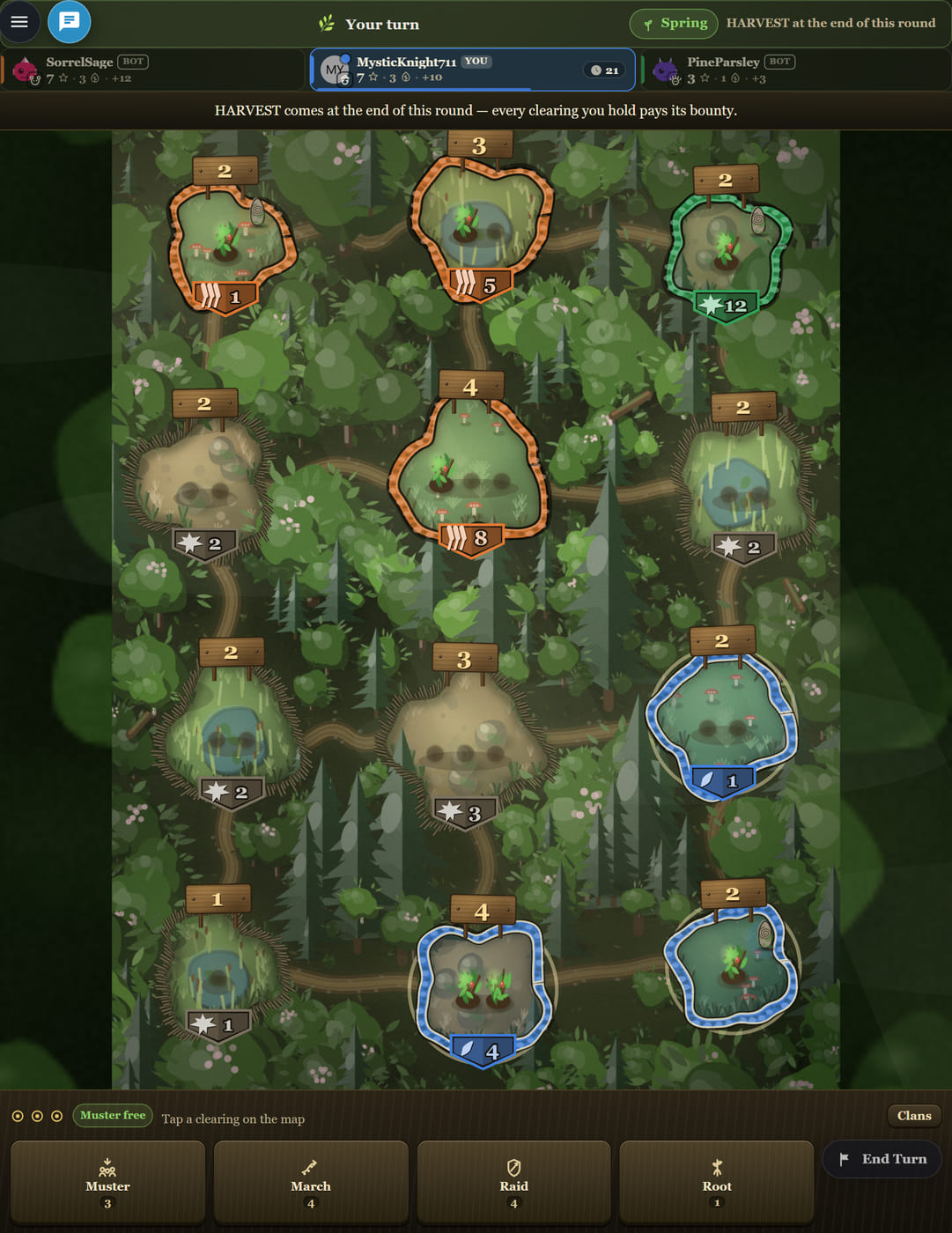
Three boards, three different battlefields
Fernvale, Winterhold and Lakeland share the same twelve clearings and rules, but play like three different fights:
| Board | Clearings / paths | Total bounty | Bounty-3 clearings | Starting clearings are |
|---|---|---|---|---|
| Fernvale (default, free) | 12 / 16 | 22 | 2 — opposite flanks, no path between them | 2 to 5 marches apart |
| Winterhold | 12 / 24 | 24 | 4 — the whole inner ring | 2 to 4 marches apart |
| Lakeland | 12 / 14 (12 ring + 2 fords) | 24 | 4 — exactly the two ford-heads | exactly 3 marches apart |
Fernvale's two rich glades sit on opposite flanks with nothing between them — commit to one side. Winterhold's extra paths mean almost nothing is far from a fight, so warrior count beats clever routing. Lakeland's fords are the only crossings, and a single stack corks a whole flank — the one board where MARCH earns its keep. Winterhold and Lakeland cost the host 100 coins a match if commerce is on; Fernvale is always free.
Pick a clan and try the spring-Root line on Fernvale — it is free, and the fastest way to feel the harvest clock working for you. Play Thornwood free in your browser, against bots or friends, no download and no account. For more boards like it, see our roundup of the best online strategy games.
Any third-party brand or game names mentioned are trademarks of their respective owners. Playgridia is an independent platform and is not affiliated with or endorsed by them.
Frequently Asked Questions
What is the best opening in Thornwood?
Attack the wood, not a rival, in the first season. Every unowned clearing is garrisoned by its own bounty, so a bounty-1 corner is held by one warrior and a bounty-3 glade by three, and wild defenders never get a clan bonus. Muster, take the cheap ground beside you, and plant a Root on the first clearing worth more than 1 that you can genuinely hold. A Root planted in spring pays at all four harvests.
How many warriors do I need to take a clearing?
In a neutral season, roughly twice the number standing there: four attackers for two defenders, six for three. Summer gives the attacker +1, so summer costs one fewer. Roots, winter and a defending clan bonus do not raise the number you need — they raise the number you lose. The raid preview's worst-case row shows you both before you confirm.
Is Thornwood decided by luck?
The luck is bounded and countable. The only random element is the thorn deck: twelve cards, four each of +1, 0 and minus 1, drawn without replacement and revealed face up for both sides. What is left in the deck is printed on screen, so you can see the odds before you raid. Plan against the worst row and luck will not decide your match.
When should I time my raids?
A harvest only counts what you hold when the bell rings, so the best timing is the last round of a season, and above all the last round of autumn, which pays double. Holding a rich clearing for two rounds and losing it on the third scores nothing, while capturing one right before a harvest pays exactly as much as holding it all season.
Can I be eliminated in Thornwood?
No. Your home clearing is a sanctuary: it can never be raided and never changes hands, so you always have somewhere to muster. Survivors of a failed raid walk back where they came from, and casualties return to your supply of eighteen warriors to be mustered again. You can lose position, but you are never knocked out of the match.