Claimridge Dice Odds and Corner Selection | Playgridia
Claimridge dice odds come from one fact: two dice have 36 outcomes and the eleven possible sums are nowhere near equally likely. A 6 or an 8 lands five times as often as a 2 or a 12, and every opening placement, every upgrade and every argument about "unlucky dice" is downstream of that table. Here is the maths, the exact numbers on each of the six boards, and the room setting that changes what the table means. Play along at Claimridge.
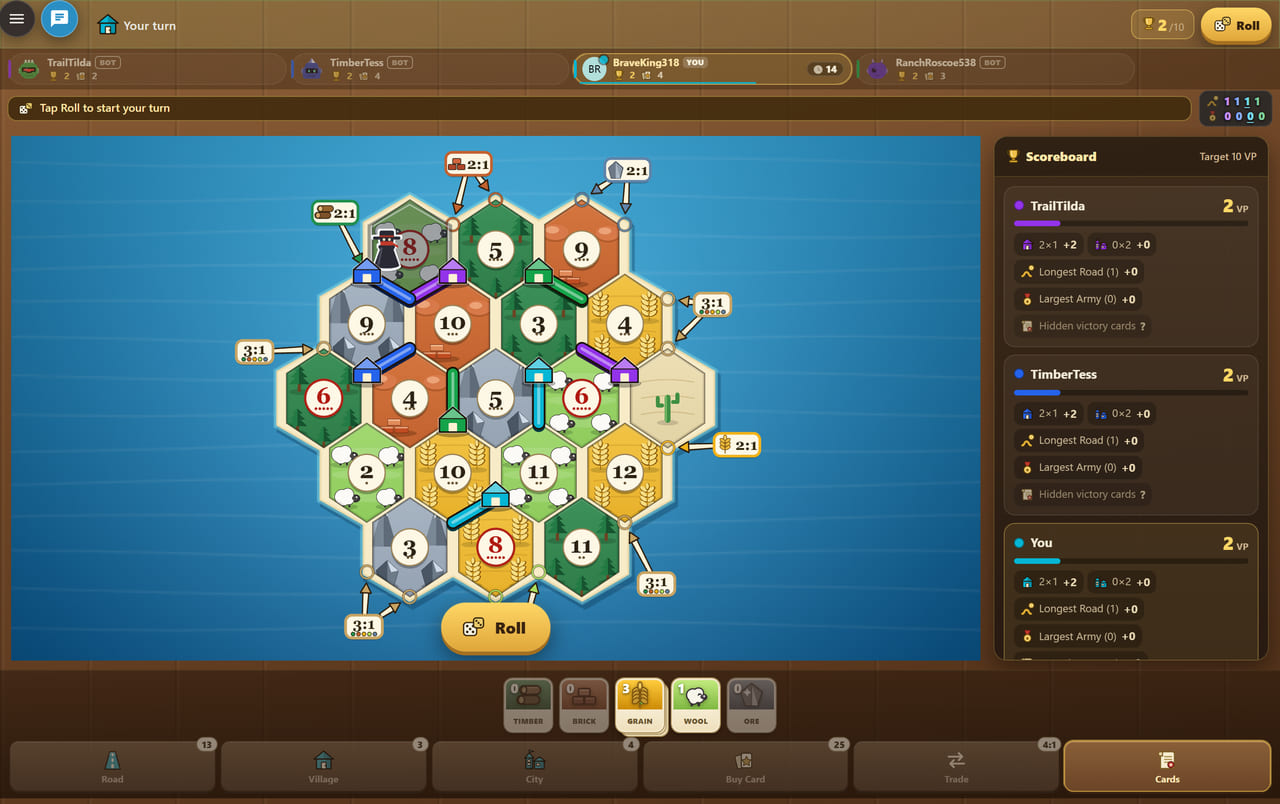
The real distribution of two dice
How many of the 36 combinations make a given total is that total's frequency — and it is exactly what the pips printed under each number disc are counting.
| Roll | Combinations | Chance | Pips on the disc |
|---|---|---|---|
| 2 | 1 / 36 | 2.8% | 1 |
| 3 | 2 / 36 | 5.6% | 2 |
| 4 | 3 / 36 | 8.3% | 3 |
| 5 | 4 / 36 | 11.1% | 4 |
| 6 | 5 / 36 | 13.9% | undefined |
| 7 | 6 / 36 | 16.7% | undefined |
| 8 | 5 / 36 | 13.9% | undefined |
| 9 | 4 / 36 | 11.1% | 4 |
| 10 | 3 / 36 | 8.3% | 3 |
| 11 | 2 / 36 | 5.6% | 2 |
| 12 | 1 / 36 | 2.8% | 1 |
So 6 and 8 come up five times as often as 2 and 12. A hex sitting on a 12 pays out about once every 36 rolls — once or twice in a whole match. The board itself tells you: a 6 or an 8 disc is drawn with a red ring and the fattest row of pips.
Real dice or the balanced deck?
The host picks the dice generator in the room, and the two options behave differently.
- Classic dice — two genuinely independent d6. Every roll starts from scratch, the table above holds forever, and no number is ever "due". This is the default.
- Balanced deck — a shuffled deck of all 36 combinations, dealt without replacement and reshuffled only when it runs dry. Every full cycle of 36 rolls therefore contains exactly six 7s, exactly one 2 and exactly one 12.
That second option inverts the usual advice. With real dice, counting is a fallacy; with the balanced deck it is arithmetic — a number that has not appeared this cycle is genuinely more likely as the deck drains, and a hex on 12 cannot simply be absent for a whole match. The per-roll odds at the top of a fresh deck are identical to real dice; what changes is the variance, not the average.
How many numbers are actually on the board
Claimridge is played on six boards, and the classic "18 tokens, no 7" bag only describes one of them. Every board gets a token bag generated for its own count of producing hexes, and a hex bearing a wasteland gets no disc at all. These are the 2–4 seat layouts.
| Board | Hexes | Hexes with a number | 6s and 8s in the bag |
|---|---|---|---|
| Frontier Valley | 19 land | 18 | 2 + 2 |
| Bounty Plains | 24 land, no wasteland | 24 | 3 + 3 |
| Canyon Pass | 20 land + 4 water | 19 | 2 + 2 |
| Gold Rush | 22 land, 2 of them gold | 21 | 2 + 2 |
| Archipelago | 20 land + 22 water | 19 | 2 + 2 |
| Two Shores | 23 land + 6 water | 22 | 2 + 2 |
The 5–6 seat layouts are all bigger again, and only a board with exactly 18 or 28 producing hexes is dealt the hand-written classic bag. The practical consequence: Bounty Plains has half again as many red hexes as everything else and none of its hexes is dead, so a corner that would be excellent on Frontier Valley is merely normal there.
Two layout rules that shape corner value
- Two red hexes never touch. The layout is re-rolled up to forty times to avoid it, so "a corner where a 6 and an 8 meet" is a genuine rarity rather than something to plan around.
- A gold field never gets a red number. Nuggets are wild, so a 6 on gold would be the strongest corner on the board by a distance. Reds are dealt away from gold first.
How to compute a corner's income
A corner touches up to three hexes, and its value is the sum of their pips over 36. A corner on 6 + 8 + 5 is 5 + 5 + 4 = 14 / 36, or 0.39 goods per roll. Upgrade it to a City and every hex pays 2 instead of 1, so it doubles to 0.78.
Rolls per round equal the number of players, so scale it: at three seats that Village averages 1.2 goods a round and the City 2.3; at six seats it is 2.3 and 4.7. That is also the honest argument for upgrading — a City costs 2 Grain + 3 Ore and doubles an income you already own, while a new Village costs four different goods and a Road to reach a corner that is probably worse than your first two.
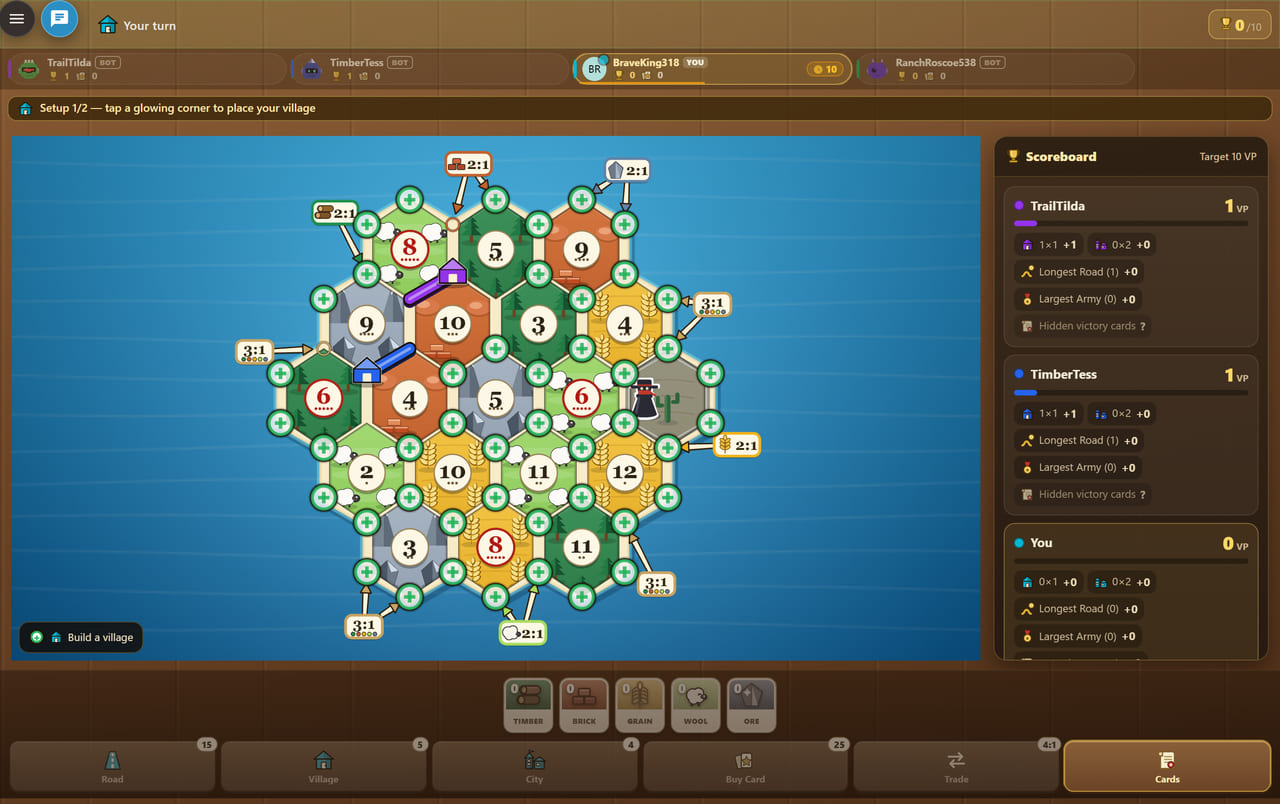
Number quality, ranked
- First class: 6 and 8 — 5/36 each, red ring.
- Second class: 5 and 9 — 4/36.
- Acceptable: 4 and 10 — 3/36.
- Weak: 3 and 11 — 2/36.
- Trap: 2 and 12 — 1/36. If a corner's third hex is a 12, treat it as a two-hex corner and price it accordingly.
How often does a 7 land?
7 is the most frequent total on its own: 6 in 36, about one roll in six. Nothing produces; instead everyone over the card limit discards half, the Bandit moves and a robbery happens. Because rolls per round equal the player count, a 7 arrives roughly every three rounds at two seats, every 1.5 rounds at four, and about once a round at six. Sitting on a big hand is therefore a calculable loss, not a style choice.
One caveat that most guides miss: the 7-card ceiling is a room option. The host can raise it to 9 or 12, or switch discarding off altogether — and on that last setting the whole "never hold more than seven" discipline simply stops applying, while the robbery half of the 7 does not.
Probability is not the whole answer
- Variety beats raw pips. A corner on a 6 and an 8 that pays the same good twice is usually worse than a humbler corner covering three goods, because the good you never produce is the one you buy at 4:1.
- The Bandit erases a number. An economy resting on one hex stops the moment a rival parks the Bandit on it. Income spread over two good numbers is far harder to switch off.
- A gold hex is worth more than its pips. It pays a nugget, which you cash for any good you like, so on Gold Rush, Archipelago and Two Shores a 5 on gold can beat an 8 on the wrong terrain.
- A Trading Post rewrites the sums. A 2:1 post turns a lopsided corner into a flexible one, which is exactly what a 4:1 bank rate does not.
Check it inside the match
Every match ships its own roll histogram: the in-game rulebook draws the theoretical share as a pale bar and what this table actually rolled as a solid one, next to the number of rolls so far. If the game feels rigged, that panel settles the argument in about four seconds — and it names the balanced-deck option in the same breath.
For the rules themselves, read how to play Claimridge; to turn these numbers into wins, the strategy guide. Where the game sits in its genre is covered in our settlement and resource-trading game overview. Or test the maths live and play Claimridge free.
Any third-party brand and game names mentioned are trademarks of their respective owners. Playgridia is an independent platform, not affiliated with or endorsed by them.
Frequently Asked Questions
What are the dice odds in Claimridge?
Two dice give 36 combinations, so 7 is the most common total at 6 in 36 (16.7%), 6 and 8 come next at 5 in 36 (13.9%) each, and 2 and 12 are the rarest at 1 in 36 (2.8%). The pips printed under each number disc count those combinations directly, so five dots means five ways to roll it.
Why does it keep rolling 7?
Because 7 genuinely is the most likely sum — there are six ways to make it with two dice and only one way to make a 2. Streaks of it are ordinary, not a bug. The in-game rulebook shows this match's actual roll histogram against the theoretical share, so you can check the dice rather than argue about them.
What does the balanced dice option do?
It replaces two independent dice with a shuffled deck of all 36 combinations, dealt without replacement and reshuffled only when empty. Every full cycle of 36 rolls then contains exactly six 7s, one 2 and one 12. The averages are identical to real dice; what shrinks is the variance, and a number that has not come up this cycle really does become more likely.
How do I work out how good a corner is?
Add the pips of the hexes it touches and divide by 36. A corner on 6 + 8 + 5 is 5 + 5 + 4 = 14 in 36, or 0.39 goods per roll for a Village and 0.78 for a City. Multiply by the number of players to get goods per round, because each player rolls once per round.
Are 6 and 8 always the best numbers?
They are always the most likely, but not always the best corner. A 6 and an 8 that pay the same good are usually worse than three different goods on smaller numbers, and on the gold boards a modest number on a gold field can beat a red one, because a nugget converts into any good you want.
Do all six boards use the same number tokens?
No. Each board draws a token bag sized for its own count of producing hexes, and only a board with exactly 18 or 28 of them gets the hand-written classic bag. Frontier Valley at 2–4 seats has 18 numbered hexes with two 6s and two 8s, while Bounty Plains has 24 numbered hexes with three of each — and no wasteland at all.