How to Play Claimridge: Full Rules Guide | Playgridia
How to play Claimridge: roll two dice, every terrain hex showing that number pays out to the Villages and Cities touching it, and you turn those goods into Roads, Villages, Cities and Fortune cards until someone reaches the victory-point target. It is a 2–6 player settle-the-frontier game on six different boards, free in the browser against bots or friends — no download, no sign-up.
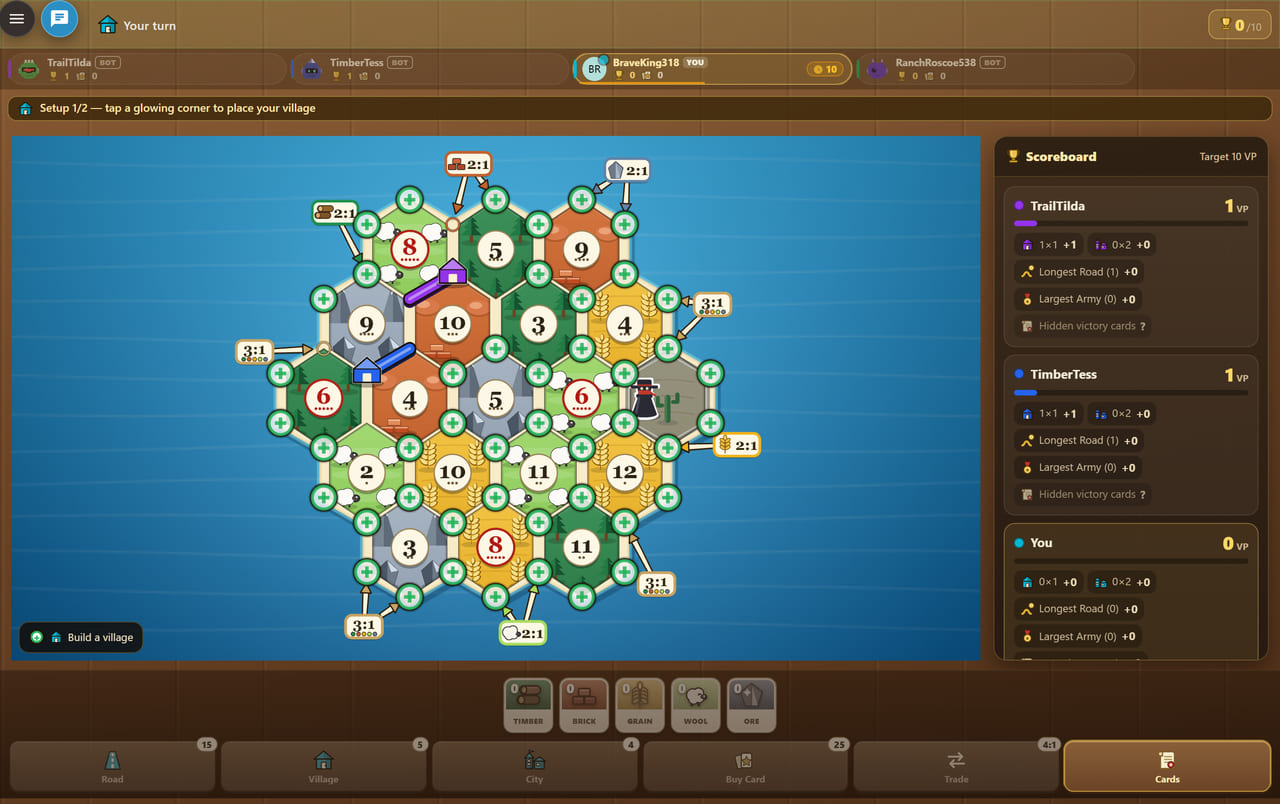
Setup: two Villages, two Roads
Placement is a snake draft. In seat order everyone lays 1 Village + 1 Road; then the order reverses and everyone lays a second Village + Road. A Village needs every neighbouring corner empty (the distance rule), and each opening Road must touch the Village you just placed. Your second Village pays out immediately — one good per producing hex it touches — and that is your whole opening hand, so place it for goods, not for looks. On the two water boards both opening Villages go on the largest island, so nobody starts marooned.
The three steps of a turn
- 1 · Roll. Two dice. Every hex showing that sum produces to each Village (1 good) and each City (2 goods) touching it — unless the Bandit is parked on it.
- 2 · Act. Build, trade with the bank or the table, buy a Fortune card, play one card, cash nuggets — in any order, as often as you can pay.
- 3 · End turn. The move clock is 180 seconds by default (90 to 600 in the room settings). If it runs out the server plays that step for you, so the table never stalls.
Six boards, picked in the room
There is no single fixed island. The host chooses one of six maps, and every map ships two layouts — compact for 2–4 seats, wider for 5–6 — with the layout chosen from the players who actually sat down. Frontier Valley's small layout is the classic 19-hex island; the other five are genuinely different games.
| Board | What it changes | Default target |
|---|---|---|
| Frontier Valley | The classic island: one landmass, one Wasteland, no water. The board to learn on. | 10 VP |
| Bounty Plains | No Wasteland at all, so every hex pays somebody; the Bandit starts off the board and only enters on the first 7. | 12 VP |
| Canyon Pass | A canyon of real water splits the land and ships are OFF — the only crossings are the north and south passes. | 10 VP |
| Gold Rush | Gold fields that pay nuggets, and more Mountains than Fields. | 12 VP |
| Archipelago | Ships ON: a main island ringed by isles, three of them carrying gold. | 10 VP |
| Two Shores | Ships ON: an ore-poor home shore and a far shore one water hex away. | 10 VP |
The target itself is a room option and its ladder belongs to the map: Frontier Valley and Canyon Pass offer 6/8/10/12, the other four offer 8/10/12/14, and the 5–6 seat layouts shift each ladder up. Ask for a number outside the list and the engine snaps it to the nearest one that board's building stock can physically reach.
The land, the goods and the gold
Five terrains pay five goods: Forest → Timber, Hills → Brick, Fields → Grain, Pasture → Wool, Mountains → Ore. A Wasteland hex produces nothing and is where the Bandit starts — except on Bounty Plains, which has none.
The sixth terrain is a gold field. It carries a number disc like any other hex, but what it pays is a nugget: a wild claim you cash on your own turn for any single good the bank still holds — the cure for the worst position in this genre, a fat hand of the wrong goods. That is also why a gold field never gets a red 6 or 8.
On the two water boards, water is real terrain with its own corners and edges. A Ship (1 Timber + 1 Wool) rides a sea edge exactly as a Road rides a land edge, and your Roads and Ships form one single network — only an edge between two water hexes is ships-only.
What everything costs
- Road: 1 Timber + 1 Brick · Ship (water boards): 1 Timber + 1 Wool
- Village: 1 Timber + 1 Brick + 1 Grain + 1 Wool
- City (upgrades a Village): 2 Grain + 3 Ore
- Fortune card: 1 Grain + 1 Wool + 1 Ore
Your stock is finite and it is per map and per table size, never one universal number: Frontier Valley at 2–4 seats gives 5 Villages / 4 Cities / 15 Roads, Bounty Plains and Gold Rush give 6 / 5 / 16, and Archipelago adds 10 Ships. A longer target adds one Village, one City and three Roads for every 2 points above the map's own default.
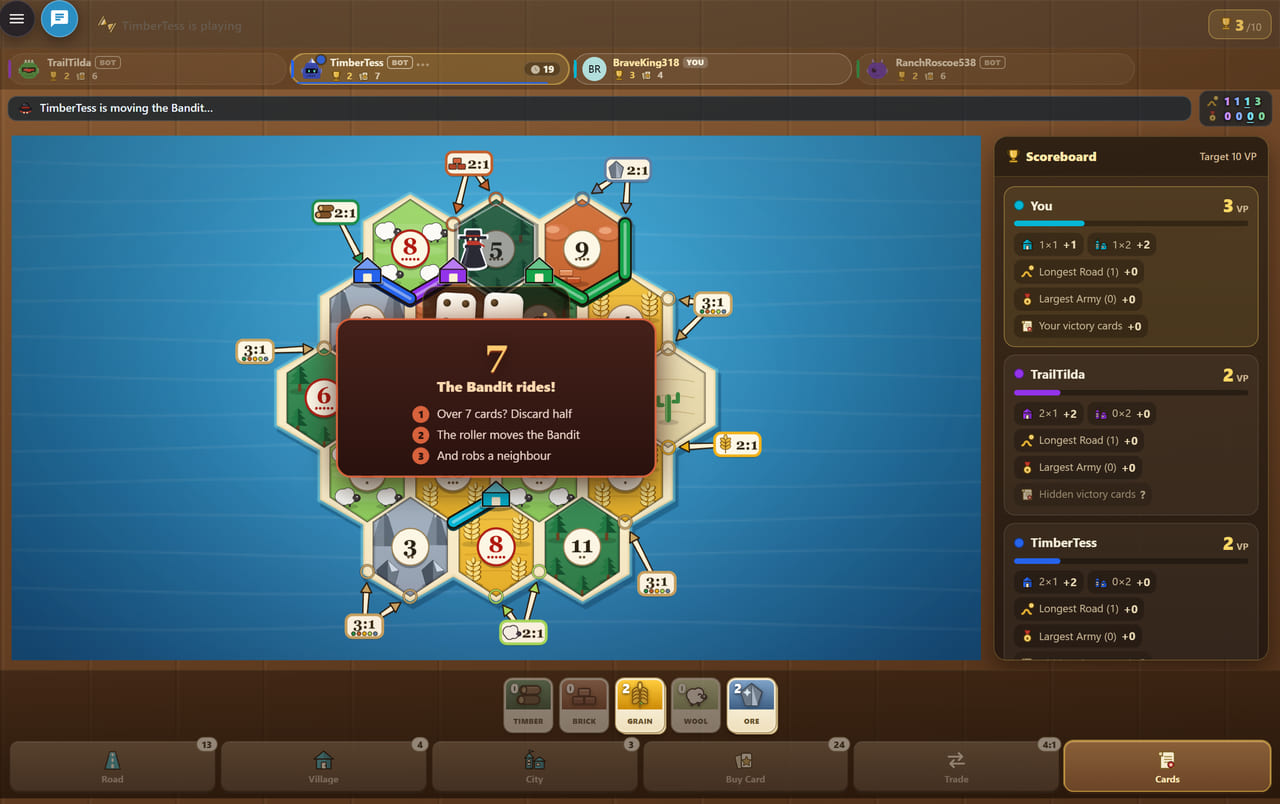
Trading: the bank, the Posts, the table
The bank always takes 4 of one good for 1 of another, and it settles several lots in a single move. A Trading Post improves that if you own a Village or City on one of its two coastal corners: a generic post is 3:1 on anything, a specific post is 2:1 on its own good. Post count is per map and per seat bucket — nine on the small layouts, ten or eleven on the large — but the mix is always four generic plus one per resource.
A trade with the other players is a bid, not a race. You post a give/get offer, every rival answers, the acceptances queue up, and you pick which one to settle with. Answers can be changed while the offer stands, and both hands are re-checked at the moment you settle, because a build in between can spend the very goods you promised. Rivals who cannot pay the get side are declined automatically and never shown the offer; if nobody can cover it, the offer is refused outright instead of sitting there dead. At two players there is one possible partner, so the accept settles it.
Fortune cards
The deck is 25 cards at 2–4 seats and 36 at 5–6, where the whole deck scales up and the bank goes from 19 of each good to 26. The small deck holds 14 Gunslinger (move the Bandit and rob someone — this feeds Largest Army), 5 Victory Cards (hidden +1 VP), 2 Road Master (2 free Roads), 2 Supply Wagon (any 2 goods from the bank) and 2 Boom (name a good, take every copy of it from every hand). Two rules: a card bought this turn waits until your next one, and you may play one card per turn.
When a 7 comes up: the Bandit
A 7 produces nothing. First everyone holding more than 7 cards discards half, rounded down — though that ceiling is a room option the host can raise to 9 or 12, or switch off. Then the roller moves the Bandit onto any land hex and robs one player with a building on it. The card is pulled blind, but it is no secret afterwards: which good moved is revealed to the thief and the victim, and nobody else. The hex under the Bandit produces nothing until he moves on. A Gunslinger does the same on demand, and three played takes Largest Army.
Scoring and winning
- Village 1 VP · City 2 VP
- Longest Road — an unbroken run of 5 or more, +2. Ships count, a rival's Village cuts the run, and a tie keeps the current holder.
- Largest Army — 3 or more Gunslingers played, +2, same tie rule.
- Landfall — on the two water boards, the first Village you plant on an island you have never settled is +2 on top of the Village itself.
- Victory Cards — a hidden +1 each.
The scoreboard everyone can read leaves the hidden cards out, so the leader may be a step closer than they look. Whoever reaches the target on their own turn wins.
One more room setting matters: the dice — two real d6, or a balanced deck of all 36 combinations dealt without replacement, so a full cycle contains exactly six 7s. It is worked through in the dice-odds and corner-selection guide. After that, read the opening and winning tactics, see where it sits in our settlement and resource-trading game overview, or just play Claimridge free.
Any third-party brand and game names mentioned are trademarks of their respective owners. Playgridia is an independent platform, not affiliated with or endorsed by them.
Frequently Asked Questions
How many players can play Claimridge?
Two to six, in any mix of humans and bots. Every one of the six boards ships a compact layout for 2–4 seats and a wider one for 5–6, and the game picks the layout from the players who actually sat down, so the island grows with the table. At 5–6 seats the bank also goes from 19 of each good to 26 and the Fortune deck grows to 36 cards.
How many points do you need to win?
It depends on the board. The victory-point target is a room option, and each map offers its own ladder: Frontier Valley and Canyon Pass offer 6, 8, 10 or 12 and default to 10, while Bounty Plains, Gold Rush, Archipelago and Two Shores offer 8 to 14 — Bounty Plains and Gold Rush defaulting to 12 because their economies are faster. The 5–6 seat layouts shift each ladder up.
What happens when a 7 is rolled?
Nothing produces. Everyone holding more than 7 cards discards half, rounded down, and then whoever rolled moves the Bandit onto any land hex and robs one player with a building beside it. The stolen card is pulled blind, but which good it was is shown to the thief and the victim afterwards. The 7-card ceiling is a room option: the host can set it to 9, to 12, or turn discarding off.
What is a nugget in Claimridge?
It is what a gold field pays instead of a good. A gold hex carries a number disc like any other, but when it produces you receive a nugget, and on your own turn you cash each one for any single good the bank still holds. Gold fields appear on Gold Rush, Archipelago and Two Shores, and the layout never gives one a red 6 or 8 because that corner would be far too strong.
Can I trade with the other players?
Yes, and it works as a bid rather than a first-tap race. You post a give/get offer, every rival answers, the acceptances collect, and you choose your partner. Answers can be changed while the offer stands, both hands are re-checked at the moment you settle, and rivals who cannot pay what you asked for are declined automatically instead of being shown a dead offer.
Which board should a first-timer choose?
Frontier Valley. It is the classic 19-hex island with no water, no gold and no ships — one landmass, one Wasteland and nine Trading Posts — so nothing is happening except the core loop of roll, produce, build and trade. Bounty Plains is the friendliest step up: it has no Wasteland at all, so almost every roll pays somebody.