Best Turn-Based Browser Games (2026) | Playgridia
Turn-based browser games are the ones you can actually finish on a lunch break: nothing depends on reflexes, nothing punishes you for looking away, and every board opens in a tab with no download and no sign-up. Here are seven of the best on Playgridia — a settlement builder, a property-trading board game, a fast card duel, two war games, a mining race and a competitive take on the mine-flagging classic — all free, and all playable against bots or real opponents.
What "turn-based" actually buys you
- No reflexes, ever. Nobody wins by clicking faster. The winner is whoever read the board better, which is why these games are exactly as fair for a ten-year-old as for a veteran.
- Your own clock. Every game carries a per-move timer the host chooses — 30 seconds in Naval Battle, three minutes in Claimridge, up to ten minutes if the table wants to think.
- Any device. Every board is built portrait-first for a phone screen and renders identically in a desktop browser. There is no app to install.
- The match survives you closing the tab. Game state lives on the server. Drop out and your seat is held; stay away longer and a bot plays it for you, then hands it straight back the moment you return.
- An opponent, instantly. Any empty seat takes a bot at Easy, Medium or Hard, so you never sit in a lobby waiting. A table with two or more humans still counts for rating even when bots fill the rest.
Seven turn-based picks at a glance
| Game | Players | What one turn is |
|---|---|---|
| Claimridge | 2–6 | Roll for resources, then build, trade and play cards in any order |
| Estates | 2–6 | Roll and move, then buy, build, bid or negotiate |
| Color Match | 2–6 | Play one card matching the colour or the number |
| Warfront | 2–4 | Recruit and manoeuvre as much as you like, then end the turn |
| Gold Miner | 2 | A timed box — drop the hook as often as the clock allows |
| Naval Battle | 2 | Exactly one decision: which square do I fire at |
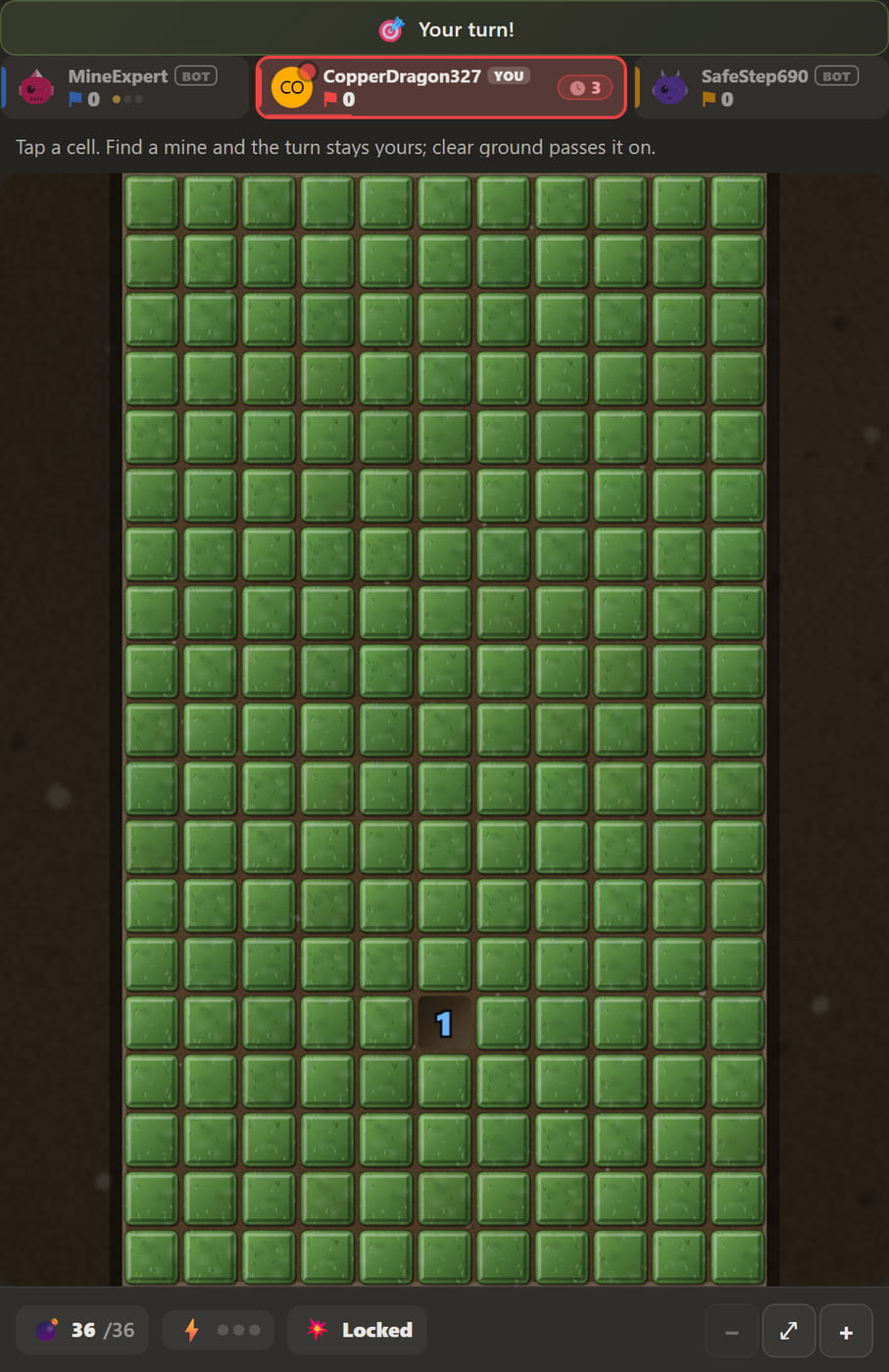
| Minesweeper | 2 | One tap — a mine keeps the turn, clear ground passes it |
Claimridge — the one for a full table
Claimridge is the deepest game on this list and the best one with a crowd. It is a settlement and resource-trading board game across six boards, each compiled from its own terrain layout: the default frontier valley is the classic 19-hex island, one board drops the desert entirely, another splits the land with a water canyon crossable only at two passes, and one scatters gold fields that pay a wild resource you can cash for anything. On your turn you roll two dice; every hex showing that number pays its resource to the camps (1) and towns (2) touching it, and then you build, trade and buy Fortune cards in any order until you end the turn. A rolled 7 sends the Bandit: everyone over the hand limit (7 cards by default) discards half, and the roller shuts down a hex and robs a neighbour. First to the victory-point target wins — 10 by default, with a 6-to-20 ladder in the room options. A trade offer is a bid rather than a race: rivals accept, and you choose the partner. 2–6 players, with dedicated boards for 5–6 seats.
Estates — the negotiation evening
Estates is the property-trading board of the set, and the one that starts arguments in the best way. Pick one of five real-geography boards — a world tour by default, or Europe, the US, Turkey or Asia — and go round a 32-space loop of 18 cities in six colour groups, plus four transport hubs and two utilities. Own all three cities in a group and rent multiplies; build up to a hotel and it multiplies again. Passing or landing on the single terminal pays $400, three doubles in a row send you to jail (bail $700, or sit out two turns), and every property you decline goes to a live auction whose countdown every new bid extends. Running out of cash is not instant death: you mortgage at half price, sell houses back at half, and can even put your own property under the hammer on your turn. Win by reaching the target net worth or by being the last player standing; otherwise the highest net worth after 25 rounds takes it. 2–6 players.
Color Match — the fast one
Color Match is the quickest game here and the easiest to teach: everyone starts with 7 cards and plays one that matches the top card's colour or its number/symbol. Skip jumps the next player, Reverse flips the direction of play (in a duel that means you go again), and a +2 can be stacked on a +2 — the penalty grows to +4, +6, +8, and whoever breaks the chain draws the lot. Wilds let you name the colour, and the +4 wild hands the next seat four cards. Draw a card that turns out to be playable and the choice is yours: play it now, or hold it. First to empty their hand wins, and your final score is the table's total card value minus whatever is still in YOUR hand — so the winner, holding nothing, always scores highest, and the losers rank by how close they came to going out. 2–6 players, and a round is usually over in minutes.
Warfront — zero luck
Warfront is the purest skill game on this list: there are no dice anywhere on the board and damage is fully deterministic, so every loss is a planning lesson. Recruit from seven unit types locked in a rock-paper-scissors chain — spearmen skewer cavalry, cavalry runs down archers, gryphons own the sky — while every village you hold grows the economy that pays for the next wave. Your hero commander is killable and carries a one-turn power spike that can swing a fight you were losing. Win by holding the central Watchtower for four rounds straight, or by destroying the enemy hero and their headquarters. Six maps come in two shapes: portrait boards that fit a phone whole, and wide boards deliberately bigger than the screen so the camera has somewhere to go. 2–4 players, free-for-all or 2v2.
Gold Miner — the ten-minute duel
Gold Miner is the one to open when you have ten minutes. It is a 12-round duel down a dark shaft: on your turn you drag to aim the swinging hook and let go, and the turn is a time box, so you fire as often as the clock allows. The shaft is unlit — an ore only shows what it really is while your hook's lamp passes over it, which makes the game as much about remembering what you saw as about aiming. Deep ore pays up to 60% more and reels in that much slower; consecutive valuables build a ×1.5 → ×2 → ×3 combo that a rock, a bone or a skull instantly breaks. Sealed chests stay secret until they surface, the mole walks off with whatever it is carrying (so you aim where it is going, not where it is), and TNT barrels only detonate if the hook touches them. Highest total after 12 rounds wins. Strictly 2 players.
Naval Battle — one decision a turn
Naval Battle has the purest turn on the list: one decision, which square do I fire at. Your fleet — a carrier, a battleship, a cruiser and a destroyer, 14 squares of hull in total — is deployed automatically on the server, so the match opens straight into the fighting. Tap enemy water and the strongest gun platform that can fire this turn is picked for you, with a confirm strip naming the ship, the shot and the square; the battleship fires a three-square salvo, the cruiser two, the others a single shell. Each hull also carries one signature ability on a cooldown: a 3×3 air strike, a 2×2 heavy bombardment, a plus-shaped cross salvo, and a torpedo run down a whole column. There is no hit chain — the turn always passes — and the fog over the enemy half only opens where your shots have already landed. Strictly 1v1, 30 seconds a move, usually done inside ten minutes.
Minesweeper — the classic, made competitive
Minesweeper here is a scoring race rather than a survival test, and at two seats it is everyone for themselves. One tap: hit a mine and you plant a flag, score a point and keep the turn; hit clear ground and it floods open, handing the turn on. Miss three times in a row and the NEXT player gets two moves, and if you fall five points behind the leader you unlock a one-shot 3×3 bomb. There are five fields, each scattering its mines differently — the default is a 9×16 board with 25 mines, exactly the count of the classic square grid, simply stood up so it fills a phone. The match ends the moment the leader is beyond catching, which is usually long before the last mine is found.
Close the tab — the match waits for you
This is the practical difference between a turn-based browser game and a live one. Every board here is server-authoritative: the client draws the game, the server decides it, and the whole match — the board, the seats, the score — sits there. Lose your connection and you have a two-minute window to come back to exactly where you were. Stay away longer and a bot takes the seat reversibly: it keeps playing so nobody else's evening stalls, and the moment you reload you take the seat back with no penalty and pick up where the bot left the board. The move clock runs anywhere from 30 seconds to ten minutes depending on the game and what the host chose, so a slow thinker is never punished and a table is never held hostage either.
Which one should you start with?
- Never played a board game online? Color Match — one card a turn, learned in thirty seconds.
- Ten minutes and one opponent? Naval Battle or Gold Miner.
- Want a real strategy evening with friends? Claimridge or Estates — both seat up to six, and neither knocks anyone out early.
- Want no luck at all? Warfront — there are no dice anywhere on the board.
- Want something short that is still competitive? Minesweeper — 2 players, everyone for themselves.
Pick one and jump in: play turn-based browser games free on Playgridia — no download, no account, just open a board and take your turn.
Any third-party brand or game names mentioned are trademarks of their respective owners. Playgridia is an independent platform and is not affiliated with or endorsed by them.
Frequently Asked Questions
What is the best turn-based game to play in a browser?
It depends how much time you have. For a long evening with a crowd, Claimridge or Estates. For a ten-minute duel, Naval Battle or Gold Miner. If you want zero luck, Warfront resolves every fight deterministically with no dice. If you are teaching someone, Color Match takes about thirty seconds to learn. All of them are free and need no download.
Do turn-based browser games need a download or an account?
No. The boards run directly in your browser, there is nothing to install, and you do not need an account to start — you can play as a guest and sit down at a table straight away.
What happens if I close the tab in the middle of a game?
The match is not lost, because it lives on the server rather than in your browser. You have a two-minute window to come back to exactly where you were. Stay away longer and a bot temporarily takes your seat so the other players are not stuck; when you return you reclaim it with no penalty and carry on from where the bot left the board.
Can I play these turn-based games against the computer?
Yes. Any empty seat can be filled with a bot at Easy, Medium or Hard difficulty, so you can start a full match immediately. A match with only one human does not move your rating; a table with two or more humans is rated even when bots fill the remaining seats.
Do turn-based browser games work on a phone?
Yes. Every board here is designed mobile-first for a portrait phone screen and behaves identically in a desktop browser. Being turn-based helps: there is no dragging or fast clicking to get wrong on a touchscreen, since a move is a single tap.