Play Catan Against the Computer: Solo Online vs Bots
Want to play Catan against the computer? You can play a game of the same genre against bots, alone, in your browser: Claimridge is a separate, independent game from Catan, with its own rules, names and artwork, and it shares only the genre. A guest host can seat up to 3 bots and a signed-in host up to 5; a match starts as soon as 2 seats are filled, so 1 human + 1 bot is already a match. The boxed game's official rules are in its own rulebook and this post does not replace them; everything below is Claimridge's.
How do you set up a table with bots?
Open a room from the game page. As a guest you can pick 2, 3 or 4 seats; 5 and 6 are locked, with the note "More than 4 players requires signing in." Every empty seat carries three small buttons: Easy, Medium, Hard. Press one and a bot sits down and a toast confirms it ("Medium bot added"); in the player list it appears as "Bot player", already marked READY. The buttons belong to the seat, so you can mix levels: one Easy, one Medium and one Hard bot can share a table, and if you picked the wrong level you can remove the bot from the list and add another. No account or download is needed; the game opens in your phone's browser with nothing to install.
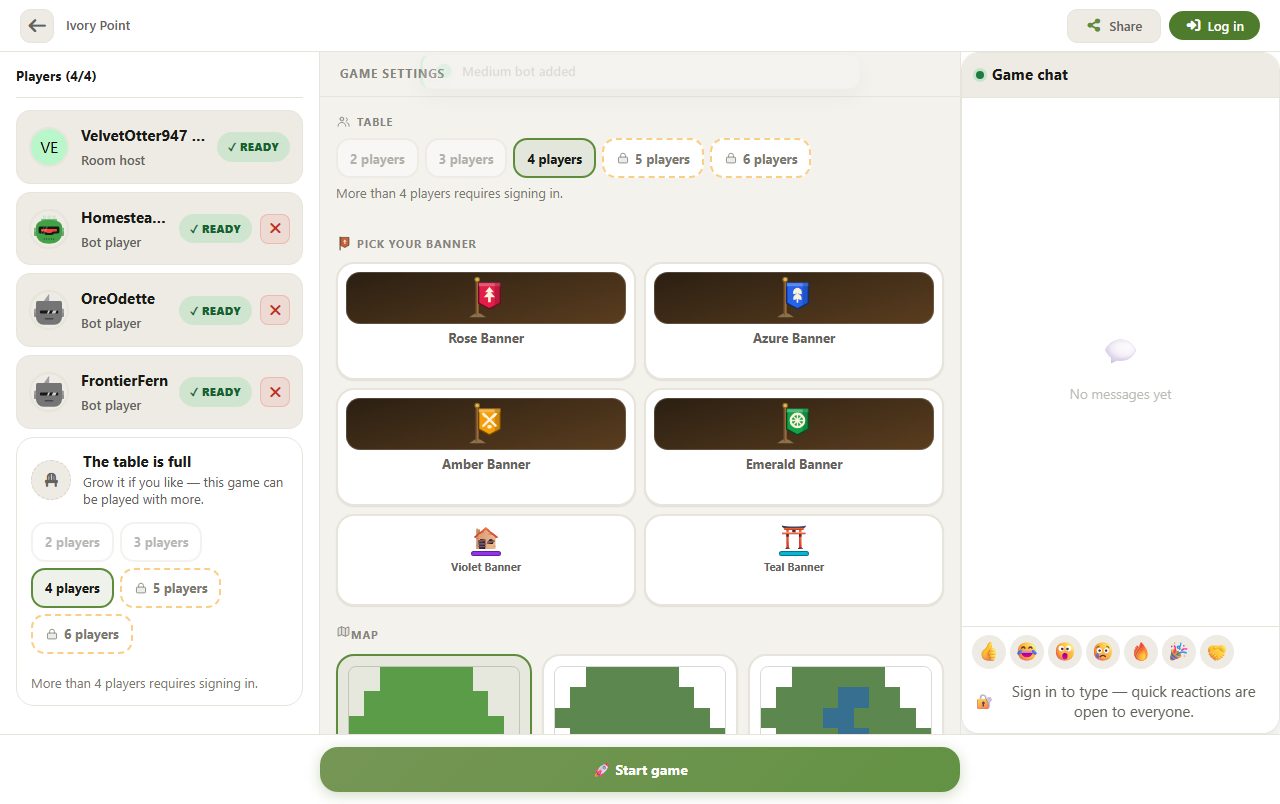
The board is built for the players who actually sat down, not for the room's seat count: 2–4 players get the small layout, 5–6 the large one. What each count changes is in how many players can play; for a two-seat bot duel see the two-player guide.
Easy, Medium, Hard: how do the bots actually play?
The level sets how well a bot plays and how it haggles. All three use only public information: hand sizes, buildings, Trading Posts and the visible score. They do not look at the cards in your hand or at hidden Victory Cards.
| Level | Opens offers? | Answers your offers | Bandit aim | Good for |
|---|---|---|---|---|
| Easy | Never | A plain yes or no: accepts an offer it can pay as long as it does not end up with fewer cards; never counters | Goes for hexes that cut production but barely looks at who is ahead; its choice is looser | Your first match, learning the turn |
| Medium | At most one offer per four of its own rounds; asks for the 1–2 cards that finish a build | Accepts when the offer does not lower the value of its hand; on a near miss it may counter by asking for one card more (or a different card it needs) | Cuts the most production, with some weight on whoever is ahead | Haggling practice, an even match |
| Hard | At most one offer per two of its own rounds; none at all while any other seat is within 2 points of the target | Pickier: refuses an offer that does not clearly strengthen its hand, and any offer from a seat within 2 points of the target; may counter asking up to two cards more; with several yeses it picks the seat furthest from winning | Concentrates on the one clear leader | Rehearsing endgame defence |
The three levels also share some habits. They put the Bandit where it really cuts production, avoid hexes their own buildings touch, and try not to send it back to its last few spots. Whoever is ahead is weighed by the same formula whether that seat is a human or a bot, so two bots do not gang up on you. A Hard bot also thinks differently when placing: it values goods it cannot produce and counts blocking a rival's strong corner. The Easy level is built so that someone in their first match can beat it.
What does a table of bots feel like?
When a bot sends you an offer, a card opens on your screen titled "<name> offers a trade": a Gives row and a Wants row, with Decline, Counter and Accept underneath. If you are slow to answer, the offer stays open for about 9 seconds (14 at most); then the bot picks a partner or withdraws it. Offers are rare: a bot keeps only one open at a time, and the gaps between them are limited so your screen does not fill up. When you make an offer, the bots answer in turn, within seconds. A bot's "no" does not prove an empty hand; the trading strategy post explains why.
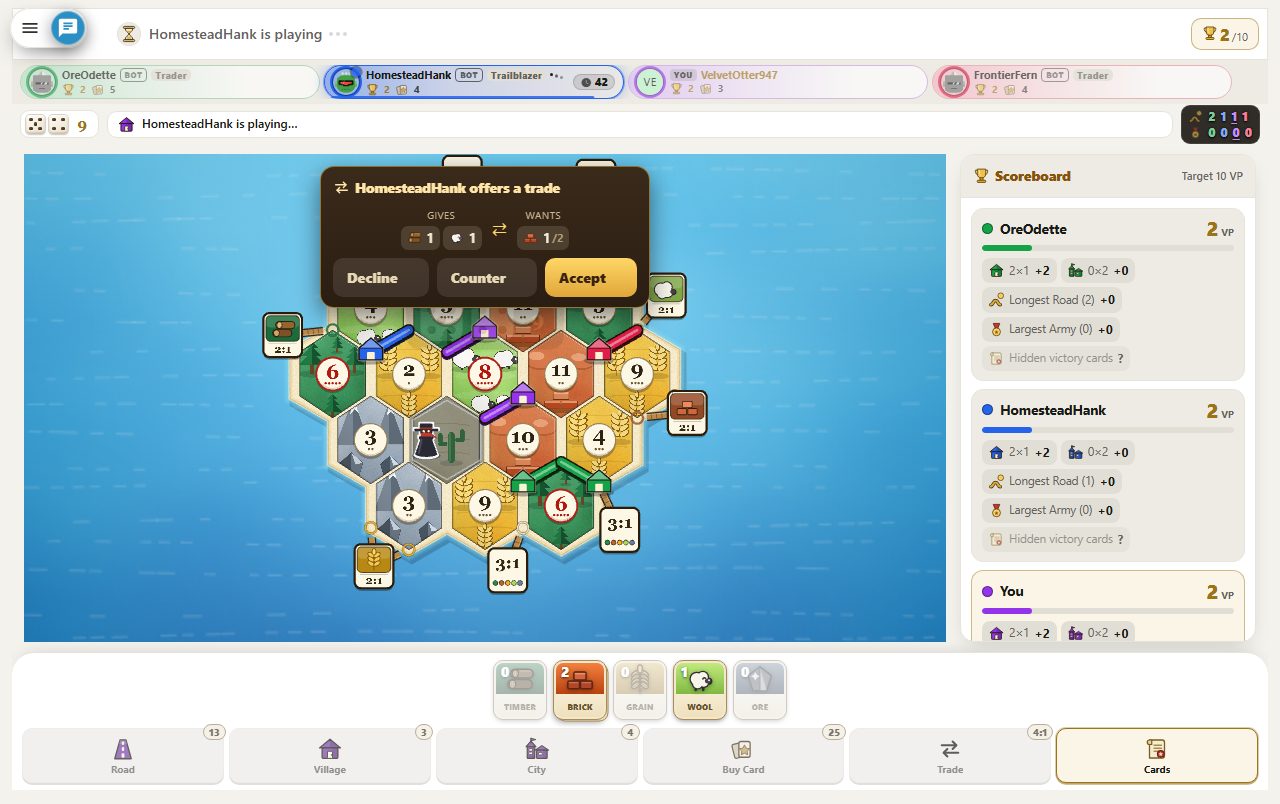
Every bot's seat chip carries a personality label next to BOT. The Trader plays for Trading Posts and the deal, the Trailblazer plays for ground (new islands, corners that close off a rival's corners), and the Settler saves toward strong numbers and Cities. A personality does not change strength: an Easy Trader is still an Easy bot, and the label only shifts what the bot values. The match and the seat number decide the personality, so bots of the same level can show up as different characters.
Practising with bots: four drills
- Learn the flow against Easy bots. With bots that never open an offer and only answer yes or no, you can focus on the order of roll, production, build, end turn, and on how a 1:1 trade changes your hand.
- Learn from a Medium bot's offers. A Medium bot asks for the 1–2 cards that finish a build, so its offer shows which build it is close to. Write your own offers the same way: ask only for the missing card (advice, not an engine rule).
- Work on the last two points against Hard bots. Within 2 points of the target a Hard bot opens no offers to you and accepts none of yours; if you are the one clear leader, you are the likely Bandit target. Rehearse taking the last points through the bank and your Trading Posts.
- Cut the luck, measure the decisions. The Balanced Deck dice system gives exactly six 7s in every 36 rolls; leave Hand Limit on a 7 at 7 cards and you practise shedding cards too; a Victory Target of 8 shortens the match. Other maps need a one-match ticket that the host buys with coins (a guest cannot buy one); Frontier Valley is always open.
Rating, the clock and the tutorial
A match with one human and bots is not rated: a rated match needs at least two humans at the start. A bot table is therefore a place to experiment without touching your rating. If a friend also sits down at the start (two humans plus bots), the match is rated; the steps are in the playing with friends guide.
The move clock defaults to 180 seconds, with six options from 90 to 600. If it runs out, a Medium-level bot plays the rest of your turn for you. There is also a step-by-step tutorial, but it does not start by itself: it is offered once when you first open the game, and you open it if you want it.
What to do now? Set up a bot table in Claimridge: pick Frontier Valley, add one Easy and one Medium bot, finish your first match alone, then raise the level. For where to put your first two Villages see the opening strategy, for every rule how to play, and for the genre overview settlement and resource-trading games.
CATAN® is a registered trademark of CATAN GmbH. Playgridia and Claimridge are not affiliated with, sponsored or endorsed by CATAN GmbH, its licensees or publishers. The name is used only to identify the game readers are searching for and to describe the genre; Claimridge is an independent game with its own rules, names and artwork.
Frequently Asked Questions
Can you play Catan against the computer?
The boxed game's official rules are in its own rulebook. In Claimridge, a separate, independent game of the same genre, you can play alone against bots: 1 human + 1 bot is already a match. No account or download is needed, and the game opens in your phone's browser.
How many bots can I add when playing alone?
A guest host can open at most 4 seats, so 3 bots; a signed-in host has 6 seats and up to 5 bots. A match needs at least 2 filled seats, so at least 1 bot. Every empty seat has Easy, Medium and Hard buttons, so you can mix levels.
What is the difference between Easy, Medium and Hard bots?
An Easy bot never opens an offer and answers a plain yes or no. A Medium bot asks for the 1–2 cards that finish a build and counters a near miss. A Hard bot is pickier, will not trade with a player within 2 points of the target, and aims the Bandit at the clear leader.
Can the bots see the cards in my hand?
No. Bots use only public information: hand sizes, buildings, Trading Posts and the visible score. They do not see hidden Victory Cards either. A bot's "no" does not prove an empty hand.
Is a match against bots rated, and what if my clock runs out?
A match with one human and bots is not rated; a rated match needs at least two humans at the start. The move clock defaults to 180 seconds, and if it runs out a Medium-level bot plays the rest of your turn. If your connection stays down for 120 seconds, a bot holds the seat and you can take it back.