How Many Players Can Play Catan? 2 to 6 Online
How many players can play Catan? The base box is for 3–4 players, and 5–6 players need an extension. Claimridge is a separate, independent game of the same genre — it has its own rules, names and artwork — and it seats 2 to 6 players in a single game, in the browser. Below you will find how the board, the bank and the card deck change as the table fills, who can open how many seats, and what fills the empty chairs.
What changes with each seat count?
The table shows what each seat count brings on Frontier Valley, the map that is always free, with default settings.
| Seats | Layout | Frontier Valley hexes | Bank (per good) | Development Cards | Default target | Host |
|---|---|---|---|---|---|---|
| 2 | Small | 19 | 19 | 25 cards | 10 points | A guest can host |
| 3 | Small | 19 | 19 | 25 cards | 10 points | A guest can host |
| 4 | Small | 19 | 19 | 25 cards | 10 points | A guest can host |
| 5 | Large | 30 | 26 | 36 cards | 10 points | Must be registered (signed in) |
| 6 | Large | 30 | 26 | 36 cards | 10 points | Must be registered (signed in) |
The first three rows are identical: tables of 2, 3 and 4 play on the same small layout. The real threshold sits between 4 and 5 — with the fifth seat the board grows from 19 to 30 hexes, the bank from 19 to 26 of each good, and the Development Cards deck from 25 to 36 cards. The default target is 10 points everywhere; what moves with the seat count is the target ladder.
On Frontier Valley the target choices are 6, 8, 10 and 12 at 2–4 players and 8, 10, 12 and 14 at 5–6. On most other maps the ladder also shifts up a step at a large table (on Bounty Plains and Gold Rush the lowest target at 5–6 players is 10). Archipelago and Two Shores are the exceptions: on both, the ladder is 8, 10, 12 and 14 at every seat count. If a target is requested that is not on the ladder, the game picks the nearest allowed value for the table that actually sat down.
The board is built for whoever actually sat down
Every map comes in two layouts: small for 2–4 seats and large for 5–6. The choice follows the number of players who actually sat down, not the seat count of the room: a 6-seat room that starts with 3 players plays on the small board, and the bank and card deck are set up to match. Terrain and number tokens are redealt every match. Seat order is shuffled among the players at the table too — the host does not have to move first.
So you do not need to settle how many people are coming before you create a room. A match needs only 2 filled seats to start, and the table is built for whoever is sitting at that moment.
Two, three and four players: the small table
A new room has 4 seats by default. On the small layout Frontier Valley is a single landmass: 19 hexes, 54 corners, 72 edges, one wasteland and 9 Trading Posts. At the default target the stock per player is 5 Villages, 4 Cities and 15 Roads, and 14 of the 25 Development Cards are Gunslingers. At three and four players you have 2 or 3 rivals to trade with; every rival sees every offer and can accept, decline or counter with their own price.
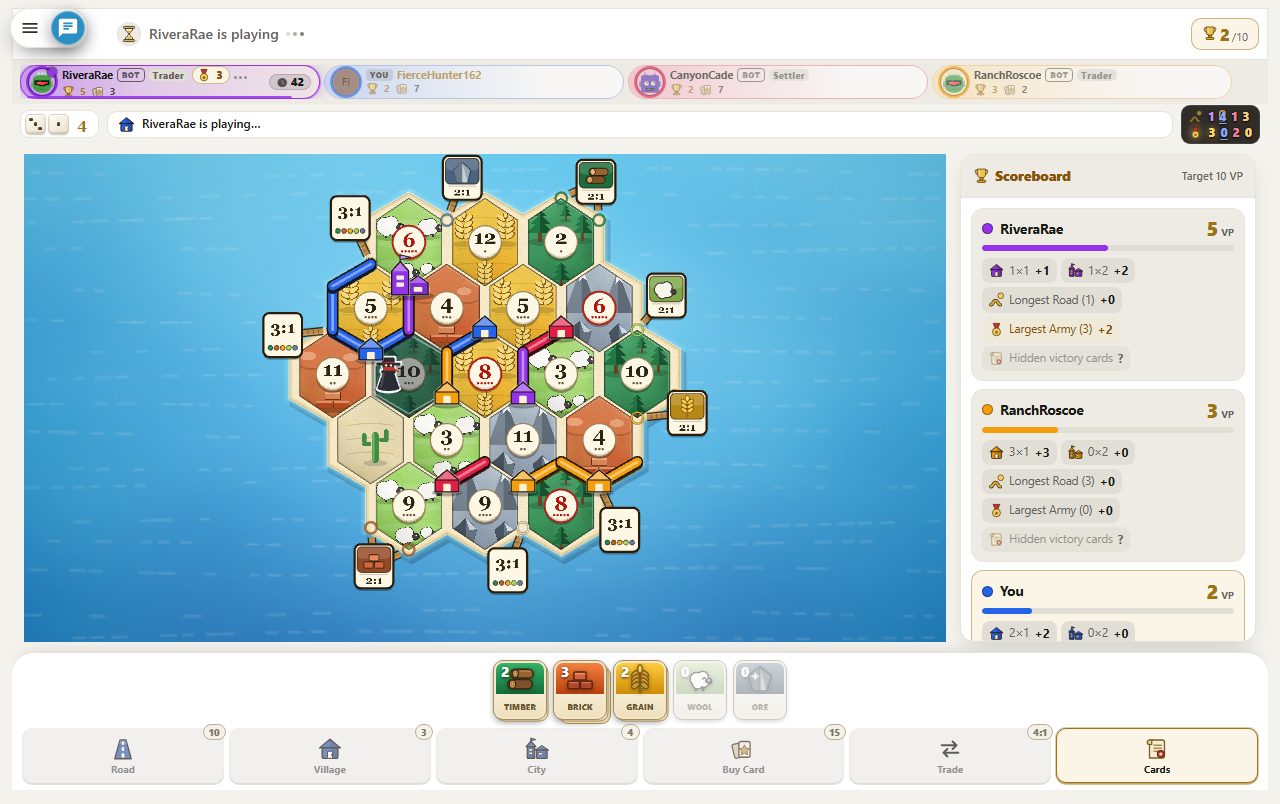
At a two-seat table the same 54 corners are shared by two players. With only one possible partner, an accepted offer settles on the spot, and the only person you can rob with the Bandit is your rival. The settings that suit a head-to-head — a short target, the Balanced Deck, the hand limit — are in the two-player duel guide.
Five and six players: the large table
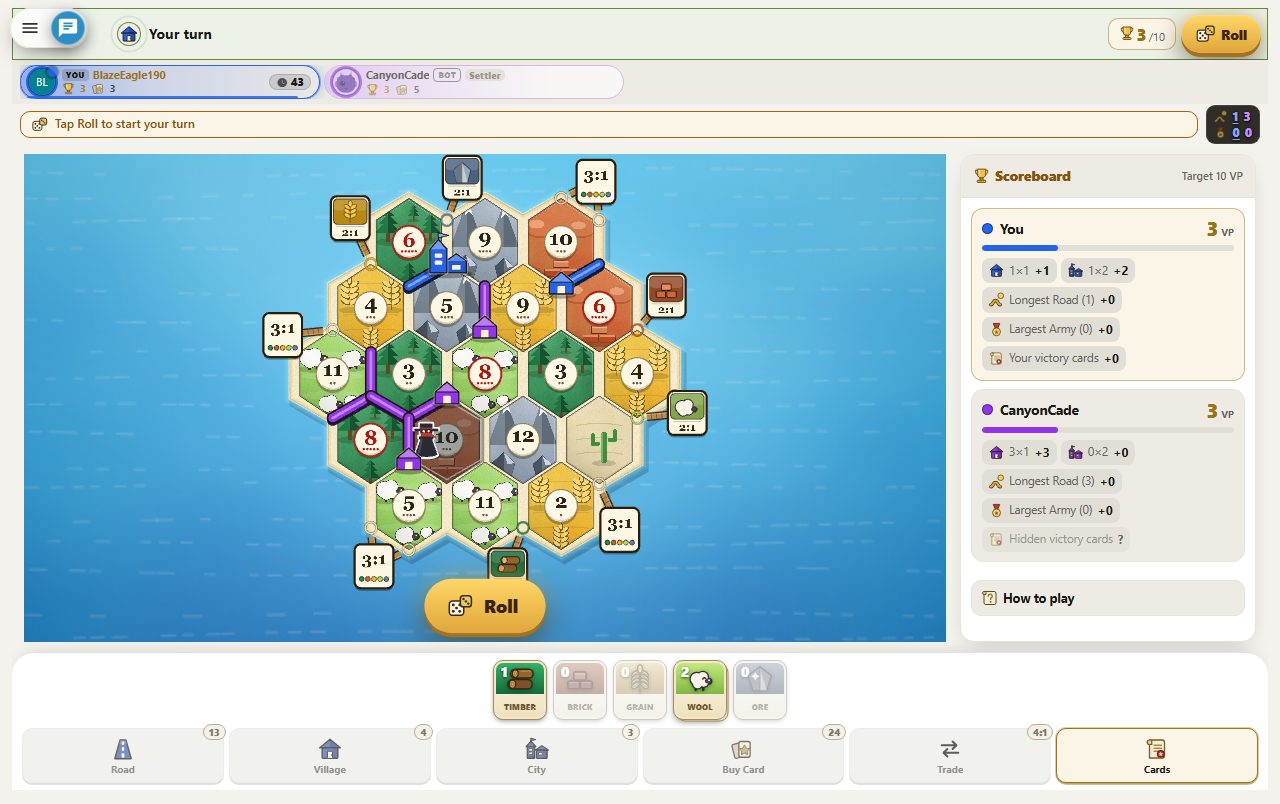
On the large layout Frontier Valley is 30 hexes and 80 corners, with two wastelands and 11 Trading Posts. At the default target the stock per player rises to 6 Villages, 5 Cities and 18 Roads. The bank holds 26 of each good and the Development Cards deck holds 36 cards (20 of them Gunslingers). There are six player colours; colours are picked in the waiting room, and a seat that picks none gets a random one.
A crowded table has two concrete consequences. The first is trading: five rivals see every offer you make, you can keep up to 3 offers open at once, and you choose who to settle with; offers close when your turn ends. The second is the 7: on average a 7 turns up about once every 3 rounds at a 2-seat table, once every 1.5 rounds at 4 seats and once a round at 6 (a round is one turn for every seat). With the Balanced Deck selected, every 36 rolls hold exactly six 7s.
On a 7, anyone over the hand limit discards half; the default limit is 7, so holding 8 or more cards is costly at a big table. If the 7s wear you down, the host can raise the limit to 9, 12 or remove it.
Empty chairs: bots and the host limit
A room you create as a guest opens at most 4 seats; seats 5 and 6 need a registered (signed-in) room owner. That is a limit of the room, not of the game: the game supports 2–6 seats. Bots fill the empty chairs: up to 3 in a guest-owned room and up to 5 in a registered host's room. A match needs at least 2 filled seats, so 1 human + 1 bot is enough. For friends, share the room link; if they have no account they can sit down as guests.
Bots come in three levels: Easy, Medium and Hard. An Easy bot never opens an offer; a Medium bot asks for the one or two cards that finish a build; a Hard bot will not trade with a seat that is within 2 points of the target. All three read only public information (hand sizes, buildings, points) and never look at a rival's cards. A match that does not start with at least two humans is not rated, so a single human with bots is a warm-up table. For the details see the guide to playing against bots; to bring friends to the table, the playing-with-friends guide.
Which table suits you?
For a first match a small table of 3–4 seats is a sensible start: one landmass, 19 hexes, 9 posts. If you love haggling and want every offer to draw more answers, try the large table of 5–6; the 7s come around more often, so agree on the hand limit up front. If you are two, there is a head-to-head on the small board, and if you are alone, a table of bots is waiting. The host also picks the move clock: 90, 120, 180, 240, 300 or 600 seconds, with 180 as the default.
The complete rules are in How to play Claimridge; to see similar options side by side, read the comparison guide, and for what sets each map apart, the six maps post. Frontier Valley is always free: open a room in Claimridge and choose how many will sit down.
CATAN® is a registered trademark of CATAN GmbH. Playgridia and Claimridge are not affiliated with, sponsored or endorsed by CATAN GmbH, its licensees or publishers. The name is used only to identify the game readers are searching for and to describe the genre; Claimridge is an independent game with its own rules, names and artwork.
Frequently Asked Questions
How many players can play Catan?
The base box is for 3–4 players, and 5–6 players need an extension. Claimridge is a separate, independent game and supports 2 to 6 players in a single game. The small layout is for 2–4 players and the large layout for 5–6.
Can I play Claimridge with 5 or 6 players?
Yes, but the person who creates the room must be registered (signed in); a room created as a guest has at most 4 seats. At a 5–6 player table Frontier Valley has 30 hexes, the bank holds 26 of each good and the Development Cards deck has 36 cards.
Can you play with three players?
Yes. Tables of 2, 3 and 4 use the same small layout: 19 hexes on Frontier Valley, 19 of each good in the bank and a 25-card deck. You can fill missing seats with bots; a match needs only 2 filled seats to start.
How does the player count change the board?
Every map comes in two layouts, small (2–4 players) and large (5–6 players). The choice follows the number of players who actually sat down, not the seat count of the room, so a 6-seat room that starts with 3 players plays on the small board. On the large layout Frontier Valley has two wastelands and 11 Trading Posts.
How many bots can I add to a table?
A guest-owned room can seat up to 3 bots, and a registered host's room up to 5. A match needs at least 2 filled seats, so 1 human + 1 bot is enough. Bots come in Easy, Medium and Hard levels, and a match that does not start with at least two humans is not rated.