Catan Map Layouts: Six Different Maps to Play Online
Catan map layouts, in short: in a game of the same genre the board does not have to follow one fixed pattern. Claimridge has six different maps, each comes in a small and a large layout, and terrain and number tokens are dealt fresh every match. Claimridge is a separate, independent game from Catan, with its own rules, names and artwork, and it opens in the browser with no sign-up.
What is re-dealt every match, and what stays fixed?
The host picks a map. Every map comes in two layouts: small for 2–4 seats, large for 5–6. The layout follows the number of players who actually sat down, not the room's seat cap: a 6-seat room that starts with 3 players plays the small board. How the bank and the Development Cards deck change at that threshold is in the how-many-players guide.
The shape and the contents are separate things. The outline of a layout is fixed per map and size; the terrain placed inside it is assigned at random every match, and the number tokens are dealt again. Some cells keep fixed terrain: the gold fields on Gold Rush, the isles on Archipelago, the far shore on Two Shores. Tokens run from 2 to 12 with no 7 token; 6 and 8 are the red ones.
Six maps side by side
Paired numbers read 2–4 seats / 5–6 seats. The target is the default victory-point goal.
| Map | Land hexes | Water hexes | Ships | Gold fields | Default target | Access |
|---|---|---|---|---|---|---|
| Frontier Valley | 19 / 30 | — | Off | — | 10 | Always free |
| Bounty Plains | 24 / 29 | — | Off | — | 12 | Ticket |
| Canyon Pass | 20 / 24 | 4 / 5 | Off | — | 10 | Ticket |
| Gold Rush | 22 / 27 | — | Off | 2 / 3 | 12 | Ticket |
| Archipelago | 20 / 25 | 22 / 24 | On | 3 / 4 | 10 | Ticket |
| Two Shores | 23 / 29 | 6 / 7 | On | 2 / 3 | 10 | Ticket |
Four maps on dry land
Frontier Valley
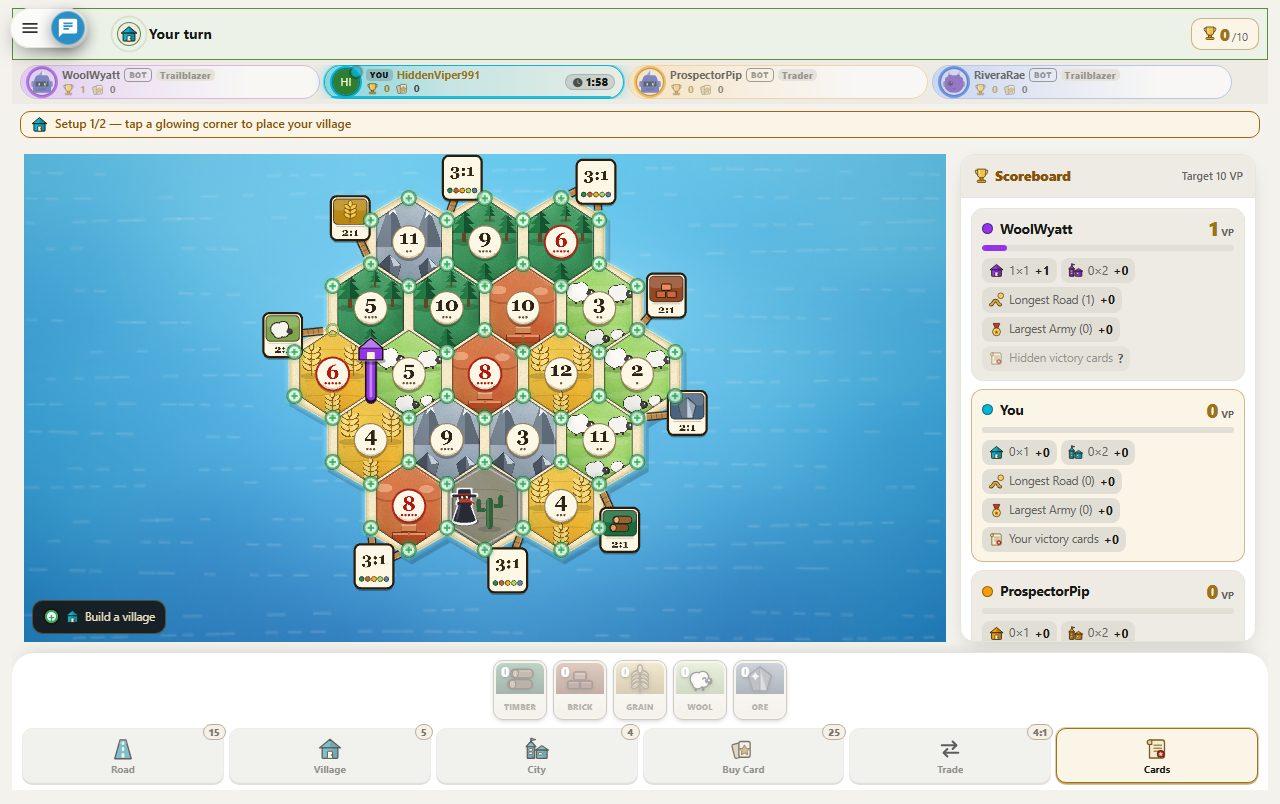
At 2–4 seats it is one landmass of 19 hexes: 54 corners, 9 Trading Posts, a single Wasteland, and a mix of 4 Forest, 4 Fields, 4 Pasture, 3 Hills and 3 Mountains. The base island of the boxed classic is 19 hexes too. At 5–6 seats it grows to 30 hexes, two Wastelands and 11 Trading Posts. No water, no gold, no ships. It is the only map that is always free.
Bounty Plains
24 hexes at 2–4 seats, 29 at 5–6, and no Wasteland at all: every hex pays somebody. The Bandit does not start on the board; it enters on the first 7 or the first Gunslinger card. The 2–4-seat layout holds three 6s and three 8s (two of each on the other small layouts). The default target is 12; at 5–6 seats the lowest option is 10.
Canyon Pass
Water splits the land in two: 20 land and 4 water hexes at 2–4 seats, 24 land and 5 water at 5–6. Ships are off, so the only way across is two land passes, one in the north and one in the south, each one hex wide. A road cannot run through a corner where a rival has a building, and the passes are narrow, so the corners there shape every crossing. Default target 10.
Gold Rush
22 hexes at 2–4 seats, 27 at 5–6. The gold fields sit in fixed spots (2 at 2–4 seats, 3 at 5–6), and Mountains outnumber Fields: 5 to 3 at 2–4 seats. A gold field pays a Nugget instead of a good: a Village takes 1, a City 2. On your own turn a Nugget cashes in for any one good the bank still holds, and if your second opening village touches a gold field, the opening hand includes Nuggets too. Gold fields are dealt non-6, non-8 numbers first; in a 3000-board measurement none came up red. Default target 12.
Two maps with ships
On Archipelago and Two Shores ships are on: a Ship costs 1 Timber + 1 Wool and forms a single network with your Roads. On both maps your two opening villages go on the largest island, and the first Village you plant on an island you have never settled is worth +2 points (Landfall). The target options are 8, 10, 12 and 14 at every seat count; the default is 10.
Archipelago
At 2–4 seats: a 12-hex main island with four 2-hex isles across open water, 20 land and 22 water hexes in total. At 5–6 seats the main island has 16 hexes, with 25 land and 24 water overall. All the gold fields are on the isles (3 at 2–4 seats, 4 at 5–6), so reaching a new island can pay +2 points and gold together.
Two Shores
Everyone starts on the home shore: 14 hexes at 2–4 seats, 17 at 5–6, with only 2 Mountains. The far shore lies one water row away and is fixed: 9 hexes at 2–4 seats (2 gold, 2 Mountains), 12 at 5–6 (3 gold, 3 Mountains). The first Village on the far shore is worth +2 points. In total 23 / 29 land and 6 / 7 water hexes.
Can two red numbers touch?
If two reds (6 or 8) land next to each other while the board is built, the deal is retried up to 40 times; if it still fails, the last attempt is kept. Keeping them apart is an effort, not a guarantee. For every map and layout we built 3000 boards and counted those where two reds touch:
| Map | 2–4-seat layout | 5–6-seat layout |
|---|---|---|
| Frontier Valley | 8 | 661 |
| Bounty Plains | 1422 | 822 |
| Canyon Pass | 0 | 641 |
| Gold Rush | 0 | 411 |
| Archipelago | 0 | 180 |
| Two Shores | 0 | 306 |
On most small layouts this is rare; on Bounty Plains roughly half of the small boards have a touching pair of reds. On the large layouts all six maps can produce one. The shared corner of two adjacent reds is worth 10 pips on its own (5 each); how to use that in an opening is in the opening strategy guide, and the odds behind the numbers are in the dice odds post.
How do you unlock the other maps?
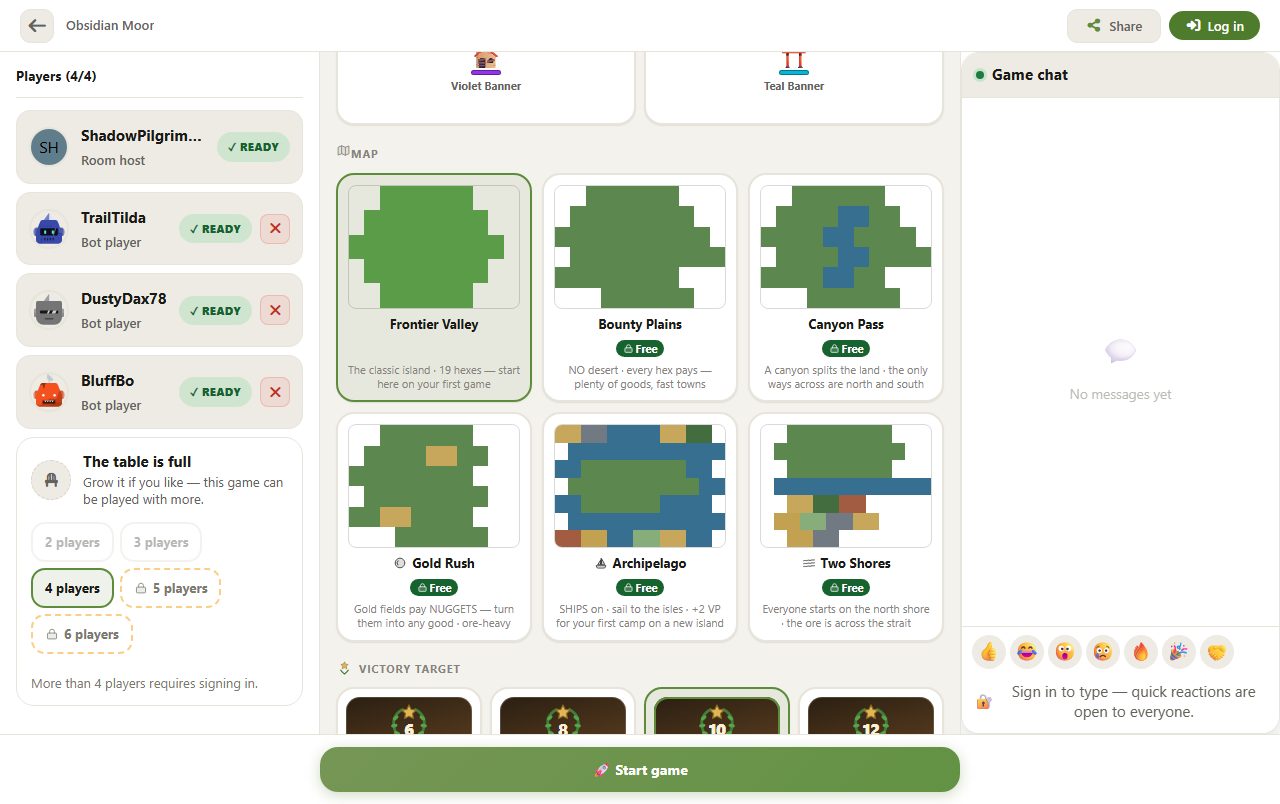
Only Frontier Valley is always free. The other five maps are played with a one-match ticket: the host buys it, and everyone at the table plays that map free. The ticket is bought with coins that are earned only by playing, and guest accounts cannot buy one. The map card in the room shows the current state: a locked card carries its price or, during a campaign, “Free”; it stays locked for a guest and a signed-in host can unlock it. The target, the hand limit and the dice system are not tied to a map; all of them are free to choose. To play with friends, see the playing-with-friends guide.
Which map should you start with?
For a first match, Frontier Valley: one landmass, no ships, 19 hexes at 2–4 seats, always free. After that, pick by the question you are curious about: crossing water on Archipelago or Two Shores, the wild Nugget on Gold Rush, narrow passes on Canyon Pass, a Wasteland-free board with a late Bandit on Bounty Plains. Map-specific opening plans are in the opening strategy, the wider picture of the genre is in the comparison guide, and every rule is in how to play Claimridge. A table with bots is a comfortable way to try a map; a match with one human is not rated. In the browser, no install: open a Claimridge room and pick your map.
CATAN® is a registered trademark of CATAN GmbH. Playgridia and Claimridge are not affiliated with, sponsored or endorsed by CATAN GmbH, its licensees or publishers. The name is used only to identify the game readers are searching for and to describe the genre; Claimridge is an independent game with its own rules, names and artwork.
Frequently Asked Questions
Does the map layout change every match?
In Claimridge, yes: terrain is assigned at random every match and the number tokens are dealt again. What stays fixed is the outline of each map and size, plus the terrain of a few cells such as Gold Rush's gold fields, Archipelago's isles and Two Shores' far shore. The layout size follows the number of players who sat down.
Is there a 6-player map?
The base box plays 3–4; 5–6 players need an extension. Claimridge is a separate, independent game, and all six of its maps have a large layout for 5–6 players; Frontier Valley has 30 hexes there. The host of a 5–6-seat room has to be signed in.
Which map is free, and how do I unlock the others?
Only Frontier Valley is always free. The other five maps open with a one-match ticket; the host buys it with coins and everyone at the table plays that map free. Coins are earned only by playing, and guest accounts cannot buy a ticket.
Can a 6 and an 8 touch?
They can. While the board is built the deal is retried up to 40 times to keep reds apart, then the last attempt is kept. In our measurement of 3000 boards at 2–4 seats, Bounty Plains had touching reds on 1422 of them and Frontier Valley on 8; the other four maps had none. At 5–6 seats all six maps produced them.
Are there maps with ships?
Yes: Archipelago and Two Shores. A Ship costs 1 Timber + 1 Wool and forms one network with your Roads. The first Village on an island you have never settled is worth +2 points, and both opening villages go on the largest island.