Catan Opening Strategy: Where to Place Your First Two Villages
Catan opening strategy, in short: in this genre a common plan is to put your first two villages on high-pip numbers and on as many different goods as you can. The examples come from Claimridge, a separate, independent game in the same genre with its own rules, names and artwork. The numbers are the game's own; the plans are advice, not rules.
Why the opening matters so much
Setup runs there and back: first seat to last, then last back to first, each placement being one Village plus a Road touching it. Seat order is shuffled at random, so you do not pick your place. The last seat builds both villages back to back; the first seat places first and last, then rolls first.
The second village carries the weight: it pays at once, one good per producing hex it touches (a Nugget for a gold field). The first village pays nothing, so your whole opening hand comes from around the second. The distance rule says every neighbouring corner of a village must be empty, so each placement removes corners for everyone. On Frontier Valley's 2–4-seat layout only 24 of the 54 corners touch three hexes; coastal ones touch one or two.
Read pips, not numbers
The tokens run from 2 to 12, with no 7; a 7 produces nothing. The dots under a token show how many of the 36 dice results make that number; 6 and 8 carry a red ring.
| Number | Pips | Out of 36 |
|---|---|---|
| 6 and 8 | 5 | 5 |
| 5 and 9 | 4 | 4 |
| 4 and 10 | 3 | 3 |
| 3 and 11 | 2 | 2 |
| 2 and 12 | 1 | 1 |
| 7 (no token) | – | 6 |
A corner is worth the pips of the (up to three) hexes it touches: 8, 5 and 10 is 5 + 4 + 3 = 12 pips. A gold field never gets a 6 or an 8. For the corner-income maths and the Balanced Deck option, see the dice odds guide.
One warning: red numbers staying apart is not guaranteed. The board is re-rolled up to forty times to separate 6s and 8s, then the last attempt stands. On Bounty Plains about half of the small boards have a 6 beside an 8; elsewhere it is rare on small boards and more common on 5–6-seat ones.
Fit five goods into two villages
Timber + Brick buys Roads and Villages (a Road is 1 Timber + 1 Brick; a Village adds 1 Grain + 1 Wool), so you spread to new corners. Grain + Ore buys Cities (2 Grain + 3 Ore) and Development Cards (1 Grain + 1 Wool + 1 Ore), so you grow where you stand; a City pays 2 goods per payout and is worth 2 points. The usual aim is for the two villages together to cover all five goods, or at least four, and to fill the gap through the bank, a Trading Post or a trade. With no Ore or gold in your opening, every City means trading for 3 Ore.
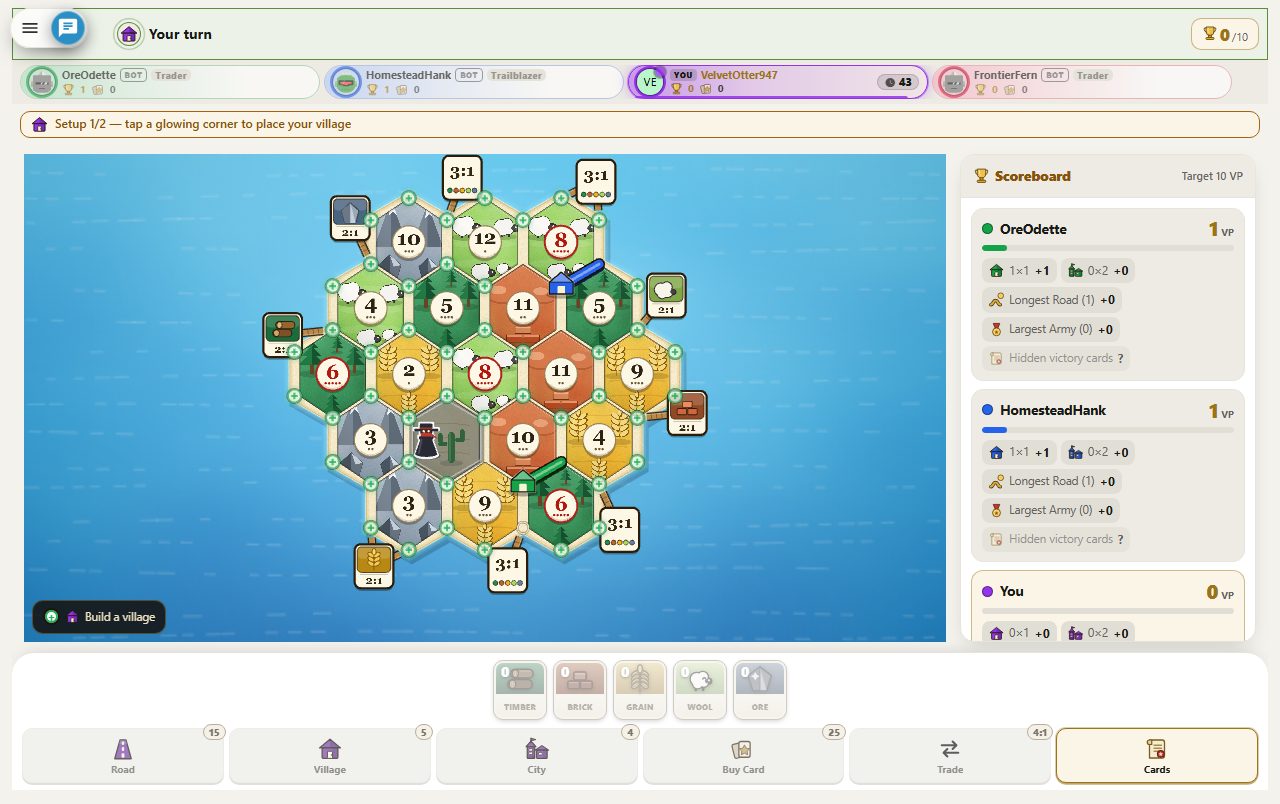
An example (invented numbers, real arithmetic): corner A touches Forest 8, Hills 5 and Pasture 10, which is 5 + 4 + 3 = 12 pips, paying Timber + Brick + Wool. Corner B touches Fields 6, Fields 5 and Mountains 9, which is 5 + 4 + 4 = 13 pips, but pays only Grain and Ore: one pip richer, yet you cannot build a single Road. Take A first, then a second village on Fields 9, Mountains 6 and Pasture 4 (12 pips): all five goods, and the second village pays Grain + Ore + Wool, exactly the price of a Development Card.
A Trading Post can be a plan
The bank trades any good 4:1. A generic Trading Post makes that 3:1, and a post for one specific good makes it 2:1 for that good; the best available ratio applies. A post works if you have a Village or City on either of its two corners. Every 2–4-seat board has 9 posts: 4 generic and one 2:1 for each good.
A common plan is a coastal corner touching the 2:1 post of a good you produce plenty of; if your goods are spread out, a generic 3:1 post is more flexible. Coastal corners touch two hexes at most on Frontier Valley, so a post usually costs you a little pip value.
Road direction and the distance rule
Your opening Road must touch the village you just placed, so its direction decides your next corner. A new Village can only go on a corner that touches your own road and has empty neighbours; if a rival building sits on a corner, your road cannot pass through it.
The distance rule cuts both ways: build right next to the corner a rival has been eyeing and it becomes illegal for them too, and the same can be done to your target. So ask not only how good a corner is but whether you reach it first, and point your opening road toward your third corner. Roads are limited (15 on Frontier Valley's 2–4-seat layout), and an unbroken run of at least 5, if it is the longest, earns +2 points from the Longest Road award; that is mid and late game, covered in the strategy guide.
Opening by map
The sum is the same everywhere, but each map's own rule steers the plan.
| Map | What changes the opening | A common plan |
|---|---|---|
| Frontier Valley | No water; 19 hexes at 2–4 seats, one Wasteland, 9 posts. Always free. | Pure arithmetic: pips, variety, post. |
| Bounty Plains | No Wasteland; the Bandit enters on the first 7 or the first Gunslinger. A 6 and an 8 can touch. Target 12 (6 Villages, 5 Cities, 16 Roads at 2–4 seats). | The shared corners of a touching 6–8 pair are worth 10 pips before the third hex, but the Bandit can go there; do not lean on one hex. |
| Canyon Pass | Water splits the land and ships are off; there is a one-hex-wide land pass in the north and one in the south. | A building or road in a narrow pass can cut a rival's expansion, or yours. |
| Gold Rush | 2 fixed gold fields at 2–4 seats, 3 at 5–6; Mountains outnumber Fields (5 to 3 at 2–4 seats); target 12. | A Nugget cashes in on your turn for any good the bank holds, so a gold corner closes a gap. |
| Archipelago | Ships on; both opening villages must go on the largest island. Your first village on another island is +2 points (Landfall). | Look for Timber and Wool in the opening: a Ship is 1 Timber + 1 Wool. |
| Two Shores | Ships on; you open on the home shore, which has only 2 Mountains. The far shore is one water row away (2 gold + 2 Mountains at 2–4 seats); your first village there is +2 points. | Ore has three routes: the home shore's 2 Mountains, trading, or a ship to the far shore. |
All six maps are in the map guide. Frontier Valley is always free; the other five open with a one-match ticket that the host buys with Coins, and everyone at the table plays free.
What to do with this
Ask three questions of every corner: how many pips, how many different goods, who gets there first? Try it against bots; a match with a single human is not rated, so it is a no-pressure warm-up. What trading can rescue is in trading strategy, the genre's wider frame in the comparison guide. In the browser, nothing to install: open a room in Claimridge and place your first two villages.
CATAN® is a registered trademark of CATAN GmbH. Playgridia and Claimridge are not affiliated with, sponsored or endorsed by CATAN GmbH, its licensees or publishers. The name is used only to identify the game readers are searching for and to describe the genre; Claimridge is an independent game with its own rules, names and artwork.
Frequently Asked Questions
Where should I place my first two villages?
In Claimridge and similar games a common plan is for the two villages together to cover all five goods, or at least four, with corners on high-pip numbers such as 6, 8, 5 and 9. A corner is worth the pips of the up to three hexes it touches. This is advice, and it shifts with the map and your seat.
Why are 6 and 8 considered good numbers?
Of the 36 results of two dice, five make a 6 and five make an 8, so each comes up 5 times in 36. Apart from 7, no total comes up more often. A 7 has no token and produces nothing.
Which village decides my starting hand?
The second one. The second Village, placed on the return leg of setup, pays one good for every producing hex it touches, plus one Nugget per gold field. The first village pays nothing.
Is the last seat an advantage?
Seat order is shuffled at random among the people who sat down, not creator-first. The last seat builds both villages back to back; the first seat places its first village before anyone, its second after everyone, and rolls first. Which is better depends on the table and the map.
Can my opening villages go on another island on Archipelago?
No. Both opening villages must go on the largest island. Your first village on another island is worth +2 points, but you reach it after setup by ship, and a Ship is 1 Timber + 1 Wool.