How to Play Match-3: Rules, Goals and Scoring Explained
How to play match-3: swap two neighbouring sweets so that three or more of the same kind line up in a row or a column; they disappear, new ones drop in from above, and you repeat until you finish the level's goal or run out of moves. This guide to match-3 rules uses Sugar Duel, a free match-3 race where every player gets the same board at the same moment, so each rule below is one you can try in a single round.
The swap: your only action
You pick a sweet and then a neighbour directly beside it, above it or below it. Diagonal swaps are refused. If the swap does not line up a match, the game rejects it and it costs you nothing: no move is spent and the board stays as it was. If it does make a match, the swap costs exactly 1 move from the level's budget.
One exception: a swap that involves a special sweet is always allowed, even when no match results. Specials get their own guide, match-3 special sweets and combos.
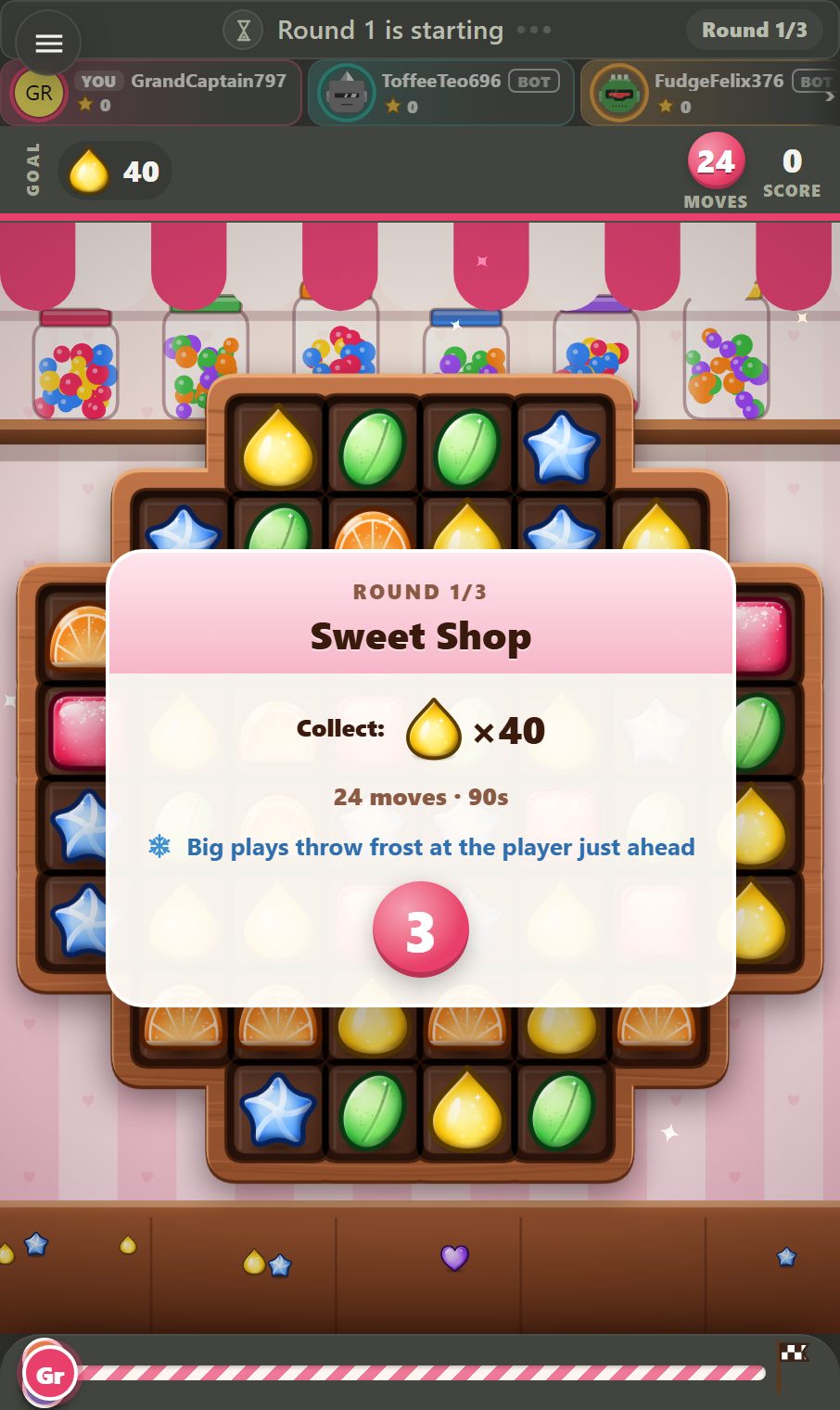
What counts as a match
- A run of 3 or more sweets of the same kind in a straight line, horizontal or vertical.
- A 2×2 square of one kind. This one is unusual: in Sugar Duel a square counts as a match too.
Each of the six sweet kinds has its own shape as well as its own colour (a cube, a half-moon slice, a drop, an egg, a star and a heart), so the board stays readable if you have trouble telling colours apart. Most levels use 5 kinds; a few use 6.
Longer matches do more than clear sweets. A line of exactly 4, an L or T shape, a line of 5 or more and a 2×2 square each leave behind a special sweet that fires later. Which shape gives which special is in the specials guide linked above.
Gravity, refills and chains
When sweets clear, the ones above fall to fill the gap and new sweets drop in at the top of the column. If the fall creates fresh matches, they clear on their own. That is a chain, and the game announces it with a word: "Chain 2!" for the second wave, and so on.
Chains cost nothing extra: the whole cascade comes from the one move you paid for. They also pay better, because each sweet is worth 20 points multiplied by the wave number it clears in. That is why experienced players aim for moves low on the board, where a fall can set off more of them. The full list of tactics is in match-3 tips and strategy.
The opening board never starts with a ready-made run or square, and it always has at least one legal move. If a board ever runs out of legal moves, it reshuffles itself with a "Shuffling!" message and no move is lost.
Goals: what you are actually trying to do
Clearing sweets is only the means. Each level has one or two goals, and the level card tells you which before the round starts.
| Goal | What you do |
|---|---|
| Collect | Clear a set number of sweets of the named kinds (the kinds are drawn fresh each round, and every player gets the same ones) |
| Snow | Melt every layer of snow lying under the sweets; each clear on a snowy cell melts one layer |
| Biscuits | Break every biscuit; a match next to one, or a blast, damages it, and some take two hits |
| Cherries | Bring a set number of cherries down to the bottom of their column; cherries are never matched |
| Score | No finish line: whoever has the most points when moves or time run out comes out ahead |
A level can combine two goals, such as snow plus biscuits. Frozen sweets (ice) cannot be swapped or moved until a match that runs through them, or a blast that hits them, breaks the ice; the sweet then stays in place.
Moves and the clock
Every level gives you a move budget, between 20 and 26 moves depending on the level. There are also two clocks. The room's round clock is 60, 90 or 120 seconds, and 90 is the default. A race level also has a closing window: when the first player completes the goal, the clock for everyone else is cut to at most 20 seconds. "At most" matters, because if less than 20 seconds were left anyway, you keep the shorter time.
There is no clock on an individual move, so you can think for as long as the round clock allows. If you stall, after 5 seconds without a swap a suggested move glows as a hint.
From round to match
In Sugar Duel the match-3 puzzle becomes a race, because 2 to 6 players, humans and bots, play the same level at the same moment. There are no turns to wait for.
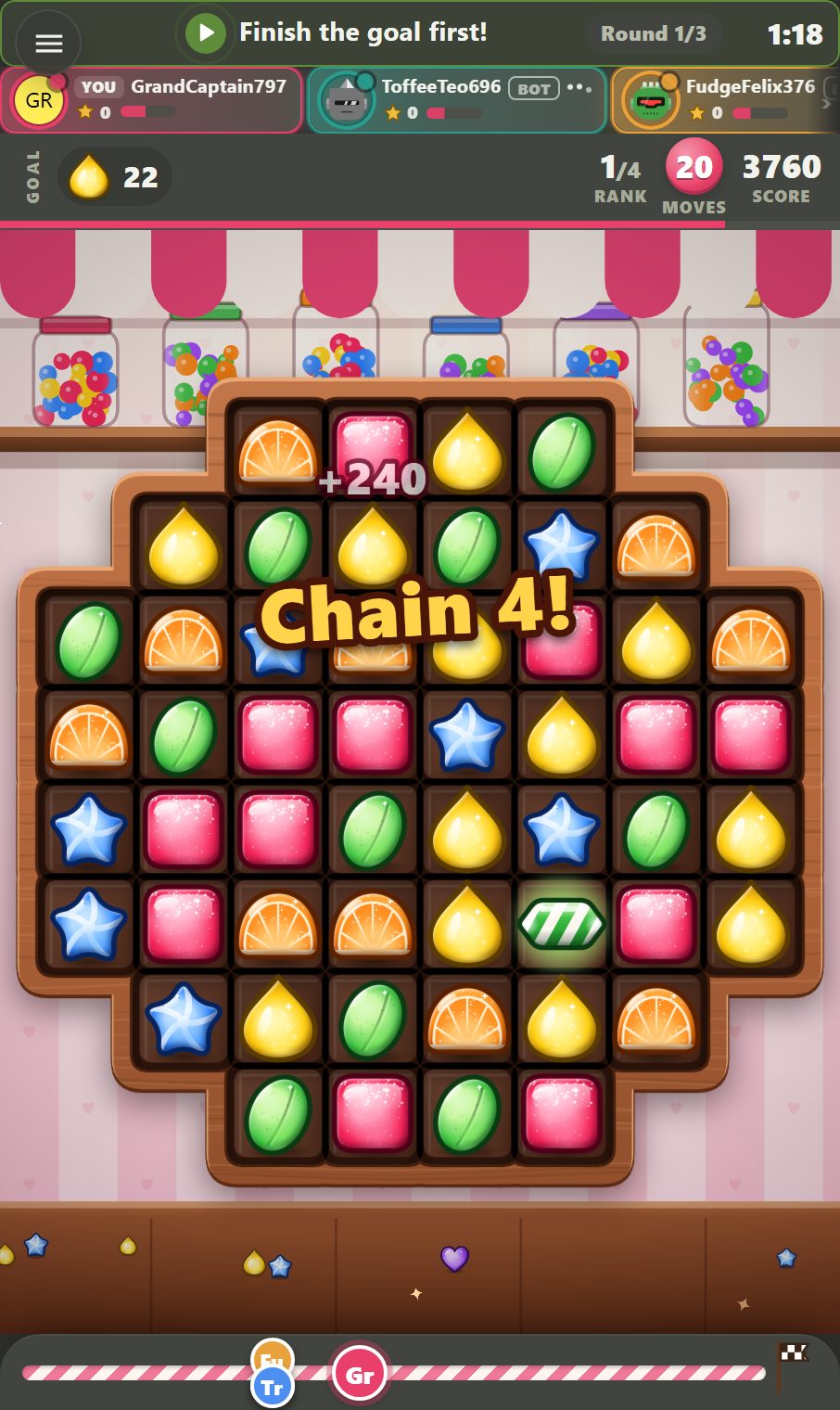
A round ends when everyone has finished, when the clock hits zero, or when the closing window runs out. Places are decided like this: in a race level, players who completed the goal rank first by finish time, then everyone else by goal progress, then by score. In a score level, it is simply points. Each place earns stars.
| Place | Stars |
|---|---|
| 1st | 10 |
| 2nd | 7 |
| 3rd | 5 |
| 4th | 3 |
| 5th | 2 |
| 6th | 1 |
A match lasts 1, 3 or 5 rounds (3 by default). After the last round, whoever holds the most stars wins; ties are broken by total points across the rounds.
Your first round
Start with a short one: pick the one-round option, then look at the level card before the countdown ends. Read the goal first, the move budget second. Then play by one habit: make the move that serves the goal, not the one that clears the most sweets. A game that rewards speed punishes you for admiring cascades. When you are ready to see it in action, play Sugar Duel free in your browser, and once the basics feel natural, read the special sweets guide.
Frequently Asked Questions
How do you play a match-3 game?
You swap two neighbouring sweets so that three or more of the same kind line up in a row or column. Matched sweets disappear, new ones fall in, and any new matches that form clear on their own. You keep going until you meet the level goal or run out of moves.
Does a swap that makes no match cost a move?
In Sugar Duel it does not: the swap is refused and nothing changes. Only a legal swap costs 1 move. A swap that involves a special sweet is always allowed.
What counts as a match in Sugar Duel?
A run of three or more sweets of the same kind in a straight line counts, and so does a 2x2 square of one kind. Longer or differently shaped matches leave a special sweet behind.
How many moves and how much time do I get?
Each level has a move budget of 20 to 26 moves. The round clock is 60, 90 or 120 seconds, with 90 as the default. After the first player finishes a race level, the others get at most 20 more seconds.
How is a match-3 round won in Sugar Duel?
In a race level the first players to finish the goal rank highest, followed by the others by progress and score. In a score level the most points wins. Places earn stars, 10 for first down to 1 for sixth, and the most stars after all rounds wins the match.
Is Sugar Duel free to try?
Yes, you can play it in your browser. Every world is free, and a room seats 2 to 6 players with bots filling empty seats.