Match 3 Tips and Strategy: 8 Habits That Win Rounds
The best match 3 tips and strategy come down to three habits: read the goal before your first swap, build the biggest shape the board offers, and watch the player ranked just above you. Here is how that plays out in Sugar Duel, where every player gets the same board at the same moment and the finishing order decides the stars.
1. Read the goal before you swap
Each level has one or two goals, and a level is a race unless every goal is a score goal. You get 20 to 26 moves, and only a legal swap spends one. A swap that lines up nothing is refused and costs nothing, so a wasted move is always a legal swap that did not move you toward the goal.
| Goal | What counts | What to prioritise |
|---|---|---|
| Collect | N sweets of each named colour | Matches in those colours; other colours only if they build a special |
| Snow | Every snow layer under the pieces | Clear cells that still show snow; each clear melts one layer |
| Biscuits | Break every biscuit | Matches next to a biscuit, or any blast; a biscuit takes one or two hits |
| Cherries | Bring N cherries down | Clear the sweets beneath a cherry until it sits in the lowest slot of its column |
| Score | Most points when time or moves run out | Cascades, specials and combos |
2. Play low, let the refill work
New sweets drop in from the top, so a match at the bottom shifts the whole column and can set off follow-up matches without spending a move. A piece cleared in wave 2 is worth 20 x 2, in wave 3 it is worth 20 x 3, and so on. The in-game hint also favours moves low on the board. When two moves look equal, take the lower one.
3. Look for the five before the four
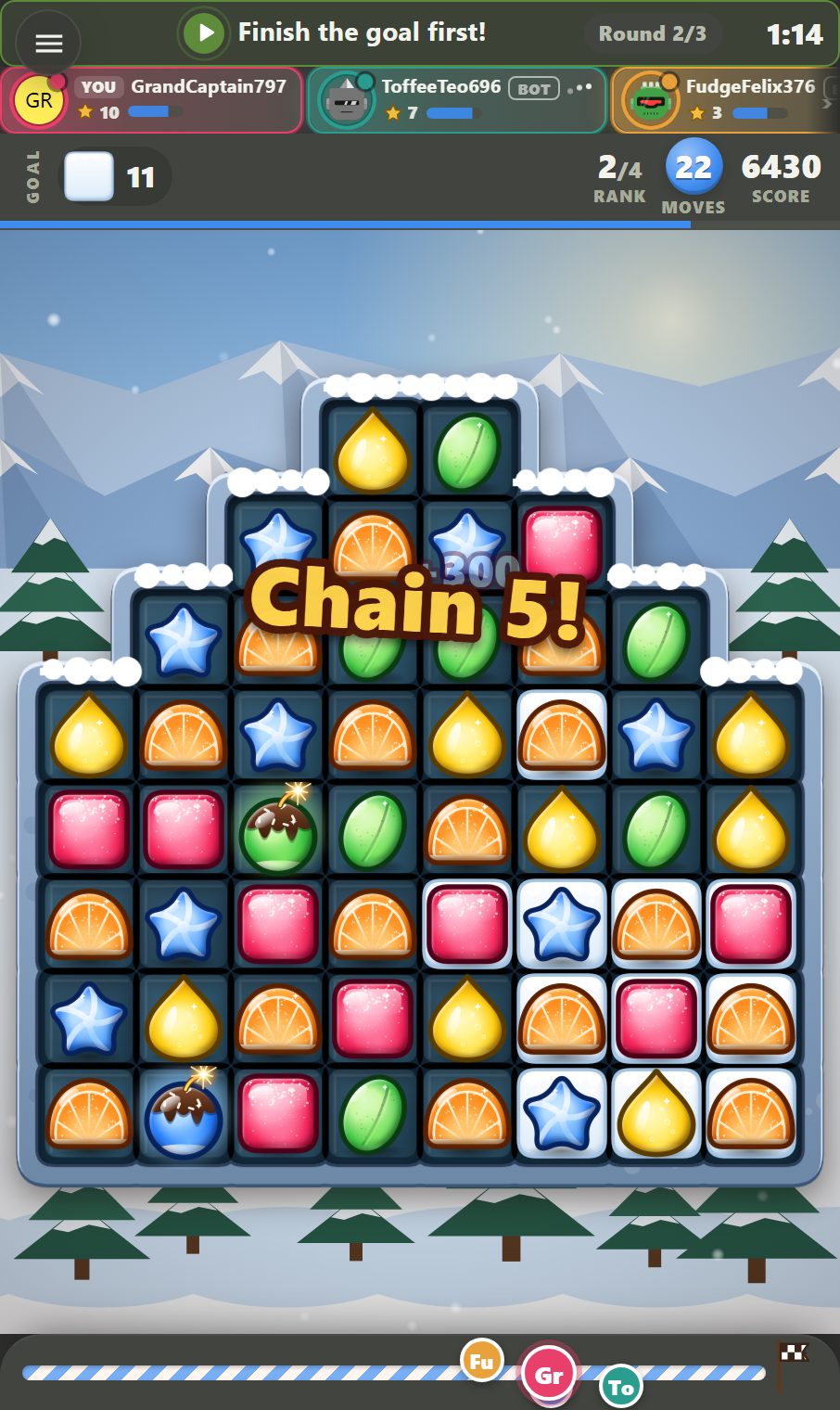
Shapes are not equal. A run of five or more makes a Rainbow, a row crossing a column (an L, T or plus) makes a Truffle, a run of exactly four makes a Cane, and a 2x2 square of one colour makes a Bee. Before you take an easy three, check whether you can stretch it to five. One thing to remember: a Cane clears across your line, so a horizontal four makes a column Cane. The full list is in the special sweets and combos guide.
4. Use specials in any direction
A special does not need to be matched to fire. Swap it with a neighbour in any direction and it goes off where it lands, even if the swap lines up nothing, and that swap is always allowed. That makes a special a goal tool: park a Cane beside the last snow in a line, or let a Bee pick its own target. A Bee prefers a biscuit, then a frozen sweet, then snow, then the sweet under a cherry, then a colour you still need. It costs one move, like any swap.
5. Save two specials for a combo
Two specials swapped into each other make a combo, and combos are the biggest plays on the board: two Rainbows clear the entire tray, two Truffles blast a 5x5 area, a Cane and a Truffle clear three rows and three columns. If your move budget allows, hold a special until a second one appears beside it instead of spending it on a small clear. The exception is a race level with few moves left: fire what you have.
6. Race rounds and score rounds are different games
In a race round, completing the goals first ranks you first, and the rest are ordered by progress, then by score. Speed and efficiency beat raw points. In a score round there is no finish line: the highest score wins, so chase cascades and combos and use every move. When the first player finishes a race level, the round clock is cut to up to 20 seconds from that moment (less if the round has less time left), so go for the goal that is closest to done. Score rounds have no closing window.
7. Frost: know who it hits and when
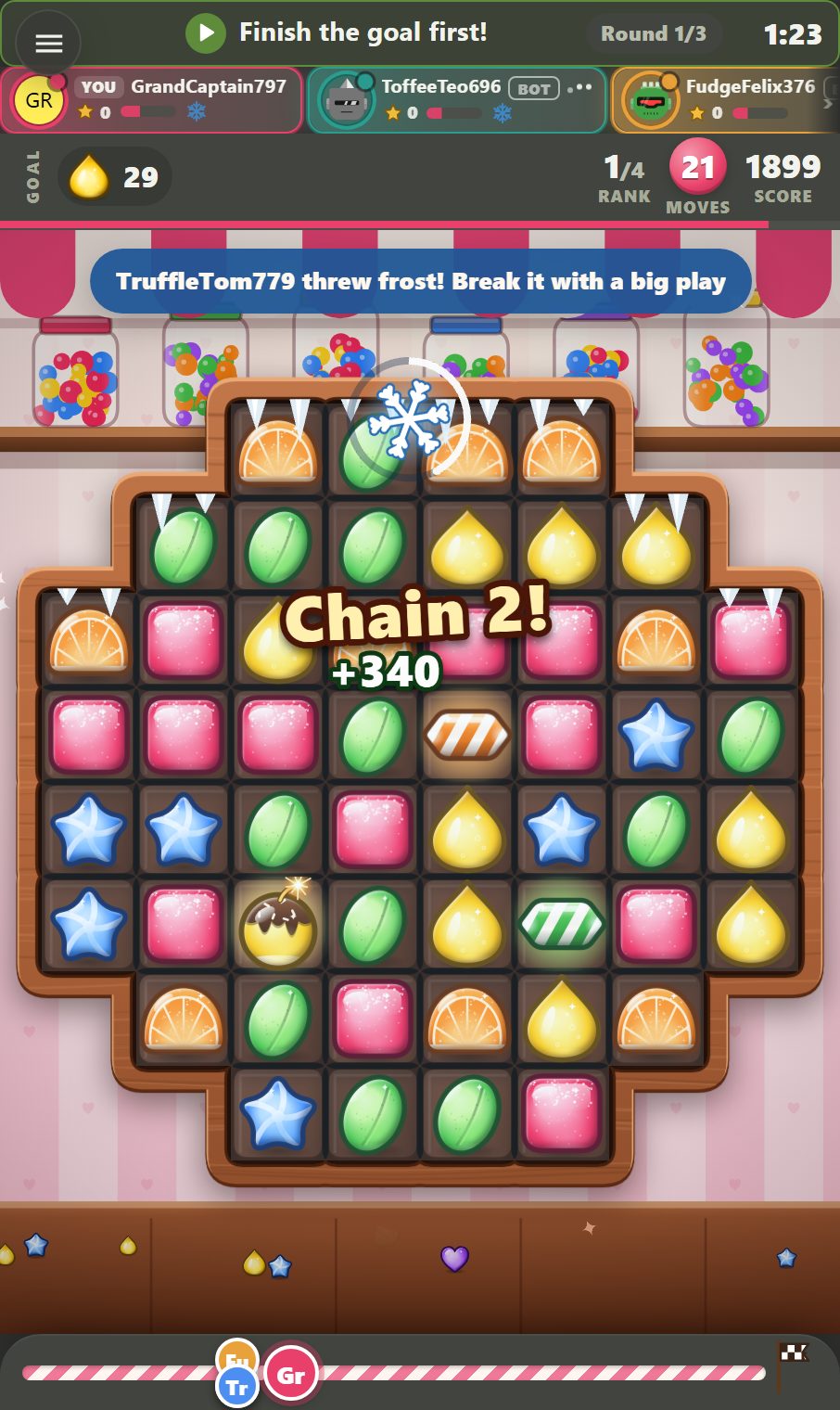
Frost is the only way two boards touch. A big play (a combo, a fired Rainbow or a cascade of four waves) throws three frozen sweets; two specials fired in one move throw two. It always goes to the player ranked just above the thrower, and the leader throws at nobody. The throw hangs over the target board for 3 seconds before it lands. If frost is coming at you, make a big or small play inside that window: it shatters the oldest incoming throw instead of throwing one of your own. You do not get both, so choose. A frozen sweet cannot be swapped, but any match through it breaks the ice and the sweet stays. A board never holds more than 8 frozen sweets.
8. Use the hint, and know the stakes
If you stall for 5 seconds, a suggested swap glows. It prefers a legal swap involving a special, then a move low on the board. Treat it as a second opinion, not an order. Then remember what you play for: places pay 10, 7, 5, 3, 2 and 1 stars, and the match goes to the most total stars. Climbing one place in a round is worth more than a few extra points. Ready to try it? Start a match on Sugar Duel, then read how the room works in the guide to playing with friends.
Frequently Asked Questions
What is the best match 3 strategy?
Read the goal first, then play for the biggest shape the board offers. A run of five makes a Rainbow, an L or T makes a Truffle, a run of four makes a Cane and a 2x2 square makes a Bee. Moves are limited to 20 to 26 per level, so each swap should move you toward the goal.
Should I play at the bottom or the top of the board?
Playing low is usually better. A match near the bottom shifts the column above it and can trigger cascades that cost no move. Cascade pieces score 20 times the wave number, so later waves pay more.
How do I stop frost in Sugar Duel?
Frost hangs over your board for 3 seconds before it lands. If you make a big play in that window (a combo, a fired Rainbow or a four-wave cascade) or a small one (two specials in one move), your play shatters the oldest incoming throw instead of throwing frost of your own.
Does a special sweet have to be matched to work?
No. Swap a special with a neighbour in any direction and it fires where it lands, even if the swap lines up nothing. It still costs one move, but it is always a legal swap.
What is different about a score round?
A score round has no finish line. The highest score when time or moves run out wins, and the closing window of up to 20 seconds after the first finisher does not apply. In a race round, the players who complete the goal first rank first.