Match 3 Special Sweets and Combos: All 10 Explained
A match 3 combo happens when you swap two special sweets into each other, and Sugar Duel has four specials and ten combos to learn: Cane, Truffle, Rainbow and Bee, from a Cane + Cane cross to a Rainbow + Rainbow that clears the whole tray. This guide covers how each special is made, what it does, what every pair does, and how chains and frost fit in. If you still need the basics of swapping and matching, start with how to play match 3.
The four special sweets and how to make them
A special is created when a match is bigger than the plain three. The shape you draw decides which one you get, and when shapes overlap the engine checks them in a fixed order: a run of 5 or more first, then an L, T or + shape, then a run of exactly 4, then a 2x2 square.
| Special | How you make it | What it does |
|---|---|---|
| Cane | A line of exactly 4 | Clears a whole row or column |
| Truffle | An L, T or + shape (a row and a column sharing one sweet) | Clears the 3x3 area around it |
| Rainbow | A line of 5 or more | Swapped with a sweet: clears every sweet of that colour |
| Bee | A 2x2 square of one colour | Clears a plus shape, then flies to one target and clears it |
Making a special also scores: a Cane is worth 60 points, a Truffle 100, a Rainbow 200 and a Bee 60.
The Cane: mind the orientation
This is the one that trips people up. A Cane points across the line you made. A horizontal line of 4 creates a column Cane, which clears the whole column. A vertical line of 4 creates a row Cane, which clears the whole row. If you are planning a Cane to clear a particular row, draw a vertical four, not a horizontal one.
The Bee: it chooses its own target
After clearing the plus around itself, the Bee flies off and clears one more sweet, and it does not pick at random. It prefers targets in this order: a biscuit, then a frozen sweet, then snow, then the sweet under a cherry, then a sweet in a colour you still need for a collect goal, then any sweet. Ties are broken by the round seed. In practice the Bee is a goal-finisher: on a biscuit or snow level it heads straight for the blocker.
Any direction, and what it costs
A special can be swapped with any neighbouring sweet, whether or not the swap lines up a match, and it fires where it lands. Slide a Cane sideways, up or down and it goes off. That still counts as a swap, so it uses one of your moves. A plain swap that makes no match is the opposite case: it is refused and costs nothing, so you can test ideas freely, as long as no special is involved. A special that is already part of a run you make is not fired twice.
All ten combos
Swap two specials into each other and you get a combo with its own name flashed on screen. Here are all ten.
| Swap | On-screen name | Effect |
|---|---|---|
| Cane + Cane | Cross! | A row and a column at the landing cell |
| Cane + Truffle | Mega Cross! | Three rows and three columns centred on the landing cell |
| Truffle + Truffle | Mega Blast! | A 5x5 blast |
| Rainbow + Rainbow | The Whole Tray! | The entire board |
| Rainbow + Cane | Rainbow Canes! | Every sweet of the Cane colour becomes a Cane and fires |
| Rainbow + Truffle | Rainbow Truffles! | Every sweet of that colour becomes a Truffle and fires |
| Rainbow + Bee | Rainbow Bees! | Every sweet of that colour becomes a Bee and fires |
| Bee + Bee | Bee Swarm! | One bee, three flights |
| Bee + Cane | Cane Bee! | The Bee carries the Cane to its target and sets it off there |
| Bee + Truffle | Truffle Bee! | The Bee carries the Truffle to its target and sets it off there |
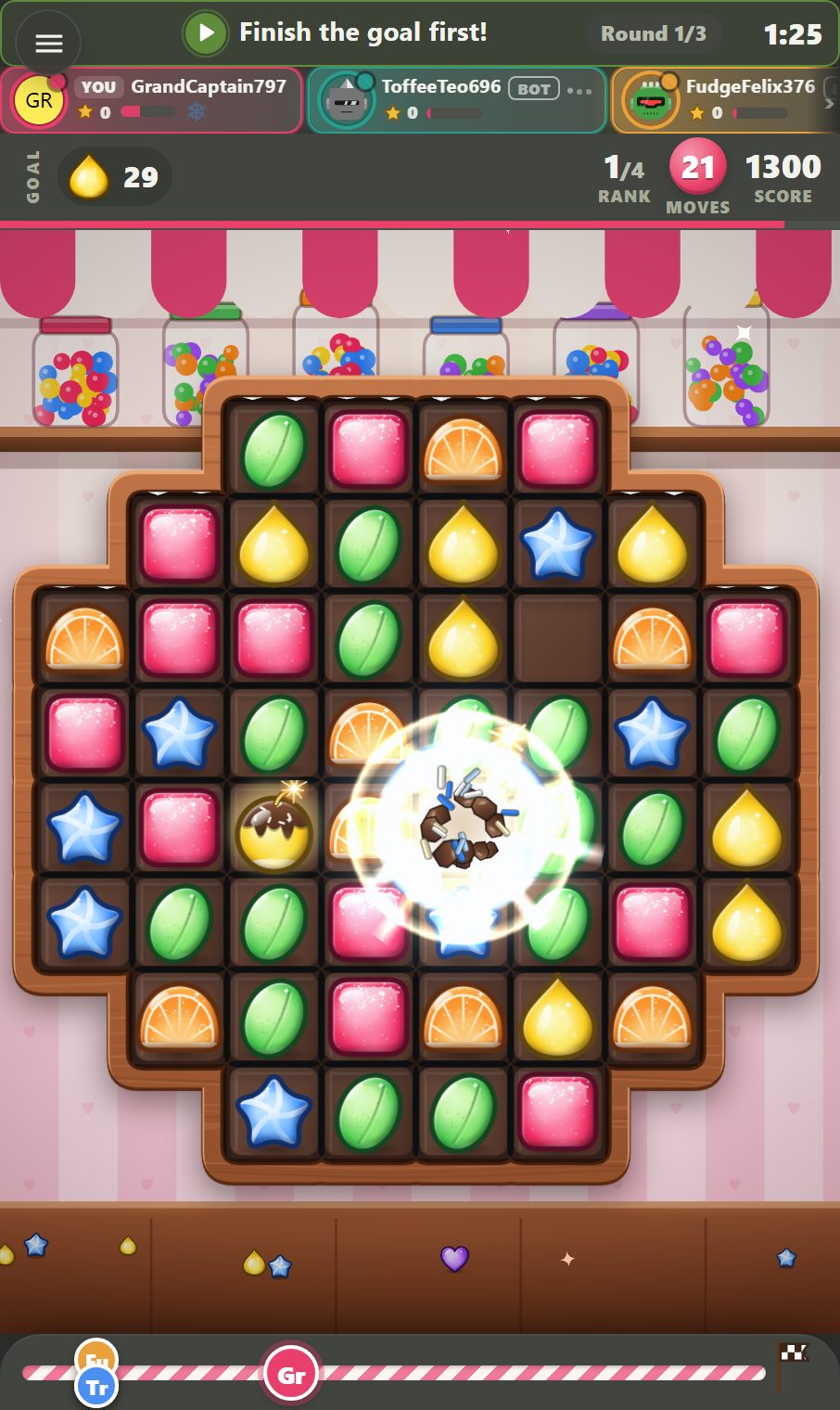
That chain reaction is worth planning around. A Rainbow that is hit by a blast, rather than swapped, clears whichever colour is most common on the board.
Chains and points
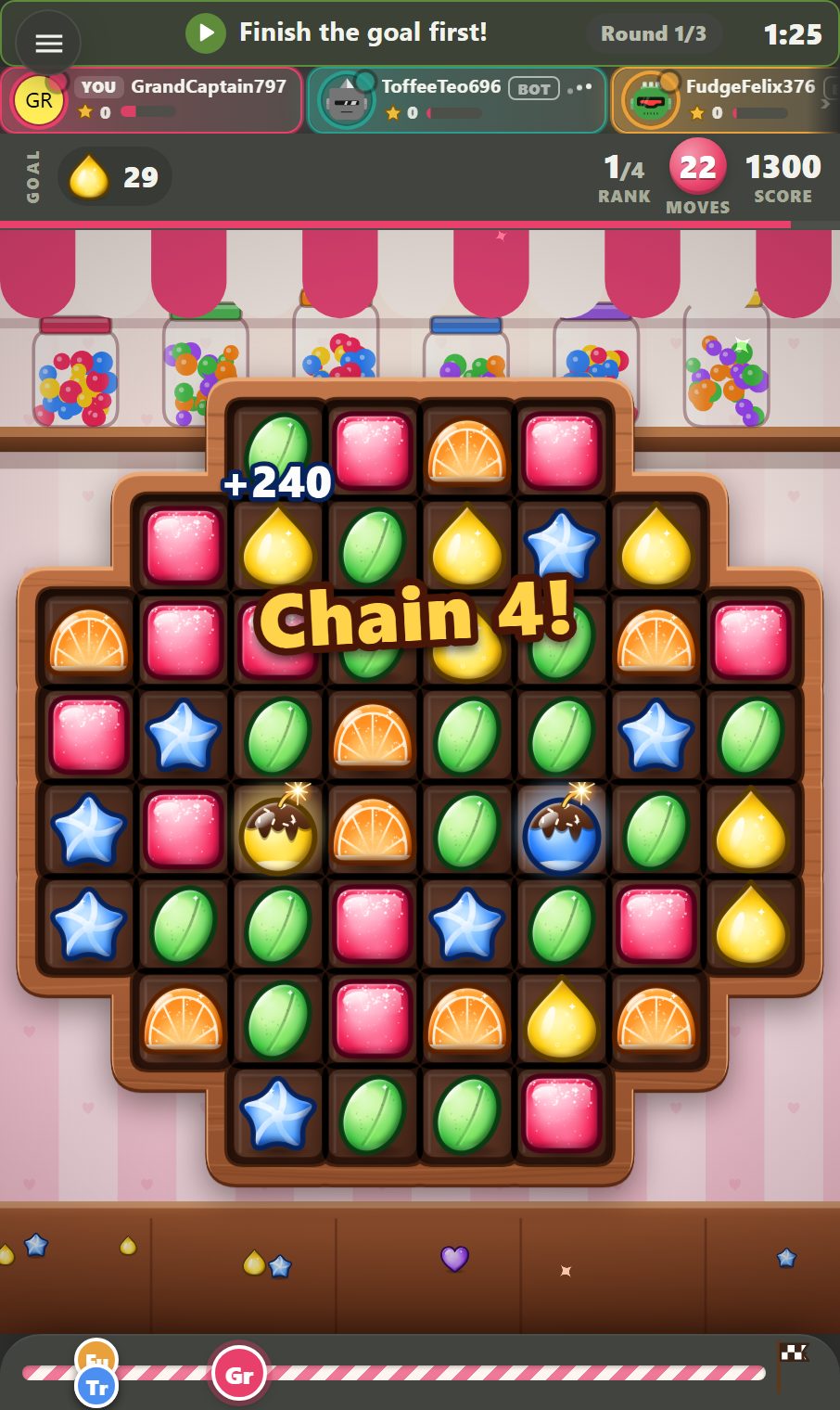
One swap can run several waves: sweets clear, new ones drop in, and if those line up they clear too. From the second wave the board flashes "Chain 2!", then "Chain 3!" and so on. Ordinary sweets score 20 points multiplied by the wave number, so a sweet cleared in Chain 3 is worth three times one cleared in the first wave. Cascades and combos from a single swap cost no extra moves, which is why a swap that triggers several waves is the cheapest way to score.
What counts as a big play (frost)
With the frost option on, which is the default, a big play sends frost to the player ranked just above you. A big play is any of these: a combo of two specials, a Rainbow going off (even one set off by another special), or a cascade of 4 or more waves. It freezes 3 sweets on their board. Setting off two or more specials in one move is a smaller play and freezes 2. Frozen sweets cannot be swapped and do not fall until a match or blast breaks the ice. The frost hangs over their board for 3 seconds first, and if they make a big or small play of their own in that time, it shatters the oldest incoming frost instead of throwing one. Your specials are both your goal tools and your defence.
Where to practise
Everything above works the same in every world, and everyone at the table gets the same board, so a combo you find is one your rivals could have found too. Once the specials feel natural, read match 3 tips and strategy for when to save them, then try a live round on the Sugar Duel page.
Frequently Asked Questions
How do you make a special piece in match 3?
In Sugar Duel, a line of exactly 4 makes a Cane, an L, T or + shape makes a Truffle, a line of 5 or more makes a Rainbow, and a 2x2 square of one colour makes a Bee. If shapes overlap, a run of 5 wins first, then the L or T shape, then the run of 4, then the square.
Which way does a Cane clear?
Across the line you made. A horizontal line of 4 creates a column Cane that clears the whole column, and a vertical line of 4 creates a row Cane that clears the whole row.
Can you swap a special sweet without making a match?
Yes. A special can be swapped with any neighbouring sweet in any direction and it fires where it lands. It still costs one move, whereas a plain swap that makes no match is refused and costs nothing.
How many match 3 combos are there?
Ten, one for every pair of specials: Cross!, Mega Cross!, Mega Blast!, The Whole Tray!, Rainbow Canes!, Rainbow Truffles!, Rainbow Bees!, Bee Swarm!, Cane Bee! and Truffle Bee!. Each name appears on screen when you swap that pair.
What counts as a big play for frost?
A combo of two specials, a Rainbow going off, or a cascade of 4 or more waves freezes 3 sweets on the player ranked just above you. Setting off two or more specials in one move freezes 2. If frost is already incoming on your board, your own big or small play shatters it instead.
How do chains score?
Each extra wave inside one swap shows Chain 2!, Chain 3! and so on. Ordinary sweets score 20 points times the wave number, so later waves are worth more, and the extra waves cost no additional moves.