How to Play Rummy: Rules for 2 to 6 Players and Jokers
How to play rummy: every player is dealt 13 cards, and on each turn you draw one card, lay down sets and runs when you can, and discard one card; the first player to empty their hand wins the deal. Rules vary between tables, so this guide sticks to the version we play on Playgridia: two to six players, two decks, four jokers.
The deck and the deal: how many cards each player gets
Rummy here uses 108 cards: two standard 52-card decks plus 4 jokers. Every player gets 13 cards, whether the table has two players or six, and only the size of the stock changes. One more card is turned face up to start the discard pile, and everything else stays face down as the stock.
| Players | Cards in each hand | Stock after the deal |
|---|---|---|
| 2 | 13 | 81 |
| 3 | 13 | 68 |
| 4 | 13 | 55 |
| 5 | 13 | 42 |
| 6 | 13 | 29 |
So rummy with two players follows exactly the same rules as rummy with six; a smaller table just means a deeper stock.
A turn: draw, play, discard
- Draw. Take the top card of the stock, unseen, or take the face-up card from the discard pile. It is only ever that one card, never the pile below it.
- Play. If you can, lay down melds, add to melds on the table, or swap a joker out (all below).
- Discard. Put one card on the face-up pile. That ends your turn.
Taking the face-up card
The face-up card comes with an obligation. You cannot discard until it has been placed in a meld or laid off, and if you have not opened yet, it has to be part of your opening. Before you do anything else that turn, Put back returns it so you can draw from the stock instead. A card drawn from the stock carries no such rule: you may throw it straight back.
Stock and clock
When the stock runs out, the discard pile except its top card is shuffled back into it, at most twice per deal; after that the deal is blocked. Each turn has one clock for everything you do: 45 seconds by default, or 30, 60, 90 seconds or 10 minutes as a room option. If it runs out, the game draws from the stock and discards a card for you, and never melds on your behalf.
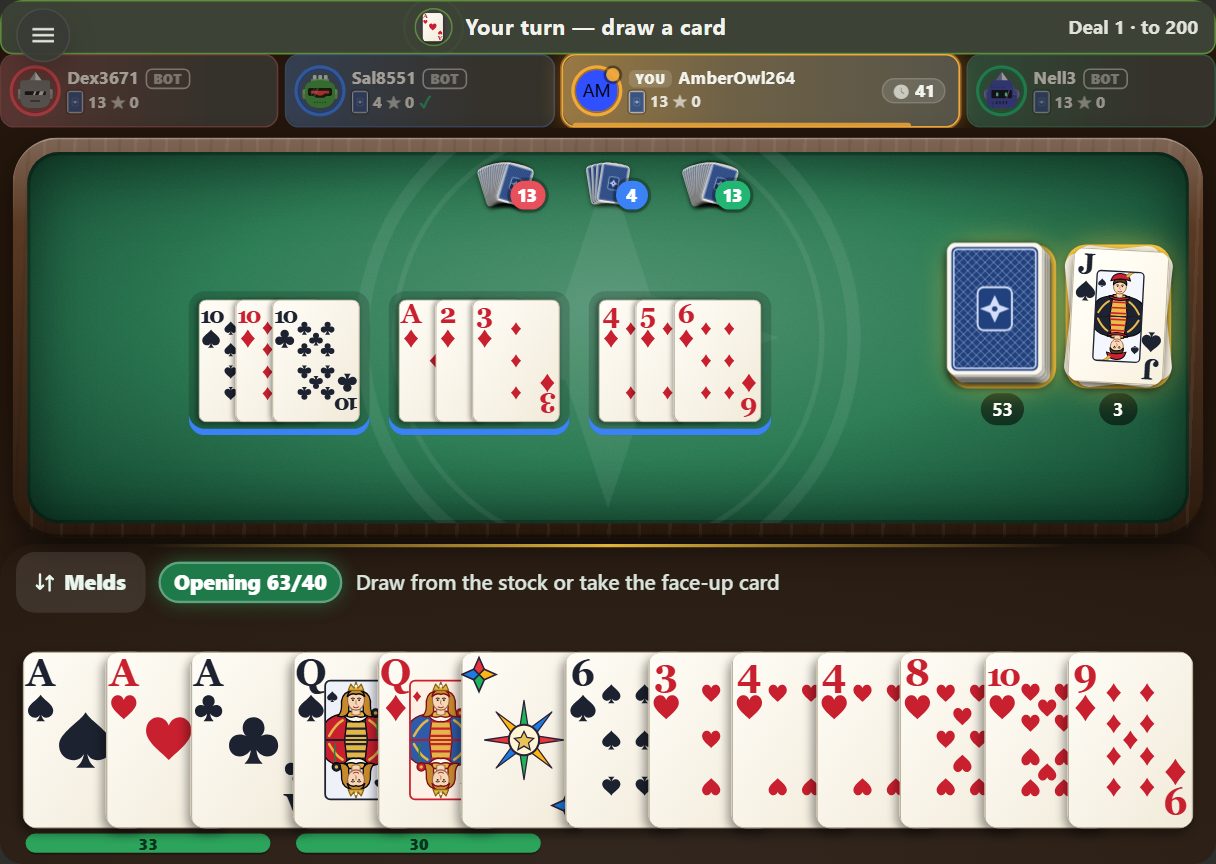
Melds and jokers: sets, runs and wild cards
| Meld | Size | Rule | Example |
|---|---|---|---|
| Set | 3 or 4 cards | Same rank, every natural card in a different suit | 7♠ 7♥ 7♦ |
| Run | 3 to 13 cards | Consecutive ranks of one suit; the ace is low or high | 5♥ 6♥ 7♥, A♣ 2♣ 3♣, Q♠ K♠ A♠ |
Two decks mean duplicate cards exist, but a set can never hold the same suit twice (7♠ 7♠ 7♦ is not a set), and it never grows past four cards. In a run the ace works at one end only, low in A-2-3 or high in Q-K-A, and runs never wrap round (K-A-2 is not a run).
Jokers
There are four jokers, and a joker stands in for any card, within two limits.
- Every meld needs at least two natural cards. A 3-card set holds at most one joker and a 4-card set at most two, so 7♠ 7♥ joker joker is legal.
- In a run no two jokers may sit side by side: 5♥ joker 7♥ joker 9♥ is legal, 5♥ joker joker 8♥ is not.
Swapping a joker out
After you have opened, a natural card that fills a joker's slot exactly takes its place, and the joker goes into your hand. In a run the card must match the slot's rank and suit; in a set it must be the same rank in a suit the set does not already hold. The freed joker has to go back down on the table that same turn.
The opening: 40 points by default
Before you can lay down anything else, your first melds have to reach a threshold: 40 by default, with 30 and 51 as room options. They go down in a single action, and the total does not carry over between turns. Any mix of sets and runs counts.
| Card | Value in an opening |
|---|---|
| 2 to 10 | Face value |
| Jack, Queen, King | 10 each |
| Ace | 11 in a set or at the high end of a run; 1 in A-2-3 |
| Joker | The card it stands for |
For example, K♠ K♥ K♦ (30) plus 5♥ 6♥ 7♥ (18) makes 48: enough to open at 30 or 40, short of 51. Three aces in a set are worth 33.
If you took the face-up card before opening, it must be inside that opening. The Opening meter above your hand shows the best total your cards can make, and once it reaches the threshold a one-tap Open button appears. One exception: if the opening leaves you with 0 or 1 cards in hand, the threshold is waived, and going out in that same turn scores double (Hand Rummy, below).
Laying off onto melds
Once you have opened, new melds need no threshold, and you can add cards to any meld on the table, yours or a rival's, even in the turn you open. A set takes a card of a suit it does not hold yet, up to four cards. A run grows at either end, ace low on the A-2-3 side or high after the king. Before you open, none of this is possible: your cards can only go down as your own opening.
Going out and counting the deal
A deal ends the moment a hand is empty, whether you discard your last card or meld or lay off your last card, so no discard is needed to go out. The winner scores the total of every rival's leftover cards: 2 to 10 at face value, jack, queen and king 10 each, ace 11, joker 20. Only cards still in hand count. If three rivals are left holding 4, 22 and 24 points, the winner scores 50.
Hand Rummy: go out in a turn that began with you not yet opened, including opening and going out in the same turn, and the deal scores double. Blocked deal: if the stock runs dry after its second rebuild, nobody goes out and the lightest hand wins, scoring the amount by which each other hand outweighs it.
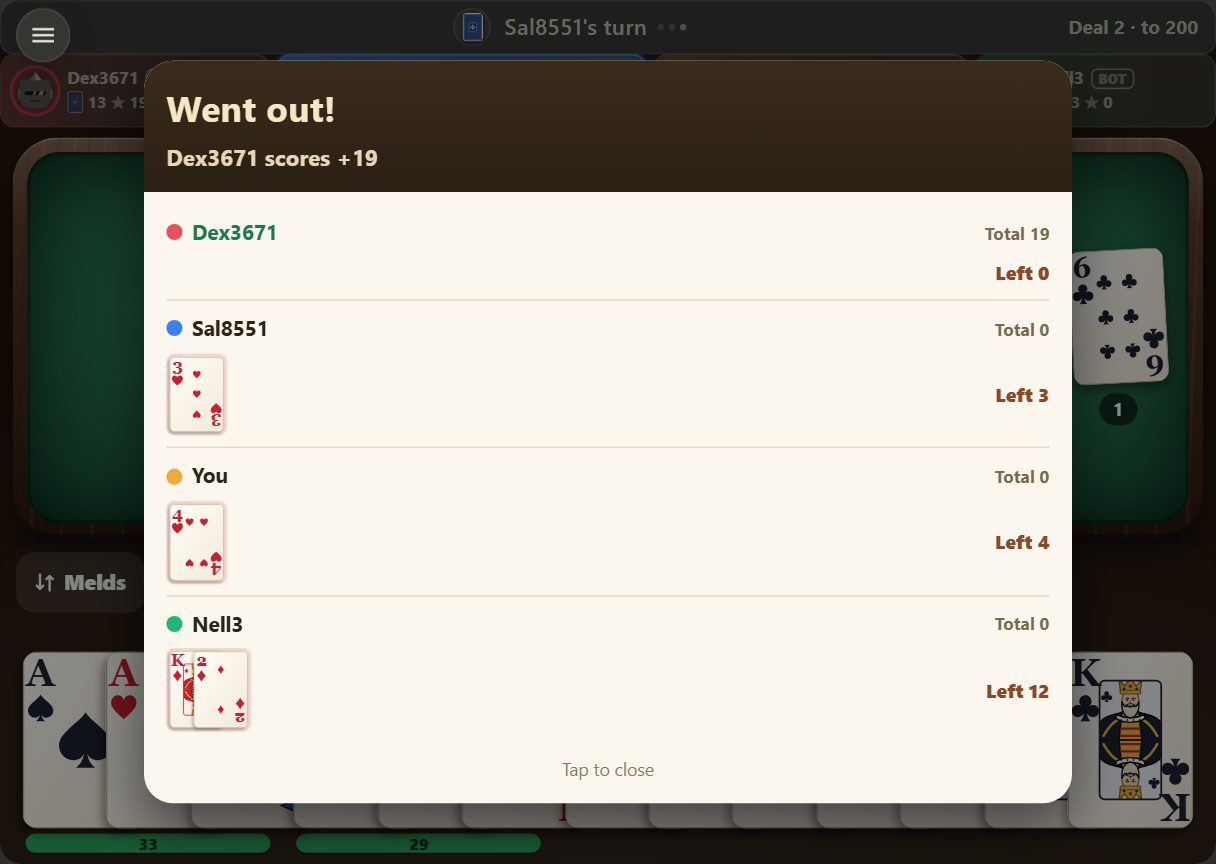
The full count, including how the three opening options change a deal, is in rummy scoring and opening points.
Match length: one deal or to 200
A room plays one deal by default, and whoever wins that deal wins the match. The other option is a match to 200: only each deal's winner scores, totals build up, and the match ends the moment a deal winner's total reaches 200.
Putting it to use
Two rules decide most early turns: a card taken from the pile has to be used, and before you open it has to be inside your opening. So take the face-up card when it fits a meld you can already count toward the opening, and otherwise draw from the stock, because a stock card can go straight back on the pile. For the ten-card, two-player cousin, see rummy vs gin rummy and how to play gin rummy. To try the rules above, open the Rummy table on Playgridia.
Frequently Asked Questions
How many cards does each player get in rummy?
On Playgridia every player is dealt 13 cards, at every table size from 2 to 6 players. The game uses 108 cards (two 52-card decks plus 4 jokers), so the stock after the deal holds 81, 68, 55, 42 or 29 cards for 2, 3, 4, 5 or 6 players. One more card is turned face up to start the discard pile.
Can you take the face-up card in rummy?
Yes, you may take the top card of the discard pile instead of drawing, but only that one card. You cannot discard until it has been placed in a meld or laid off, and if you have not opened yet it has to be part of your opening. If you change your mind before doing anything else that turn, Put back returns it and lets you draw from the stock.
How many points do you need to open in rummy?
The default is 40, and a room can choose 30 or 51 instead. All the opening melds go down in one action, and the total does not carry over between turns. Cards 2 to 10 count face value, jack, queen and king count 10, an ace counts 11 in a set or at the high end of a run (1 in A-2-3), and a joker counts as the card it stands for.
Can you lay off cards before you have opened?
No. Laying off, adding extra melds and swapping out a joker are all possible only after you have opened. Once you have, even in the same turn, you can add cards to any meld on the table, yours or a rival's.
Do you have to discard to go out in rummy?
No. The deal ends the moment your hand is empty, whether you discard your last card or meld or lay off your last card. The winner scores the penalty points left in the rivals' hands, doubled (Hand Rummy) if the winner had not opened before that turn.
How many jokers are there and what is a joker worth?
There are 4 jokers, and each stands in for any card. Every meld needs at least two natural cards, so a 3-card set holds at most one joker and a 4-card set at most two, and a run never has two jokers side by side. In an opening a joker is worth the card it replaces; stuck in your hand when someone goes out, it costs 20 points.