Rummy vs Gin Rummy: The Differences, Side by Side
Rummy vs gin rummy comes down to table size and where your melds live: Gin Rummy is a two-player, ten-card duel in which your melds stay hidden in your hand until someone knocks with 10 or fewer points of unmatched cards (deadwood), while Rummy seats 2–6 players with 13 cards each, puts melds face up on the table once you clear an opening total, and goes to the first player to empty their hand. Rules vary between tables, so everything below is how Rummy and Gin Rummy run on Playgridia.
The differences at a glance
| Rummy | Gin Rummy | |
|---|---|---|
| Players | 2–6 | Exactly 2 |
| Deck and jokers | Two 52-card decks plus 4 jokers (108 cards) | One 52-card deck, no jokers |
| Cards dealt | 13 each, at any table size | 10 each |
| Stock after the deal | 81, 68, 55, 42 or 29 cards for 2, 3, 4, 5 or 6 seats | 31 cards |
| Where melds live | Face up on the table, in the owner's seat colour | In your hand until someone knocks |
| Opening requirement | First melds must total 30, 40 or 51 (room option, 40 by default) | None, there is no opening |
| Ace in a run | Low (A-2-3) or high (Q-K-A), never wrapping K-A-2 | Low only; Q-K-A is not a meld |
| Laying off | Anyone who has opened, onto any meld on the table | Only the defender after a plain knock, onto the knocker's melds |
| Taking the face-up card | Allowed, but it must go into a meld or lay-off that turn (into your opening, if you have not opened); Put back until you act | Free; you just cannot discard that same card straight back |
| How a deal ends | First hand to empty, by discarding or melding the last card | Someone knocks with deadwood of 10 or less |
| Who scores | The winner only: the sum of rivals' leftover cards (ace 11, joker 20), doubled for Hand Rummy | Knock: the difference. Gin: 25 + the defender's deadwood. Undercut: the difference + 25 |
| Match length | One deal by default, or first to 200 | One deal by default, or first to 100 |
| When the stock runs out | Pile reshuffled into the stock, up to twice; then the lightest hand wins | A discard leaving 2 or fewer stock cards: dead deal, no score, redeal |
In both games a set is 3–4 cards of one rank in different suits, a run is 3–13 consecutive cards of one suit, and one card is turned face up to start the discard pile.
Open melds versus hidden melds
Rummy is played in the open: every meld sits on the felt in its owner's seat colour, and the seat chips show who has opened. Gin Rummy flips that. Until someone knocks the felt holds only the stock and the face-up pile, so the only public clues to a rival's plan are what they pick up and what they throw.
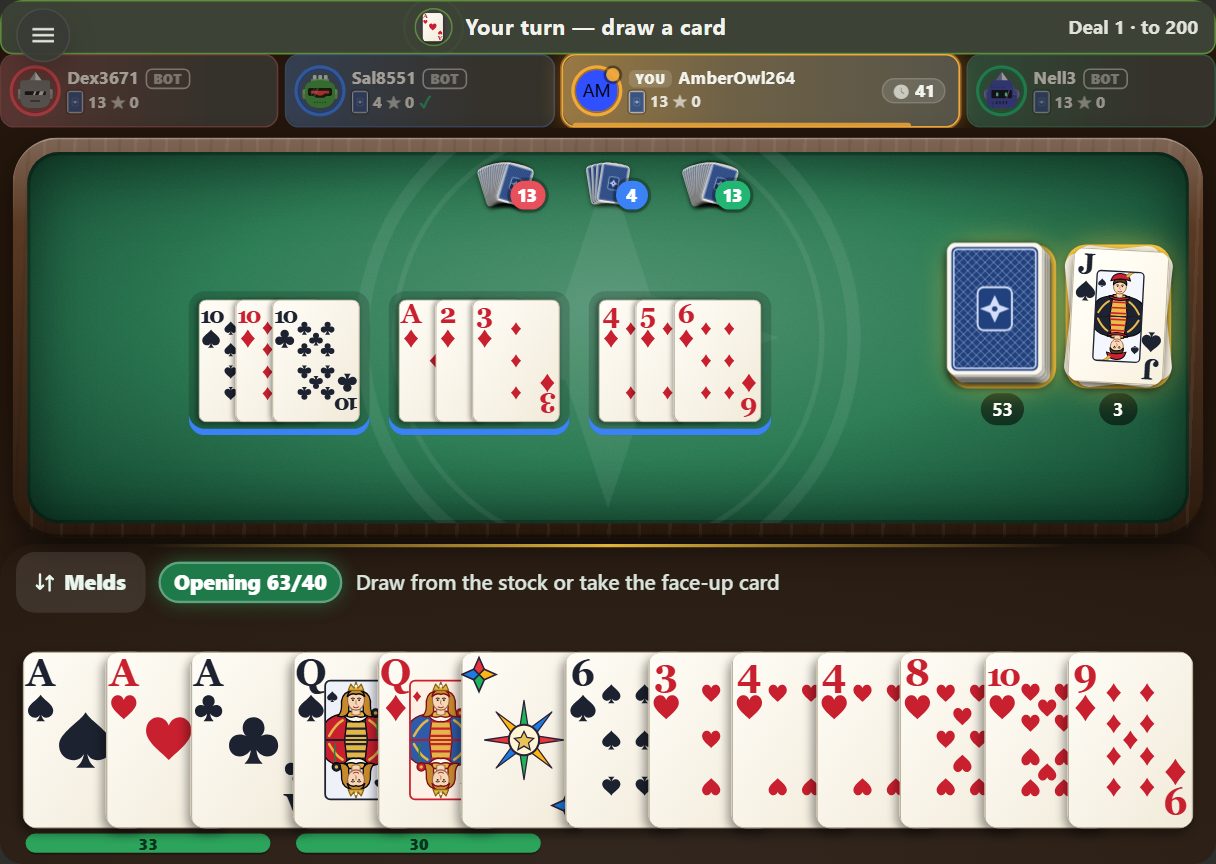
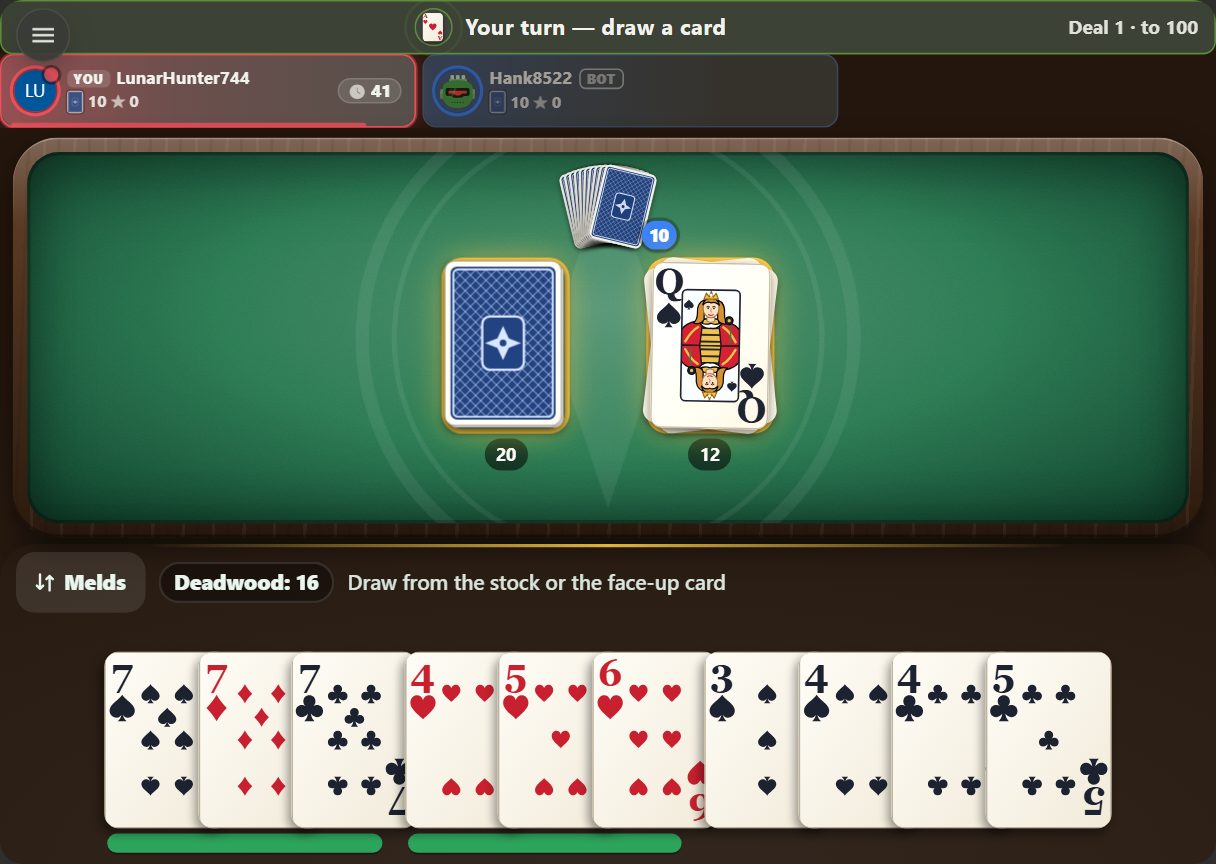
On Playgridia the pile shows only its top card and a count, and the line reporting a rival's last move fades after about four seconds, so remembering pickups is your job in both games. The meter above your hand shows where you stand: "Opening n/40" in Rummy until you open (at the default threshold), "Deadwood: n" in Gin.
The opening threshold versus the knock
Rummy: you must open first
Until you have opened you can only draw or take, then discard. The opening is one action whose melds must total the room's threshold: 30, 40 or 51, with 40 the default. A set counts its cards at face value (face cards 10, ace 11) and a run counts each card at its value (ace 1 when low, 11 when high), so three kings (30) plus a run of 5-6-7 (18) clear 40.
If you take the face-up card before opening, it has to be part of your opening; Put back undoes the take until you do something else. The threshold is waived if the opening leaves you with zero or one card, and going out in a turn that began unopened is Hand Rummy, which doubles the score.
Gin: you decide when to knock
There is no opening in Gin. Each turn you draw or take, then discard or knock. A knock is legal when, after your discard, the cards left outside melds total 10 or less (ace 1, 2–10 face value, J/Q/K 10). The game finds the arrangement that minimises your deadwood, so you never declare melds. Knock with 0 deadwood and it is gin.
The risk is the undercut: after a plain knock the defender melds their own hand and lays off onto your melds, and if their deadwood ends equal to or lower than yours, they score instead of you. Rummy has no knock to time.
Jokers, aces and laying off
Rummy uses four jokers. Each stands in for any card and costs 20 penalty points if stuck in your hand. A meld needs at least two natural cards, and once you have opened, a natural card that fills a joker's slot exactly frees that joker into your hand, to be placed again that turn. Gin has no jokers.
The ace is low or high in a Rummy run and costs 11 in a leftover hand; in Gin it is low only and costs 1. In Rummy anyone who has opened may add cards to any meld on the table, yours or a rival's. In Gin only the defender lays off, after a plain knock and onto the knocker's melds.
Scoring: everything left versus the gap
Only one player scores a Rummy deal: the sum of every rival's leftover cards (2–10 face value, J/Q/K 10, ace 11, joker 20), doubled for Hand Rummy. Nothing is deducted because a rival has opened: every card still in their hand counts in full.
Gin scores the gap between the two hands. A plain knock scores the difference in deadwood: knock on 4 against a defender's 11 and you score 7. Gin scores 25 plus the defender's deadwood, so against 20 it is worth 45. An undercut scores the defender the difference plus 25: knock on 10 against a defender on 2 and the defender takes 33, and a tie is an undercut worth exactly 25.
Both default to one deal; the longer option plays to 200 in Rummy and 100 in Gin. Worked examples are in Gin Rummy scoring and Rummy scoring and opening points.
Which one should you play?
- Two players, one sharp decision per turn, a plan hidden until the knock: Gin Rummy.
- Three to six players: Rummy. Gin Rummy seats exactly two.
- You like jokers, laying off and reading open melds: Rummy, which also seats two for a duel with those tools.
Both are on Playgridia: Rummy for 2–6 seats and Gin Rummy for two. In a room you can add bots at easy, medium or hard, and the four table looks, Club Felt by default, never change a rule. To learn the rules step by step, read how to play Rummy and how to play Gin Rummy, then pick the one that fits your table, or play both.
Frequently Asked Questions
What is the difference between rummy and gin rummy?
Gin Rummy is a two-player game with ten cards each from one 52-card deck, where melds stay in your hand until someone knocks with 10 or less deadwood. Rummy seats 2–6 players with 13 cards each from two decks plus four jokers, and melds go face up on the table after an opening of 30, 40 or 51 points (40 by default). Rules vary between tables; these are the Playgridia rules.
Can gin rummy be played with more than two players?
On Playgridia, no: Gin Rummy is exactly two seats. If you want three to six players, pick Rummy, which seats 2–6.
Does gin rummy use jokers?
No. Gin Rummy uses a single 52-card deck with no jokers, and its aces are low only. Jokers appear only in Rummy, which has four of them; each stands in for any card and costs 20 penalty points if left in your hand.
How many cards are dealt in rummy and in gin rummy?
Rummy deals 13 cards to each player at any table size, from a 108-card pack. Gin Rummy deals 10 each from a 52-card deck, leaving 31 cards in the stock after the deal. In both games one card is then turned face up to start the discard pile.
What does gin mean in gin rummy?
Gin is a knock with no deadwood: after your discard all ten cards are in melds. On Playgridia it scores 25 plus the defender's deadwood, and the defender cannot lay off onto your melds.
Is gin rummy harder than rummy?
Mechanically, Gin has fewer actions: draw or take, then discard or knock. Rummy adds opening, melding, laying off and swapping jokers, plus the rule that a face-up card you take must be used. Gin's decisions are fewer but sharper: when to knock, and the undercut risk when the defender's deadwood is equal or lower.