Gin Rummy Strategy Tips: When to Knock or Go for Gin
Good gin rummy strategy comes down to three habits: shed your ten-point cards early, treat every pile pickup as information, and time your knock against the stock count and the risk of an undercut. Rules vary between tables, so the numbers here are those of Playgridia's two-player table: ten cards each, a knock limit of 10, and 25 bonus points for gin and for an undercut. Need the basics first? Read how to play Gin Rummy; the point maths is in Gin Rummy scoring.
Early game: shed the heavy cards, build around the middle
Deadwood counts at face value, with J, Q and K at 10 and an ace at 1. Unmatched tens and face cards are the expensive ones to be caught holding, and the first to throw: one of them already uses your whole knock allowance of 10.
Aces are cheap but poorly connected: on our table an ace is low only, so it joins A-2-3 runs or a set of aces and nothing else (Q-K-A is not a meld). A king connects only downward. An ace or king fits one three-card run, a two or queen fits two, and everything from three to jack fits three, so build around the middle.
A lone leftover card never stops you knocking, because no card costs more than 10. With nine of your ten cards in melds after your discard you can always knock, and if the tenth fits too, that is gin.
Reading the discard pile
What your pickups tell your rival
When you take the face-up card, your rival's board names it in an event line for about four seconds; a blind stock draw reveals nothing. So take from the pile only when the card completes a meld or clearly cuts your deadwood. It is also a commitment: you cannot discard that card again the same turn, you cannot use it as your knock card, and Gin has no put-back.
What their pickups tell you
The same line works for you. A card your rival takes usually lands in a meld or near-meld, so note its rank and suit and stop feeding that rank and its same-suit neighbours. A pile card they pass over for a blind draw probably did not help them. Our medium and hard bots take a pile card only when it joins a meld and lowers their deadwood, so against them that signal is reliable.
The catch is memory. The pile shows only its top card and the event line fades, so the count is on you. Only the top card can ever be taken, so anything buried is out of the deal for both of you: with one 52-card deck, if the 6 you needed for your 7-8 was discarded and covered, stop waiting for it.
Choosing a safe discard
A discard is safe when it is unlikely to help your rival: not a rank or same-suit neighbour of what they took, ideally a rank they have been throwing themselves. Our medium and hard bots weigh your pickups the same way.
Knock now, or play for gin?
You may knock once your deadwood after discarding is 10 or less. A plain knock pays only the difference between the two hands' deadwood; gin (zero deadwood) pays 25 plus all of your rival's deadwood, and they get no lay-offs. Against a rival left with 15, knocking on 4 earns 11 points; gin earns 40.
Waiting has a price. The stock is a clock: 31 cards remain after the deal, and if a discard leaves two or fewer with nobody having knocked, the deal is dead: no score, same dealer re-deals. Each extra turn also gives your rival another chance to knock first.
| Situation | Lean | Why |
|---|---|---|
| 0 deadwood after your discard | Go gin | 25 plus their deadwood, no lay-offs, no undercut. |
| 1 to 4 deadwood, plenty of stock | Often keep playing | One good draw makes gin. Our hard bot holds out while the stock is above 18. |
| 5 to 10 deadwood, stock large | Knock only at the low end | A knock near 10 is the easiest to undercut. Our medium bot waits for 6 or less while the stock is above 22. |
| Melds that cannot take extra cards | Knock | A set of four, or a set whose fourth card you saw discarded, allows no lay-offs. |
| Stock down to a handful | Knock if you can | A dead hand scores nothing; you can still knock on the turn that draws the third-last card. |
Avoiding the undercut, and playing the defender
Before you knock
An undercut happens when your rival, after melding their hand and laying off onto your melds, is left with deadwood equal to or lower than yours. They score the difference plus 25, and a tie is worth exactly 25 to them.
So look at what each of your melds can still take. A set of three takes one card, the fourth of its rank; a run takes a card at either end, except that nothing goes below an ace or above a king; and every card you saw discarded is a lay-off your rival cannot make. The server tries melds-first and lay-offs-first and keeps whichever leaves them less deadwood, so assume they find the best one.
When you are the one defending
If your rival knocks, the server melds your hand and lays off what it can onto their melds. Your decisions come earlier: a card that continues a run your rival has been building costs less to hold than its face value suggests, because you can lay it off if they knock, and holding it blocks them. Against gin there are no lay-offs, so do not sit on a heavy card for long.
How our bots decide
The three bot levels are a ladder of habits worth knowing. They read only their own hand, the discard pile and what you took from it, never your hand or the stock order.
| Level | Takes the pile card when | Knocks at | Plays for gin |
|---|---|---|---|
| Easy | it joins a meld and cuts its deadwood by 5 or more | 5 or less | No |
| Medium | it joins a meld and cuts its deadwood by at least 1 | 6 or less while the stock is above 22, 8 or less while above 14, then 10 | No |
| Hard | same as medium | 10 or less | Yes: it skips a knock at 1 to 4 deadwood while the stock is above 18 |
Easy is the one to learn on: half the time it throws one of its four loosest cards at random. Medium is readable, because a knock while the stock is above 22 means 6 or less. Hard shows the gin-or-knock judgement: it estimates its expected deadwood after the next draw over every card it has not seen, and weighs what you have picked up before it discards. Choose the level when you add the bot; the default is medium.
Let the board do the counting
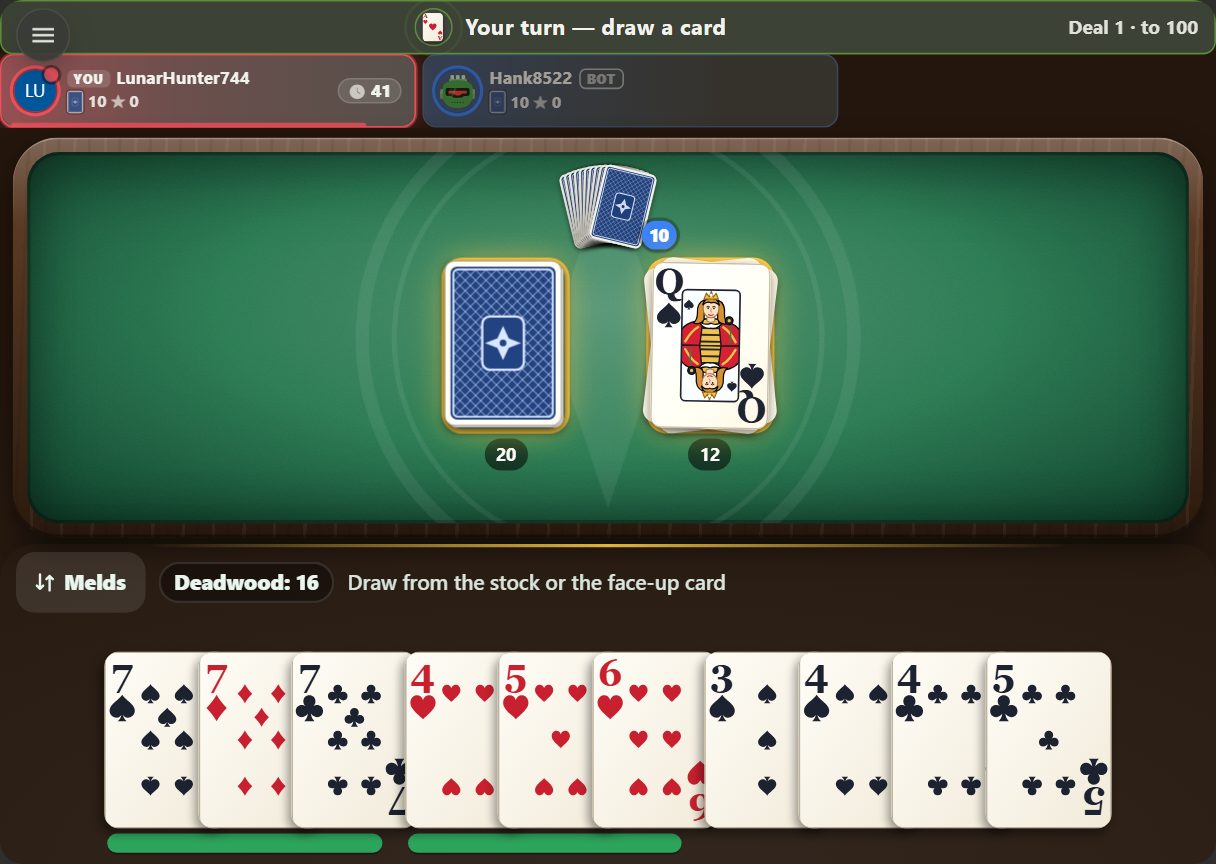
The "Deadwood: n" meter shows your best arrangement; once you have drawn, it shows what you would keep after your best discard, and flags you as ready at 10 or less. With no card selected, a one-tap button reads "Gin!" or "Knock" plus the deadwood you would keep, and plays that best discard. The hint button lights the best discard.
Putting it together
Pick one habit per match: count what has been buried, or fix your knock point before you draw. Then climb the ladder on the Gin Rummy table: easy for the flow, medium for timing a knock against the stock, hard for when to hold out for gin.
Frequently Asked Questions
When should you knock in gin rummy?
You can knock as soon as your deadwood is 10 or less after your discard. Knocking early wins only the difference, and if your rival ends with equal or lower deadwood after laying off onto your melds, they undercut you. A sound habit is to knock low (6 or less) while the stock is full, accept a higher knock as it shrinks, and knock before the stock runs down to two cards, because a dead hand scores nothing.
Is it better to knock or go for gin?
Gin pays 25 plus all of your rival's deadwood and gives them no lay-offs, while a plain knock pays only the difference. With 1 to 4 deadwood and plenty of stock left, one good draw can turn a knock into gin, and our hard bot waits in exactly that spot while more than 18 cards remain in the stock. Waiting gives your rival extra turns to knock first, and a dead hand scores nothing, so do not wait once the stock is nearly gone.
How do you avoid being undercut in gin rummy?
An undercut happens when your rival's deadwood, after laying off onto your melds, is equal to or lower than yours; they score the difference plus 25, and a tie is worth 25. Check what your melds can still take before you knock: a set of four takes nothing, and a set whose fourth card was already discarded cannot be extended. Be wary of knocking at 9 or 10 when your runs have open ends.
Should you pick up from the discard pile in gin rummy?
Only when the card completes a meld or clearly cuts your deadwood. Your rival sees the card you took in the event line for about four seconds, you cannot discard it again that turn, and Gin has no put-back. A blind draw from the stock shows your rival nothing.
What is the best first discard in gin rummy?
A good default is the highest unmatched card, because tens and face cards cost 10 each while an ace costs 1. Keep it instead if it sits next to cards that could make a meld, and remember that an ace is low only, so it connects just to twos. If your rival has taken a pile card, avoid throwing its rank or its same-suit neighbours.
How do the computer opponents play Gin Rummy?
There are three levels. Easy knocks at 5 deadwood or less; medium knocks at 6 while the stock is above 22, at 8 while it is above 14, then at 10; hard knocks at up to 10 but skips a knock at 1 to 4 deadwood to play for gin while the stock is above 18. Hard also estimates what its next draw is likely to bring, using every card in its hand and the pile.