Gin Rummy Scoring: Cheat Sheet for Knock, Gin, Undercut
Gin Rummy scoring is a comparison of leftover cards: when someone knocks, both players add up the cards that sit outside a meld (the deadwood), and the winner of the deal scores the difference, plus 25 for a gin or an undercut. Only the winner of a deal scores, and nobody ever loses points. Rules vary between tables; this page is how Playgridia counts, with a cheat sheet, worked sums and a score sheet. For the rules of play itself, see how to play Gin Rummy.
Gin Rummy scoring cheat sheet
Call the knocker's deadwood K and the defender's deadwood D, counted after any lay-offs (see below). Every deal ends in one of these ways.
| Outcome | When | Who scores | Points | Example |
|---|---|---|---|---|
| Knock | The knocker has 10 or less and D is higher than K | The knocker | D − K | K 4, D 17: 17 − 4 = 13 |
| Gin | The knocker has 0 deadwood | The knocker | 25 + D (no lay-offs) | D 45: 25 + 45 = 70 |
| Undercut | D is lower than K | The defender | (K − D) + 25 | K 10, D 2: (10 − 2) + 25 = 33 |
| Tie | D equals K (an undercut with nothing to subtract) | The defender | Exactly 25 | K 5, D 5: 0 + 25 = 25 |
| Dead hand | A discard leaves two or fewer cards in the stock and nobody knocked | Nobody | 0 | The same dealer deals again |
Two things the table does not say out loud. The loser of a deal scores 0, not a minus number. And the knock limit is 10: you may knock only if the cards you keep after your discard leave 10 deadwood or less.
How to count deadwood
An ace is worth 1, cards 2 to 10 are worth their face value, and a jack, queen or king is worth 10. There are no jokers in Gin Rummy. The ace plays low only: A-2-3 is a run, Q-K-A is not, so an ace you cannot use costs just 1. (Table-style Rummy counts differently; see Rummy scoring and opening points for the ace at 11 and the joker at 20.) A leftover K♠, 6♦ and A♣ is 10 + 6 + 1 = 17.
You do not have to find the best arrangement yourself. The server groups your cards so that the deadwood is as low as possible, and it never settles for a worse grouping on your behalf. The Deadwood: n meter in your hand dock shows that number; once your best discard leaves 10 or less, you can knock. On paper, any deal takes three steps:
- Take the knocker's deadwood, K (10 or less; 0 means gin).
- Take the defender's deadwood, D, after lay-offs unless the knock was a gin.
- Gin: the knocker scores 25 + D. Otherwise, if D is higher than K the knocker scores D − K; if D is equal or lower, the defender scores (K − D) + 25.
How lay-offs change the count
After a plain knock, the defender first melds their own hand, then lays their loose cards onto the knocker's melds: a card of the missing suit onto a three-card set, or a card at either end of a run. Gin Rummy rules apply here, so the ace is low only and there are no jokers. The server tries two orders (own melds first and the rest laid off, or lay-offs first and the rest melded) and keeps the one that leaves the defender less. That final number is D. After a gin there are no lay-offs at all; the defender's D is simply their best arrangement.
Lay-offs only ever help the defender. The more open ends the knocker's melds have, the more cards the defender can get rid of before the totals are compared.
Worked examples
A knock with two lay-offs
You knock with the set 7♠ 7♥ 7♦, the runs 4♣ 5♣ 6♣ and J♥ Q♥ K♥, and one loose 3♦. K = 3. Your rival holds the set 9♠ 9♥ 9♦, the run 2♥ 3♥ 4♥, and four loose cards: 7♣, 3♣, Q♠ and 5♦. Before lay-offs that is 7 + 3 + 10 + 5 = 25. The 7♣ goes onto your sevens (or the top of your club run) and the 3♣ goes under your club run, so D = 10 + 5 = 15. You score 15 − 3 = 12. Without the two lay-offs it would have been 25 − 3 = 22, so they cost you 10 points.
A gin
You go gin with 0 deadwood and the rival's best arrangement leaves 45. No lay-offs, no comparison: 25 + 45 = 70 for you.
An undercut and a tie
You knock on 10, but your rival lays off and melds down to 2. They have undercut you: (10 − 2) + 25 = 33 to the rival, 0 to you. Had the rival come down to exactly 10, the difference would be 0 and they would score just the 25. A tie always favours the defender.
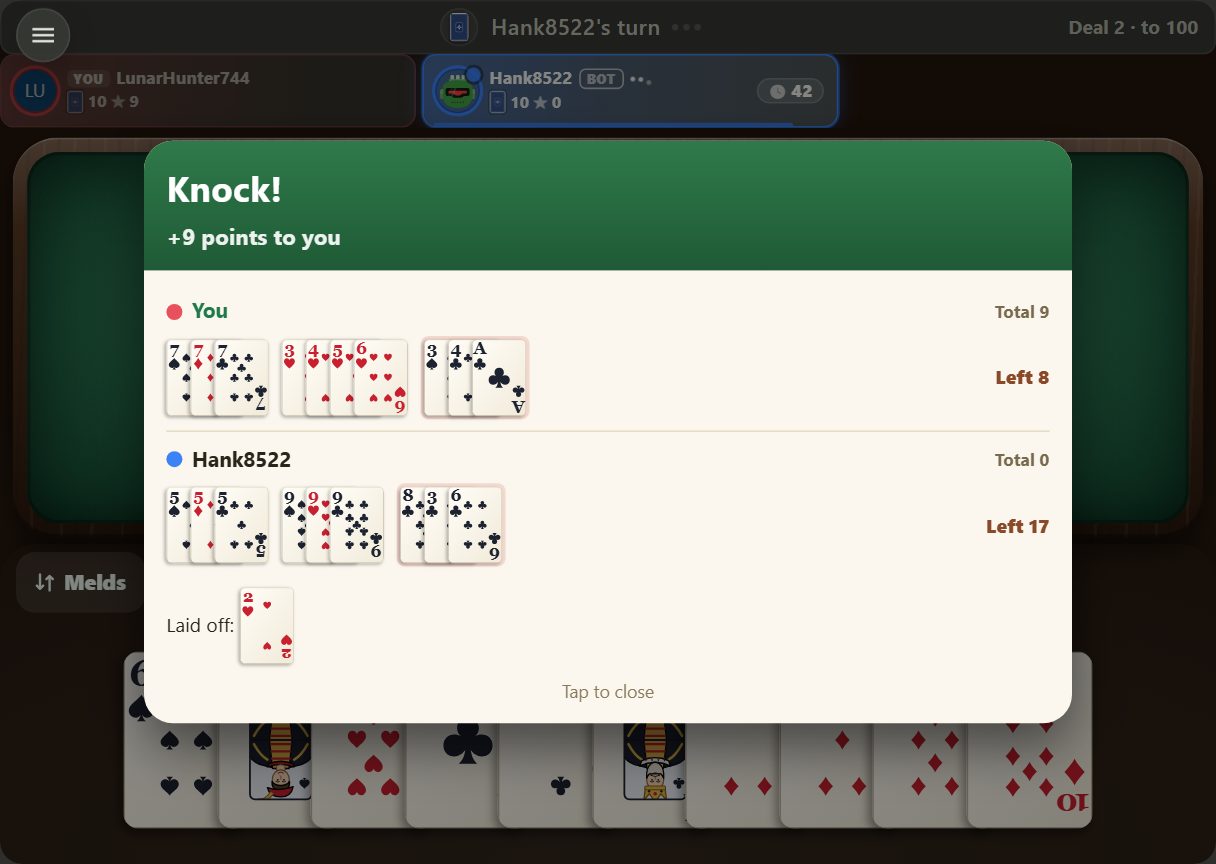
This account appears at the end of every scored deal. While the match goes on it closes by itself after a few seconds; once the match is over, a button on the board brings the last deal's account back.
Keeping score over a match
By default a Gin Rummy match on Playgridia is a single deal, and its winner wins the match. The other option is To 100: scores add up across deals, only the winner of each deal scores, and the match ends the moment a deal winner's total reaches 100. The dealer moves one seat after every scored deal; a dead hand is dealt again by the same dealer and counts for nothing.
A running score sheet (example)
An invented match to 100, to show how the totals move. Only the winner's column ever changes.
| Deal | What happened | Sum | You | Rival |
|---|---|---|---|---|
| 1 | You knock on 8, rival is left with 20 | 20 − 8 = 12 | 12 | 0 |
| 2 | Rival knocks on 10, you are left with 15 | 15 − 10 = 5 | 12 | 5 |
| Dead hand | Stock runs down, nobody knocks | none | 12 | 5 |
| 3 | Rival knocks on 6, you also end on 6 | tie: 25 | 37 | 5 |
| 4 | Rival goes gin, you hold 22 | 25 + 22 = 47 | 37 | 52 |
| 5 | You go gin, rival holds 40 | 25 + 40 = 65 | 102 | 52 |
After deal 5 your total of 102 has passed 100, so the match is over.
What our tables do not add
Rules vary between tables, and some add extra bonuses on top of the outcomes above. Playgridia's account is just the three: a knock, a gin and an undercut, with a tie counted as an undercut. A deal scores what the formulas give, a dead hand scores nothing, and the match ends at 100 or after one deal. If you play house rules with extra bonuses, keep that tally yourself; the totals on our board will not include them.
What to do with this
Before you knock, do the sum from the other side. A knock on 9 only wins if the rival cannot get to 9 or lower, and when they do, they take the difference plus 25 and you take nothing. A gin is the one finish nothing can punish: no lay-offs and no undercut. For ways to build toward it, read the Gin Rummy strategy tips, then count a few deals for real in Gin Rummy on Playgridia.
Frequently Asked Questions
How many points is a gin worth in gin rummy?
On Playgridia a gin scores 25 plus all the deadwood your rival is left holding. The rival cannot lay off onto a gin hand, so their count is just their best arrangement. Rules vary between tables on the size of the gin bonus.
How much is an undercut worth?
The defender scores the gap between the two deadwood counts plus 25. For example, a knock on 10 against a rival who gets down to 2 is worth (10 - 2) + 25 = 33 to the rival. The knocker scores nothing for that deal.
What happens if both players have the same deadwood?
A tie counts as an undercut. The difference is zero, so the defender scores exactly 25 and the knocker scores nothing.
How many points do you play to in gin rummy?
On Playgridia a match is one deal by default, and the winner of that deal wins. In the To 100 option, scores add up over deals and the match ends the moment a deal winner's total reaches 100. Only the winner of each deal scores.
Does the ace count as 1 or 11 in gin rummy?
In Gin Rummy an ace is worth 1 as deadwood, and it plays low only: A-2-3 is a run, Q-K-A is not. Jacks, queens and kings are worth 10 and there are no jokers. The table-style Rummy game on Playgridia counts an ace as 11 in a leftover hand.
Do you score anything when the deal is dead?
No. If a discard leaves two or fewer cards in the stock and nobody has knocked, the deal is dead: nobody scores and the same dealer deals again. You can still knock while two cards remain in the stock, so a knock can save a deal that a discard would kill.