Rummy Scoring: Opening Points, Penalties and the 51 Rule
Rummy scoring uses two separate counts: the points your melds are worth when you open, and a penalty for every card still in your hand when the deal ends. On Playgridia you open with 30, 40 (the default) or 51 points, and the winner of a deal scores the combined penalty of every rival's leftover cards, doubled if they went out without having opened on an earlier turn. Rules vary between tables, so this guide describes how our Rummy counts; for the basics of play see how to play Rummy.
Two counts, side by side
The same card is worth different amounts depending on what you are counting. Use the middle column to work out an opening and the right-hand column for what you are stuck with at the end of a deal.
| Card | Opening count (in a meld) | Penalty count (left in hand) |
|---|---|---|
| 2 to 10 | Face value | Face value |
| Jack, Queen, King | 10 | 10 |
| Ace | 11 in a set or after the king (Q-K-A); 1 in A-2-3 | 11 |
| Joker | The value of the card it stands in for | 20 |
An ace sits at one end of a run only: A-2-3 and Q-K-A are runs, K-A-2 is not. The joker is the most expensive card to be caught holding. Gin Rummy counts differently (ace 1, no jokers), which is covered in Gin Rummy scoring.
Opening with 51 (or 30, or 40)
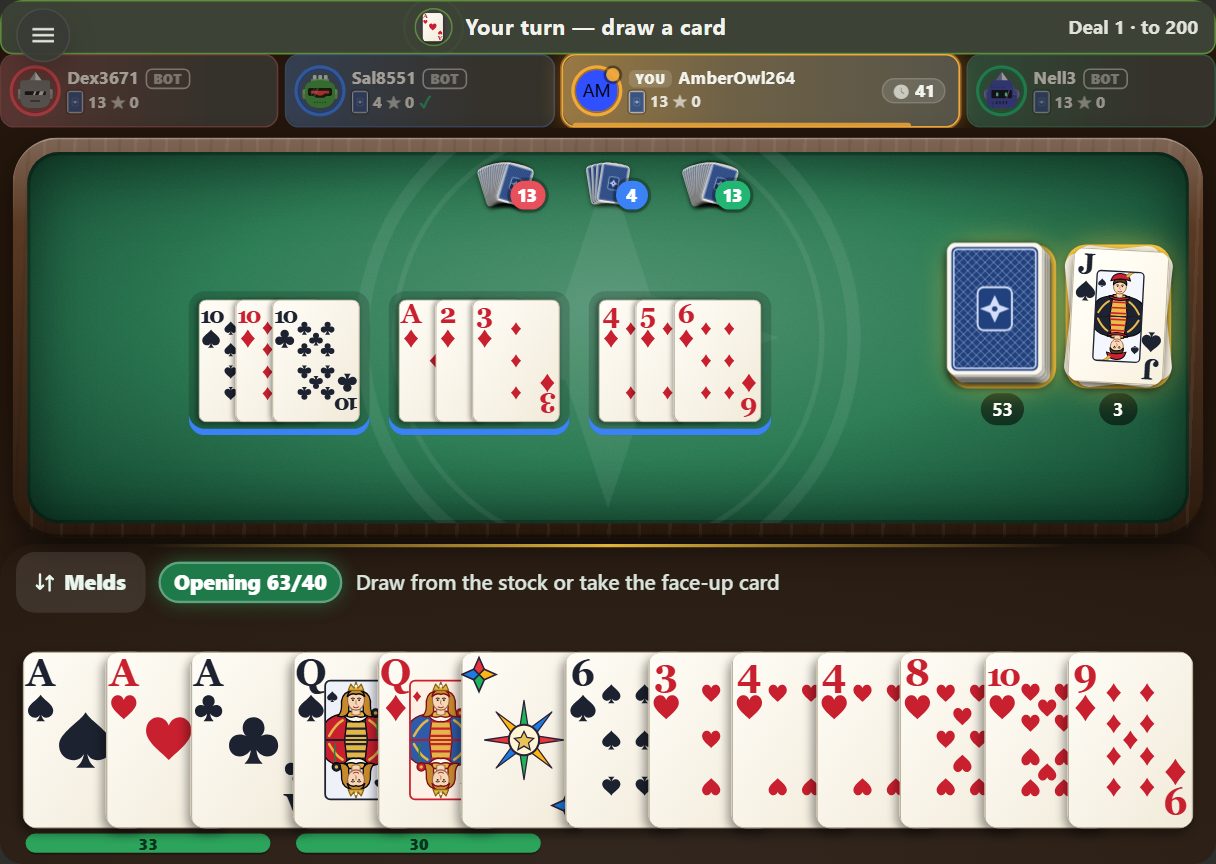
Until you have opened, the only melds you may lay down are the opening itself: your first melds, put down in one action whose total reaches the threshold. The host picks the threshold under "Opening threshold" in the room options: 30, 40 or 51, with 40 as the default. Many players know the 51 table by its number, "Rami 51" in French, and on Playgridia it is simply this same rule with the threshold set to 51.
- One action, not a running total. Only the melds in that single opening action are added up. Laying down 20 this turn and 20 next turn does not open.
- Any mix of sets and runs qualifies. There is no "natural run first" requirement here. Rules vary between tables, so check the house rules if you are used to another version.
- Jokers count. A joker is worth the card it replaces, though every meld still needs at least two natural cards.
- A card you took must be in the opening. If you take the face-up card before you have opened, it has to be part of your opening. Otherwise use Put back, which is only possible before you do anything else that turn.
- Afterwards the threshold is gone. Once you have opened, new melds and lay-offs onto any meld on the table need no minimum.
Worked openings
A set is the card value times the number of cards; a run is the sum of its positions. The last column shows the highest threshold the total reaches.
| Meld(s) | Arithmetic | Total | Reaches |
|---|---|---|---|
| A-2-3 in one suit | 1 + 2 + 3 | 6 | none |
| 5-6-7 in one suit | 5 + 6 + 7 | 18 | none |
| 7-7-7 | 3 × 7 | 21 | none |
| 7-7-7-7 | 4 × 7 | 28 | none |
| K-K-K | 3 × 10 | 30 | 30 |
| 10-J-Q in one suit | 10 + 10 + 10 | 30 | 30 |
| Q-K-A in one suit | 10 + 10 + 11 | 31 | 30 |
| A-A-A | 3 × 11 | 33 | 30 |
| 5, joker, 7, joker, 9 in one suit | 5 + 6 + 7 + 8 + 9 | 35 | 30 |
| 5-6-7 run plus 7-7-7 set | 18 + 21 | 39 | 30 |
| K-K-K-K | 4 × 10 | 40 | 40 |
| 7-7-7 plus K-K-K | 21 + 30 | 51 | 51 |
| A-A-A plus 5-6-7 run | 33 + 18 | 51 | 51 |
| 10-J-Q-K-A in one suit | 10 + 10 + 10 + 10 + 11 | 51 | 51 |
So 51 asks for two strong melds or one long ace-high run, while 30 can be met by one set of kings or aces. On Playgridia the dock does the adding for you: an Opening meter compares your best melds with the threshold, the groups in your hand show their own point values, and a one-tap Open button appears once they reach it.
The waiver: opening by going out
The threshold is waived if your opening action leaves you with 0 or 1 cards in hand. An opening worth only 28 is accepted at any threshold when it leaves a single card, and because you then discard that card and go out in a turn that began unopened, the deal is a Hand Rummy and scores double.
Scoring a deal
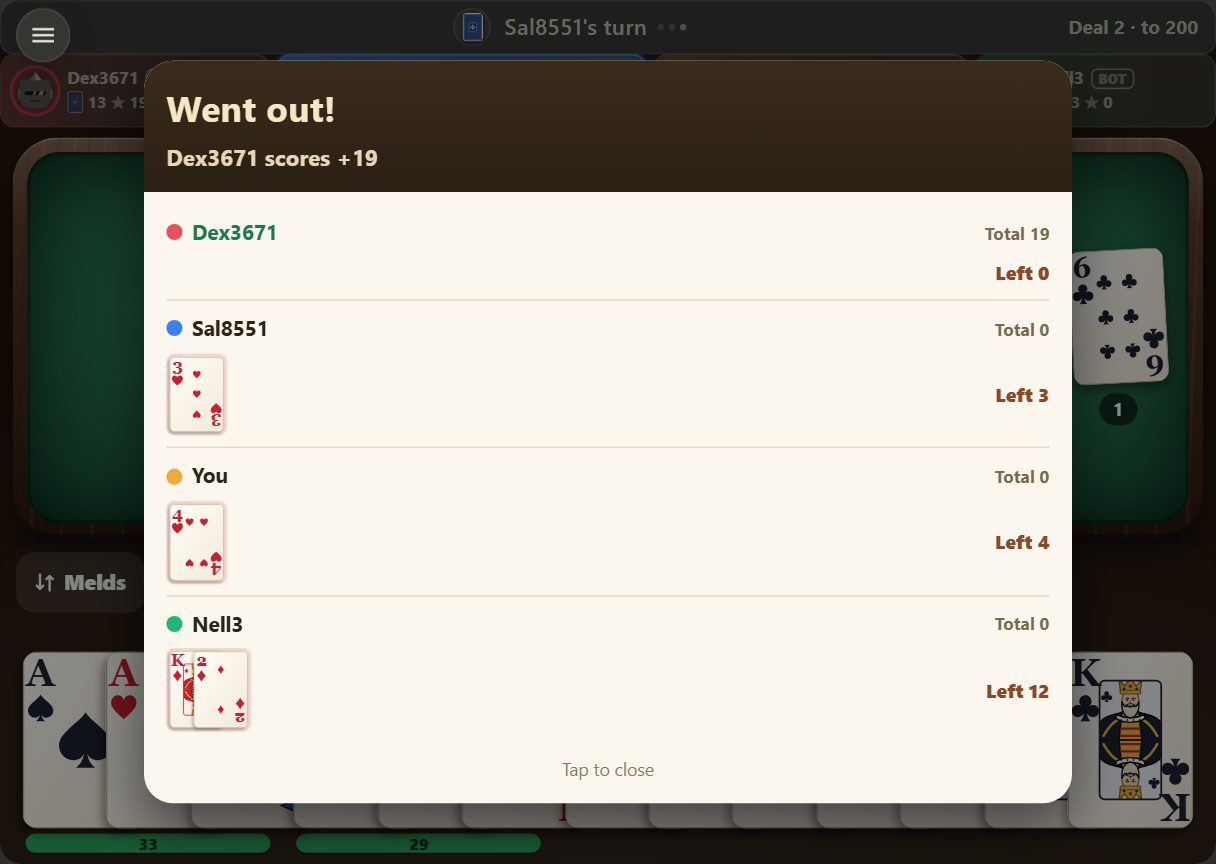
A deal ends when someone empties their hand, either by discarding the last card or by melding or laying it off, with no discard needed. The winner scores the sum of every rival's penalty for the cards still in that rival's hand: 2 to 10 at face value, J, Q and K 10 each, ace 11, joker 20.
- Only cards left in hand count. A rival's melds on the table are not subtracted, and cards they could not play count in full even if they opened earlier.
- Nothing extra is added for a rival who never opened. Their cards are counted like anyone else's.
A worked deal
Three rivals are caught holding K and 7 (10 + 7 = 17), ace, joker and 3 (11 + 20 + 3 = 34), and 4, 4 and Q (4 + 4 + 10 = 18). The winner scores 17 + 34 + 18 = 69.
Hand Rummy: double
If the winner went out in a turn that began with them not yet opened, including opening and going out in the same turn, the deal is a Hand Rummy and the sum is doubled: 69 becomes 138. A winner who opened on an earlier turn scores the ordinary 69.
When nobody can go out
When the stock runs out, the discard pile except its top card is shuffled back into it, at most twice per deal. If the stock runs dry a third time, or the pile has fewer than two cards, the deal is blocked: the lightest hand wins, with a tie going to the lower-numbered seat. The winner scores the sum, over every other player, of how much heavier that player's hand is. With hands of 25, 17 and 24 points the 17 wins and scores (25 − 17) + (24 − 17) = 15. A blocked deal is never doubled.
How long a match lasts
The default is one deal: the first scored deal ends the match and its winner wins. Choose "To 200" in the room options and scores build up over several deals, with the match ending as soon as a deal's winner reaches 200. Only a deal's winner scores, everyone else adds nothing for that deal, and the dealer moves one seat after each scored deal so the first player rotates.
What to do with this
Count your best melds before you commit to a threshold, and count your hand every turn: every unplayed card is points for the winner, and aces (11) and jokers (20) cost the most, so do not sit on them longer than you need to. Start with an opening of 30, then raise it to 40 and 51 as you get comfortable. You can try all three in Rummy on Playgridia, and Rummy vs Gin Rummy shows how the two games' counts differ.
Frequently Asked Questions
How many points do you need to open in Rummy 51?
In the 51 setting your first melds, laid down in a single action, must total at least 51 points. For example 7-7-7 (21) plus K-K-K (30) makes exactly 51, and so does one 10-J-Q-K-A run in a single suit. On Playgridia the host can also choose 30 or 40, and 40 is the default.
Does a joker count toward the 51 opening?
Yes. A joker counts as the card it stands in for, so 5, joker, 7, joker, 9 in one suit is worth 5 + 6 + 7 + 8 + 9 = 35. Every meld still needs at least two natural cards, and a run cannot have two jokers side by side.
How much is a joker worth if I am left holding it?
A joker left in your hand costs 20 points, the most of any card. Aces cost 11, face cards 10 and the other cards their face value, and the winner of the deal scores the total of what every rival is left with.
Is the ace 1 or 11 in Rummy?
It depends on what you are counting. In a Rummy opening on Playgridia it is 11 in a set or at the top of a run (Q-K-A) and 1 in A-2-3, and as a leftover card it costs 11. In Gin Rummy deadwood the ace is always 1.
What happens if nobody goes out?
The discard pile can be shuffled back into the stock at most twice per deal. After that, a stock that runs dry blocks the deal, and the lightest hand wins and scores the sum of how much heavier every other hand is. With hands of 25, 17 and 24 points, the winner scores 8 + 7 = 15.
Does the winner get extra points for rivals who never opened?
No. There is no fixed penalty for a rival who never opened, so their leftover cards are counted like anyone else's. The only bonus is the double score for a Hand Rummy: going out in a turn that began with you not yet opened.