Gin Rummy Rules: How to Play for 2 Players, Step by Step
Gin Rummy rules fit in one sentence: two players, one 52-card deck, ten cards each, and on every turn you draw one card and discard one while building sets and runs, until you knock because the cards left over (your deadwood) total 10 or less. This guide shows how to play Gin Rummy step by step, as it runs on Playgridia. Rules vary between tables, so wherever a number matters below, it is the number this game uses.
What you need and how the deal works
Gin Rummy is played by exactly two players with one standard 52-card deck and no jokers. Each player is dealt 10 cards, one more card is turned face up to start the discard pile (the upcard), and the other 31 cards form the face-down stock. Which seat plays first is drawn at random when the room starts, and in a longer match the lead alternates from one scored deal to the next.
A turn: draw one card, discard one card
- Draw. Take the top card of the stock without seeing it, or the top card of the discard pile. You can only ever take that single top card, never a handful from the pile.
- Discard. Put one card from your hand face up on the pile. That ends your turn. You may not throw back the card you just took from the pile, but a card drawn from the stock can go straight back.
There is no pass round on the first upcard: whoever plays first may take it or draw from the stock. Your melds stay in your hand and are only laid open when someone knocks. The move clock is a budget for the whole turn, 45 seconds by default (30, 45, 60 or 90 seconds, or 10 minutes, in the room options). If it runs out, the server draws from the stock and discards for you, but it never knocks on your behalf.
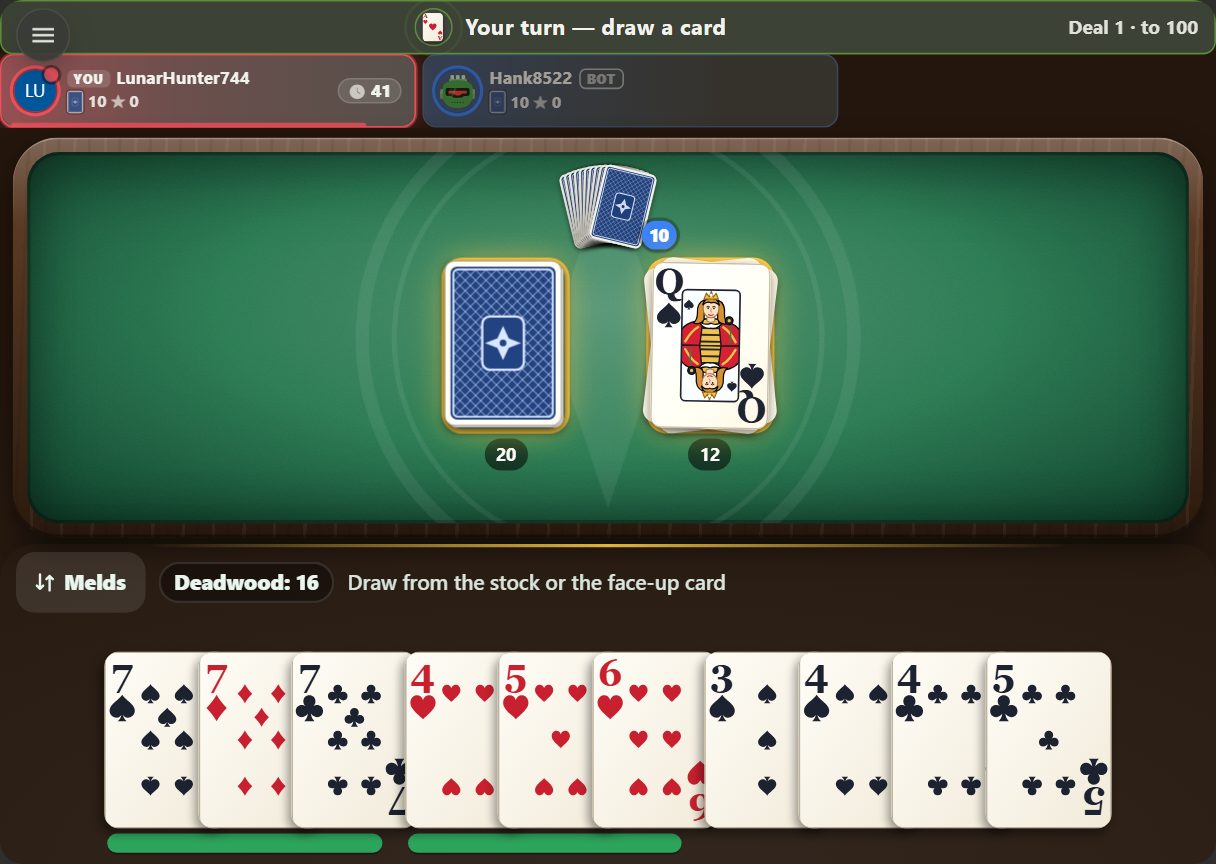
Melds and deadwood
A set is 3 or 4 cards of the same rank, each in a different suit. A run is 3 or more consecutive cards of one suit. The ace is low only: A-2-3 is a run, but Q-K-A is not a meld in Gin Rummy.
| Cards | Meld? | Why |
|---|---|---|
| 7♥ 7♠ 7♦ | Yes, a set | Three of one rank, three different suits |
| 7♥ 7♠ | No | A set needs at least 3 cards |
| 4♣ 5♣ 6♣ 7♣ | Yes, a run | Four in a row, all one suit |
| 4♣ 5♣ 6♦ | No | A run stays in one suit |
| A♠ 2♠ 3♠ | Yes, a run | The ace counts low |
| Q♠ K♠ A♠ | No | The ace is never high in Gin Rummy |
Every card that is not in a meld is deadwood, and it costs you its value:
| Card | Deadwood value | Example |
|---|---|---|
| Ace | 1 | A♦ = 1 |
| 2 to 10 | Face value | 7♣ = 7 |
| Jack, Queen, King | 10 each | K♥ = 10 |
Leftover cards of 5♠, 3♦ and A♦ make 5 + 3 + 1 = 9 deadwood, low enough to knock. Add a king and it is 19, too high. When you knock, the server arranges your hand for the lowest possible deadwood, so you never have to work out the best grouping yourself.
Knocking and going gin
After you draw, you can end the deal by knocking instead of a plain discard. You discard one card and knock in a single action, and the other ten cards must leave deadwood of 10 or less. If the count is higher, the knock is refused and the deal goes on. Knocking is an alternative to discarding, so you can also keep playing for a lower count. The one restriction mirrors the discard rule: the card you knock with cannot be the card you just took from the pile.
If all ten remaining cards fit into melds (deadwood 0), you have gone gin. It is the strongest finish: the other player gets no chance to lay off, and you score a bonus.
What the defender does, and the undercut
After an ordinary knock, the other player (the defender) lays their hand open, groups it into their own melds and then lays off deadwood onto the knocker's melds: extending a set to four cards, or adding to either end of a run (the ace is still low). Only the defender lays off, and the server picks whichever order leaves the defender the least deadwood. Then the two totals are compared:
- If the defender still has more deadwood than the knocker, the knocker wins the deal.
- If the defender has equal or lower deadwood, it is an undercut and the defender wins the deal instead. A tie counts as an undercut.
That is the risk of knocking early: the defender gets a look at your melds and a chance to catch you.
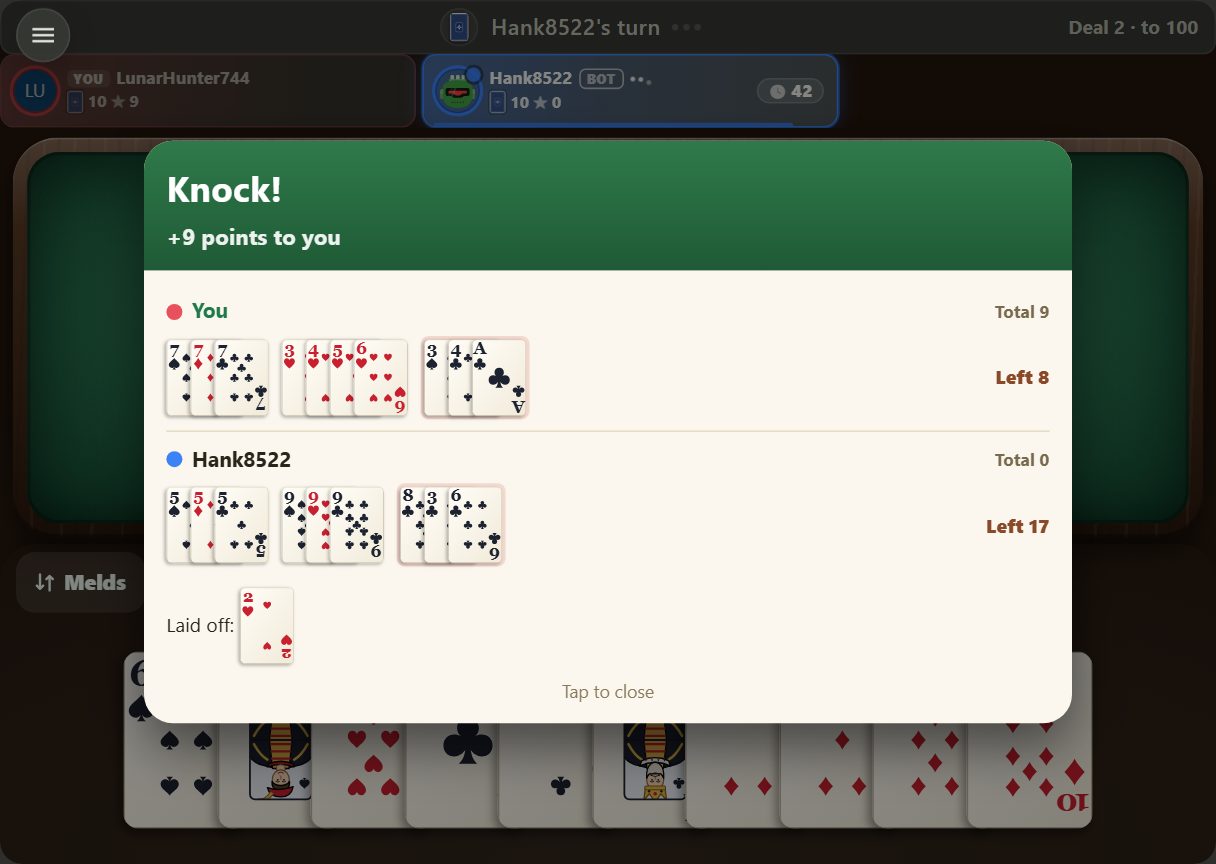
Scoring, dead hands and match length
Only the winner of a deal scores. After a knock, the knocker scores the difference between the two deadwood totals. Going gin scores a 25-point bonus plus the defender's whole deadwood. An undercut scores the defender the difference plus a 25-point bonus, so a tie is worth exactly 25. Bonuses are table rules and vary between tables; 25 and 25 are the ones Playgridia uses. Worked examples are in the Gin Rummy scoring guide.
If a discard leaves two cards or fewer in the stock and nobody has knocked, the deal is dead: nobody scores, it does not count as a win, and the same dealer deals again. The stock is a clock, so knock before it runs thin.
The room options set the match length. One deal (the default) means the winner of the first scored deal wins the match. The other option plays to 100: scores add up over several deals, and the match ends the moment a deal's winner reaches 100 in total.
What the table does for you on Playgridia
The Gin Rummy table keeps the arithmetic off your plate:
- Deadwood meter. It shows the deadwood of your best arrangement. On your discard step it shows what you would have after the best discard, and it turns green once you can knock.
- Auto-grouped hand. In the default Melds sort, your hand is grouped into the best melds. A button cycles to Suit and Rank sorting, and dragging cards yourself gives you your own order.
- One-tap Knock or Gin. When a knock is possible, a Gin! or Knock button uses the best discard, and the Knock button shows the deadwood you would be left with. Select a card yourself and the button appears only if that card works.
- Hint. The Hint button highlights the best discard.
- Drag to discard. Drop a card on the pile to throw it.
Your rival's hand is a fan of card backs with a count. The pile shows only its top card and a count, and you cannot browse earlier discards, so remember what your rival picks up: a short line names the rival's last action, but it fades after about four seconds.
Where to go from here
Start with one habit: after every draw, glance at the Deadwood meter and ask which card is costing you most. Tens and face cards are the expensive ones. When you are ready to plan around a rival, read the Gin Rummy strategy tips, and if you are weighing this game against the table version with jokers and up to six seats, see Rummy vs Gin Rummy.
Frequently Asked Questions
How many cards do you get in Gin Rummy?
Each player is dealt 10 cards from one 52-card deck with no jokers. One more card is turned face up to start the discard pile, and the other 31 cards form the face-down stock. Gin Rummy is played by exactly two players.
When can you knock in Gin Rummy?
After you draw, you may discard one card and knock if the other ten cards leave deadwood of 10 or less. There is no minimum number of turns, so a knock is allowed on your first turn if the count is low enough. You cannot knock with the card you just took from the discard pile.
What is an undercut in Gin Rummy?
An undercut happens when, after laying off onto the knocker's melds, the defender has deadwood equal to or lower than the knocker. The defender then wins the deal and scores the difference plus a 25-point bonus. A tie counts as an undercut and is worth exactly 25.
Can you lay off cards after gin?
No. When a player goes gin, the defender gets no lay-offs and the knocker scores 25 plus the defender's deadwood. After an ordinary knock, the defender may lay off onto the knocker's sets and runs.
Is an ace high in Gin Rummy?
No. On Playgridia the ace is low only, so A-2-3 is a run but Q-K-A is not a meld. As deadwood the ace counts 1 point, while jacks, queens and kings count 10 each.
What happens when the stock runs out in Gin Rummy?
If a discard leaves two cards or fewer in the stock and nobody has knocked, the deal is dead. Nobody scores, it does not count as a win, and the same dealer deals again.