How to Play Seven Sails: Complete Guide | Playgridia
Here is how to play Seven Sails, the naval war-and-trade game on Playgridia. You command one ship on a tile-grid sea: you carry cargo between islands to pay for a crew, then use that crew to take islands off rival captains. Hold the map's island target — or be the last captain afloat — and the archipelago is yours. Seven Sails is free in the browser for 2–6 players, with no download.
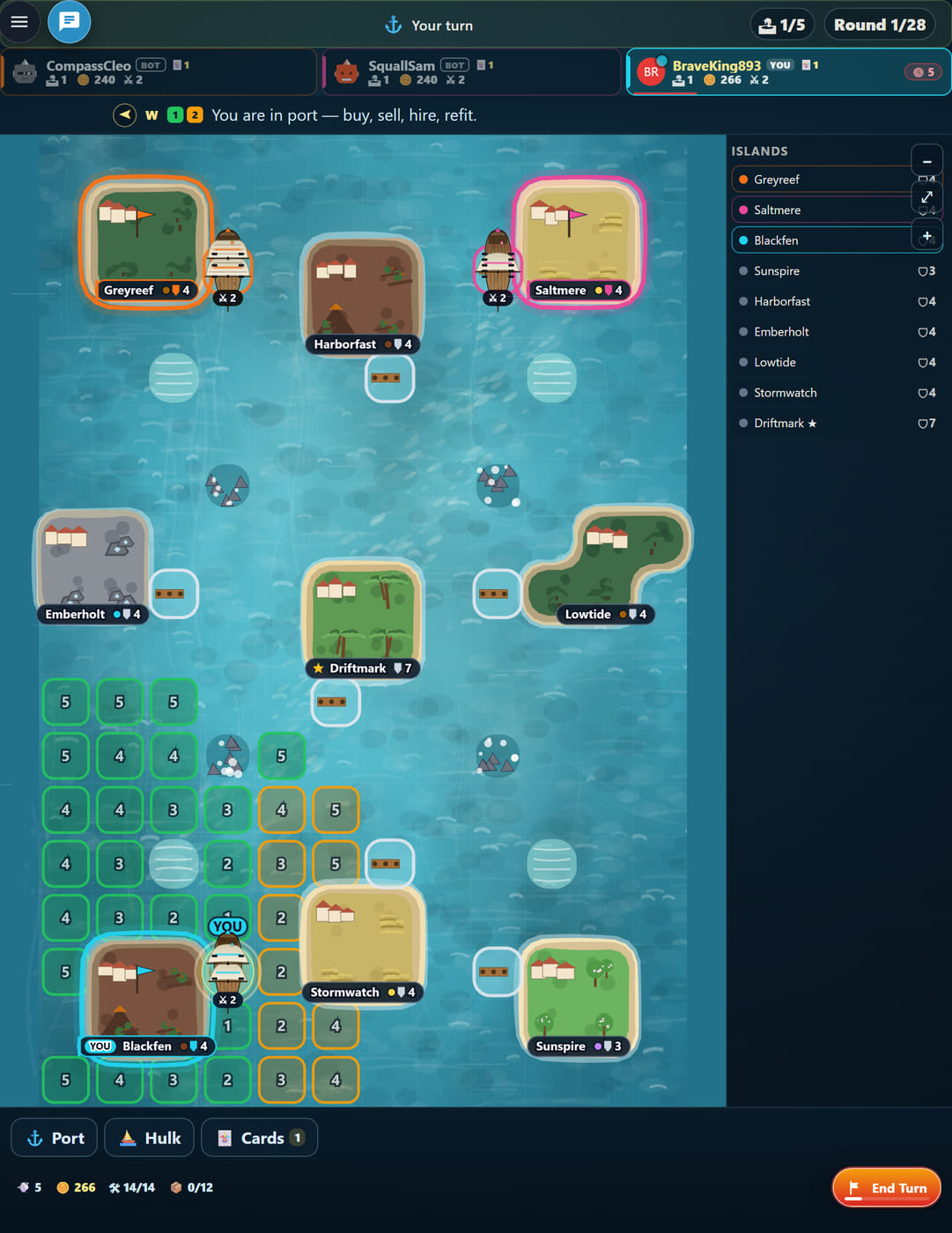
The sea is a grid, and you really steer
Your ship stands on a tile and carries a heading. Each turn you get sail points equal to your ship's speed; the engine solves the wind for you and lights up every tile you can reach with its price written on it. Tap one and she comes about and sails there, tile by tile.
- Green tile — 1 point. The wind is behind you or abeam.
- Amber tile — 2 points. You are beating into it.
- A shoal costs 1 extra, and a deep-draught hull (Galleon, Hulk) cannot enter one at all. Reefs are impassable and block a line of fire.
- The wind is mostly steady: there is a 34% chance per round that it backs or veers one point of eight. Chain shot in your rigging costs you speed, but never below 3.
You never compute an angle. That is the whole design: the arithmetic is the engine's job, the route is yours.
What one turn looks like
Island tax, convoy income and a 14-gold harbour stipend land at the top of your turn; a garrison above two souls and a deck above three cost upkeep, and the stipend guarantees upkeep can never put you in debt. Then you sail — and everything else happens where the ship is.
- On a harbour tile the market, the quay, the yard and the island panel all open. Harbour business costs no movement at all, only gold.
- Laying alongside a rival costs 1 sail point, a bombardment 1, and putting a party ashore 2.
- Then End Turn. The move clock is 90, 120 or 180 seconds and defaults to 120.
Trade pays for the war
Five goods move on this sea: grain, timber, coffee, silk and gems. Each is cheap where it is grown and dear where it is wanted, and your hold remembers what every crate cost, so a sale reads back as profit in green or a loss in red rather than as a bare number.
- Profit lives between islands. Buying pushes a price up and selling pushes it down, and the sell price is always clamped below the buy price — so buying and selling in the same harbour is a guaranteed loss, by design.
- Trading at somebody else's harbour pays them a 12-gold dock fee.
- Hold two islands and you can found a convoy between them: 65 gold once, then 15 gold every round. A rival whose ship is sitting on that lane can raid it for 48 gold and a card.
- Every island produces one good and demands two. The map's hub — Driftmark on The Narrows, King's Rest on The Great Archipelago — produces nothing, pays fairly for everything, and carries the richest tax on the board.
Your crew is a roster of people
You start with 240 gold and two hands. Every harbour keeps a visible recruit pool that refreshes each round; a rival's quay will sell you only one hand per turn.
| Crew | Cost | Melee | Gunnery | Volley | What they do |
|---|---|---|---|---|---|
| Sailor | 24 gold | 1 | 2 | — | Feeds the broadside |
| Marine | 34 gold | 2 | 1 | 1 | Volleys before any melee |
| Corsair | 42 gold | 3 | — | — | Best boarder, deck or beach |
Sailors feed the broadside, Marines fire a musket volley before any melee begins, and Corsairs fight hand to hand on a deck or a beach. A hand who has survived three fights can be promoted at a harbour for 46 gold, adding one to every line above. Nobody ever dies: casualties are wounded, and two of them are back on their feet every round on an island you hold. Every hand past the third on your deck costs 1 gold a round, and every garrison soul past the second costs 2.
The duel: three exchanges, then the deck
Lay alongside a rival for 1 sail point and a battle scene takes the screen. You get up to three exchanges, and you pick the shot each time.
- Round shot holes the hull. At zero hull she strikes.
- Chain shot shreds the rig: she slows down and cannot run.
- Grape shot sweeps the deck and kills crew.
Chain and grape each trade one shot for their specialisation, and both sides fire at the same moment — there is no first-strike bonus for being the attacker. There are no dice anywhere in this game. Every shot is a card dealt off the BATTERY DECK: four hits and four blanks, drawn without replacement, with the composition printed on screen. Eight shots land exactly four times, and four shots can never all blank. That is bounded luck you can count instead of a die you pray at.
After an exchange you may throw the grapples and go over the rail. Your marines volley first, then up to three rounds of melee — and a mutual wipe is a defender hold, because a deck you failed to clear is a deck you did not take. Losing does not end your campaign: the victor takes a quarter of your purse (up to 160 gold) and three cargo units, and you refit at your own island next turn for 90 gold, back on the water at 60% hull.
The Sea Fortune hand
One shared deck of 13 card types serves the whole table. You draw for winning a fight, taking an island, raiding a convoy, or banking a sale worth 70 gold of profit or more — and every captain starts the match already holding one.
- You hold at most five, and you may play only one per engagement. The question is never "do I have a card", it is "is this the fight".
- Cards are played face up, so you can see what a rival has armed and they can see yours.
- The defender may play one out of turn — the single thing a captain can do on somebody else's go.
- Favourable Slant and Crossing the T grow or shrink a broadside; the Carpenter's Gang patches the hull; a Fog Bank buys you out of a fight instantly with no return fire; a Black Flag doubles the prize.
Taking a shore
An island's garrison is real people too, and taking one is a two-step job.
- Bombard (1 sail point). Two hits silence the walls and the battery for the turn, and every third hit beyond that costs the garrison a soul. Note that bombarding commits you: that island is closed to you for the rest of the turn.
- Land (2 sail points). You choose how many go ashore, and the true odds are printed before you commit. Win and the survivors stay as the island's new garrison — so landing everybody leaves your ship empty.
A captured island loses every building, so you rebuild from scratch: walls 100 gold, a shore battery 125 (it fires on any enemy ship within two tiles, on their turn), a shipyard 145 (halves repair costs), a warehouse 90 (+4 tax and a bigger recruit pool).
How you win — and how you lose
The map owns the target. On The Narrows (portrait, 12×18, nine islands, 2–4 captains) you need 5 islands at two or three seats and 4 at four. On The Great Archipelago (wide, 22×14, thirteen islands, 2–6 captains, west against east) it runs 5 · 6 · 5 · 5 · 4 as the table grows. Get there and the match ends at once; your final score is simply your island count.
You can also win by being the last captain afloat — and you are only out once you have lost your last shore and your ship together. A struck captain who still holds ground always comes back. If nobody meets the target, a per-map round cap (28 on The Narrows, 32 on The Great Archipelago, roughly a third shorter on the Quick pace option) scores the leader out.
Ready to sail? Play Seven Sails free — and when you want the tactics, read our Seven Sails strategy guide.
Any third-party brand or game names mentioned are trademarks of their respective owners. Playgridia is an independent platform and is not affiliated with or endorsed by them.
Frequently Asked Questions
Does Seven Sails use dice?
No. Every shot is a card dealt off the battery deck: four hits and four blanks, drawn without replacement, with the composition printed on screen. Eight shots land exactly four times, so a broadside can never whiff completely. The same deck resolves broadsides, musket volleys, boarding melee and shore bombardment.
How do you win Seven Sails?
Hold the number of islands your map asks for — between 4 and 6, depending on the board and how many captains sat down — or be the last captain still afloat. Your final score is your island count. Gold only matters as the third tiebreak if the round cap runs out first.
Can you be knocked out of a match?
Yes, but it is hard. You are eliminated only when you have lost your last island AND your ship. A captain whose ship is struck but who still holds ground refits for 90 gold at the start of their next turn and comes back at 60% hull.
Which ship should a beginner pick?
The Galleon is the most forgiving: the thickest hull in the game, three guns, and armour that shrugs off one hit every exchange at sea. The Cog trades better than anything else but carries no guns at all, which makes it the hardest opening for a new captain.
How long does a match take?
Most matches end on the island target well before the round cap, which is 28 rounds on The Narrows and 32 on The Great Archipelago. The move clock is 90, 120 or 180 seconds per turn and defaults to 120, and the room's Quick pace option cuts the round cap by about a third.