Seven Sails Strategy: How to Win Islands | Playgridia
A winning Seven Sails strategy starts from one fact: this game is not scored on gold, it is scored on islands. Hold the number your map asks for — 4 to 6, depending on the board and how many captains sat down — or be the last one afloat. Everything below serves that. If you have not played yet, start with our how-to-play guide and come back.
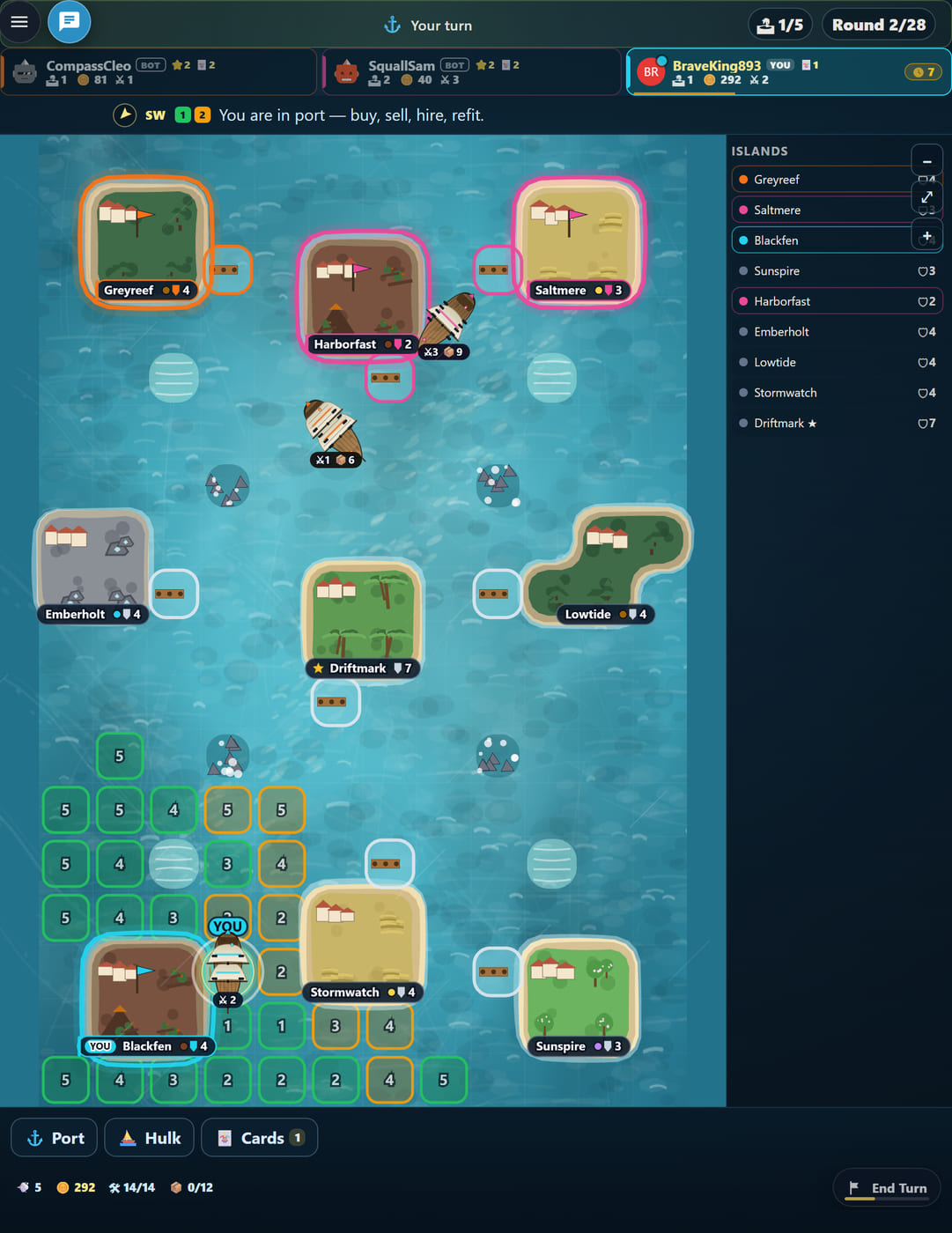
Know the number you are racing to
The map sets your target, not the rulebook, and it moves with the table.
- The Narrows (nine islands): 5 islands at two or three captains, 4 at four.
- The Great Archipelago (thirteen islands): 5 · 6 · 5 · 5 · 4 from two captains up to six.
You begin holding exactly one — your home. So the real question every turn is "which shore is the cheapest one left". Early it is a neutral contested shore held by four militia. Later it is not: rival aggression scales with the round number and with who is leading, and once the free shores run out the cheapest island on the board is the leader's. Expect the last two islands of any match to be taken off a person, not off the map.
Pick the hull that matches your plan
Your hull is chosen in the waiting room, every number is printed on the chip before the match starts, and it is the whole of the game's asymmetry. It is also your seat colour — that is, every ownership mark on the chart.
| Hull | Speed | Guns | Hold | Berths | Plays like |
|---|---|---|---|---|---|
| Cog | 6 | 0 | 8 | 7 | Pure trader: better prices at every harbour, but no guns — she must buy her war |
| Frigate | 7 | 2 | 5 | 8 | An extra broadside shot; owns open water, ordinary on a beach |
| Schooner | 9 | 1 | 5 | 6 | Fastest hull; attacking, the enemy answers with 2 fewer shots in the first exchange |
| Galley | 6 | 1 | 6 | 11 | The biggest deck in the game plus +2 melee storming a shore — the conqueror |
| Galleon | 6 | 3 | 9 | 10 | 16 hull and shrugs off a hit each exchange at sea; deep draught, no shoals |
| Hulk | 5 | 0 | 12 | 7 | Island tax and convoy income +35%; helpless in a duel, unmatched once it holds ground |
The counters are real: a Schooner's raking pass cuts return fire but does nothing about a Galleon shrugging off a hit every exchange, and a Galley that cannot reach a beach is just a slow ship with one gun. Pick for what you intend to be doing in round twelve, not round two.
Your first ten rounds: trade, then buy the war
You start with 240 gold, two Sailors and one Sea Fortune card. Two Sailors is not an assault force — a contested shore keeps four militia and it will hold.
- Run cargo before you run at anybody. Buy where a good is produced, sell where it is demanded, and never both in one harbour: the sell price is clamped below the buy price by design.
- Bank a sale worth 70 gold of profit or more and you draw a Sea Fortune card — the cheapest card in the game and worth routing for.
- Buy Corsairs for the beach and Sailors for the guns. Two Sailors on deck is one extra broadside shot; a Corsair at 42 gold is melee 3.
- Recruit at home. A rival's quay sells you only one hand a turn; your own pool refreshes every round.
- Always bombard before you land. One sail point, and two hits silence the walls and the shore battery for the turn. But it commits you: that island is closed to you for the rest of the turn, so never open on a shore you were not going to storm.
Win the duel before it starts
Your shot count is your ship's guns, plus one for every four points of gunnery on deck, plus one. So Sailors are gun crew you can buy, and the Guns upgrade (85 then 135 gold) is a permanent extra shot.
- Count the deck. Four hits and four blanks, drawn without replacement: eight shots land exactly four times. A big broadside is therefore more reliable, not merely bigger — stacking shots is how you remove luck, not how you gamble.
- Pick the shot for the outcome you want. Round shot to take the prize, chain to stop a runner (or to strand a rival away from the island you are about to storm), grape immediately before boarding, because a deck with no crew on it cannot fight back.
- Chain and grape cost you one shot each. If you only have two shots, round shot is usually still right.
- Both sides fire at the same moment. Attacking buys you the choice of shot and nothing else. If the numbers are against you, break off — that exit is always open.
- Sell your hold before you go hunting. Losing costs a quarter of your purse (up to 160 gold) and three cargo units, and a full hold is exactly what makes you worth attacking.
A boarding is decided by melee power, and a mutual wipe is a defender hold. The percentage on the board button is the true odds of the whole melee, computed over that same deck — trust it, and do not take a coin flip you did not need.
Keep your veterans alive
Nobody dies in this game, which is exactly why a veteran crew is a real asset.
- A hand who has survived three fights promotes at a harbour for 46 gold and gains +1 melee, +1 gunnery and +1 volley. A promoted Corsair fights at 4.
- Casualties always take the weakest unit first, so a mixed party protects your veterans by putting fresh Sailors in front of them.
- Wounded recover two per round, but only on an island you hold — plan a pass through your own harbour instead of grinding on an empty deck.
- Do not land everybody. If you win, the survivors stay ashore as the new garrison and your ship sails on with no crew: no gunnery bonus, no boarding, and nobody to take the next shore with.
Hold what you take
A captured island loses every building, so the turn after a conquest is a building turn.
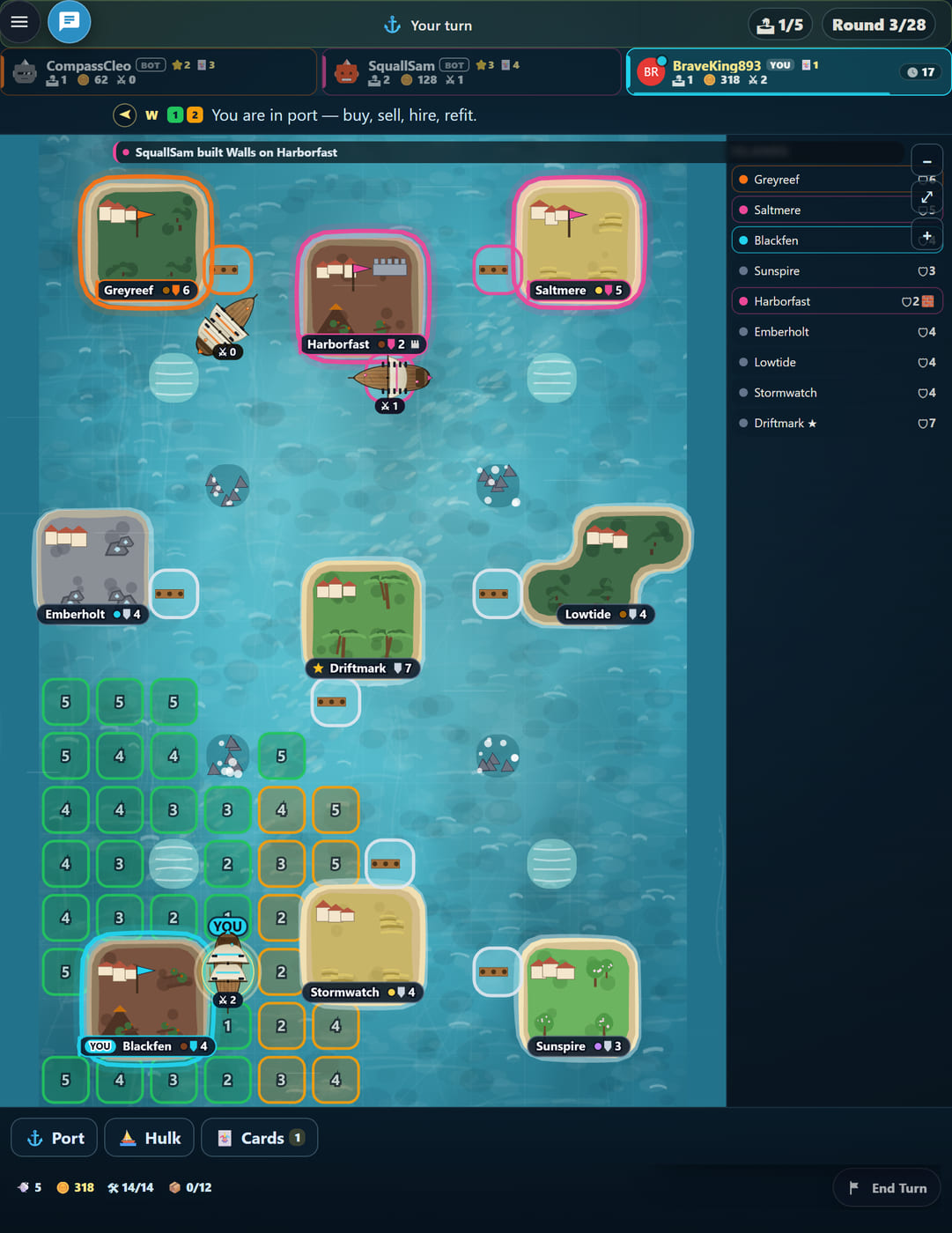
- Walls (100 gold) on any island a rival can reach — two extra defence shots is often the difference between holding and re-taking.
- A shore battery (125) on a border island. It fires on any enemy hull within two tiles on their turn: the only thing you own that plays while you are not playing.
- A warehouse (90) on a quiet island: +4 tax every round and a bigger recruit pool. It pays for itself and then keeps paying.
- A convoy once you hold two islands: 65 gold, then 15 every round. Do not run one through open water a fast hull patrols — a raid takes 48 gold and hands them a card.
Watch upkeep. Every garrison soul past the second costs 2 gold a round, so a fat garrison on a safe island is money you are not spending on the next one.
Play your Sea Fortune hand like an ace
You hold at most five, and a draw past five is simply declined — so a hoarded hand is discarded income. One card per engagement, played face up.
- Crossing the T before an even fight beats Favourable Slant after it: cutting their shots protects your hull as well as landing yours.
- Fog Bank is an escape button. Keep one while you are carrying a hold worth 300 gold.
- Rum Ration is the beach card: +2 melee turns a marginal landing into a favourable one, and it works on a shore assault as well as a boarding.
- Assume the captain you are shooting at holds one too — the defender may play out of turn. Odds printed before a card is revealed are not the odds you will get.
Five mistakes that cost matches
- Buying and selling in the same harbour. It is a guaranteed loss; the market clamps the sell price below the buy price.
- Trading past round fifteen with no crew. Gold is not the score, and a pile of it with two Sailors on deck cannot take a shore.
- Landing your whole party. Your ship sails on empty, and the crew is the game's whole engine.
- Opening a bombardment you do not follow up. It closes that island for the rest of the turn and leaves you nothing next turn.
- Ignoring the leader near the cap. If the round cap arrives (28 on The Narrows, 32 on The Great Archipelago), the win goes to most islands, then flagship level, then gold. One island taken off the leader is worth two of anybody else's.
Play Seven Sails free and put the fleet to sea.
Frequently Asked Questions
What is the fastest way to win Seven Sails?
Take the neutral shores early. They are held by four militia and they are the cheapest islands on the board; once they are gone, only defended rival islands remain. In practice that means one or two cargo runs, buy Corsairs, bombard the shore, then land against a printed win percentage you actually like.
Which ship is the strongest in Seven Sails?
There is no single strongest hull — the six play six different games. The Frigate and Schooner own open water, the Galley is the best hull for storming a shore, and the Cog and Hulk print money but are helpless in a duel. The Galleon is the most forgiving: the thickest hull, three guns, and armour that eats a hit every exchange.
Should I focus on trading or fighting?
Both, in that order. The score is your island count, so a pure trader never reaches the target — but trade is the only thing that pays for crew, upgrades and buildings. In practice: trade in the opening, take neutral shores in the mid-game, and fight rivals for the last islands.
How do I survive against a stronger fleet?
Build walls and a shore battery — the battery fires on the enemy during their own turn, so it defends while you are not playing. At sea, break off when the numbers are against you, or play a Fog Bank. And remember you are only eliminated when your last island and your ship are gone together.
Do I lose everything when my ship is sunk?
No. The victor takes a quarter of your purse, capped at 160 gold, and three cargo units. At the start of your next turn you refit at your own island for 90 gold and come back at 60% hull. Only a captain with no island left to refit at is actually out of the match.