Free Online Property Trading Game | Playgridia
If you want a free online property trading game you can start in seconds, Estates is exactly that: a browser-only, no-download version of the classic roll-buy-build-and-collect-rent loop, built for 2 to 6 players against friends or bots.
Everything a property-trading fan expects
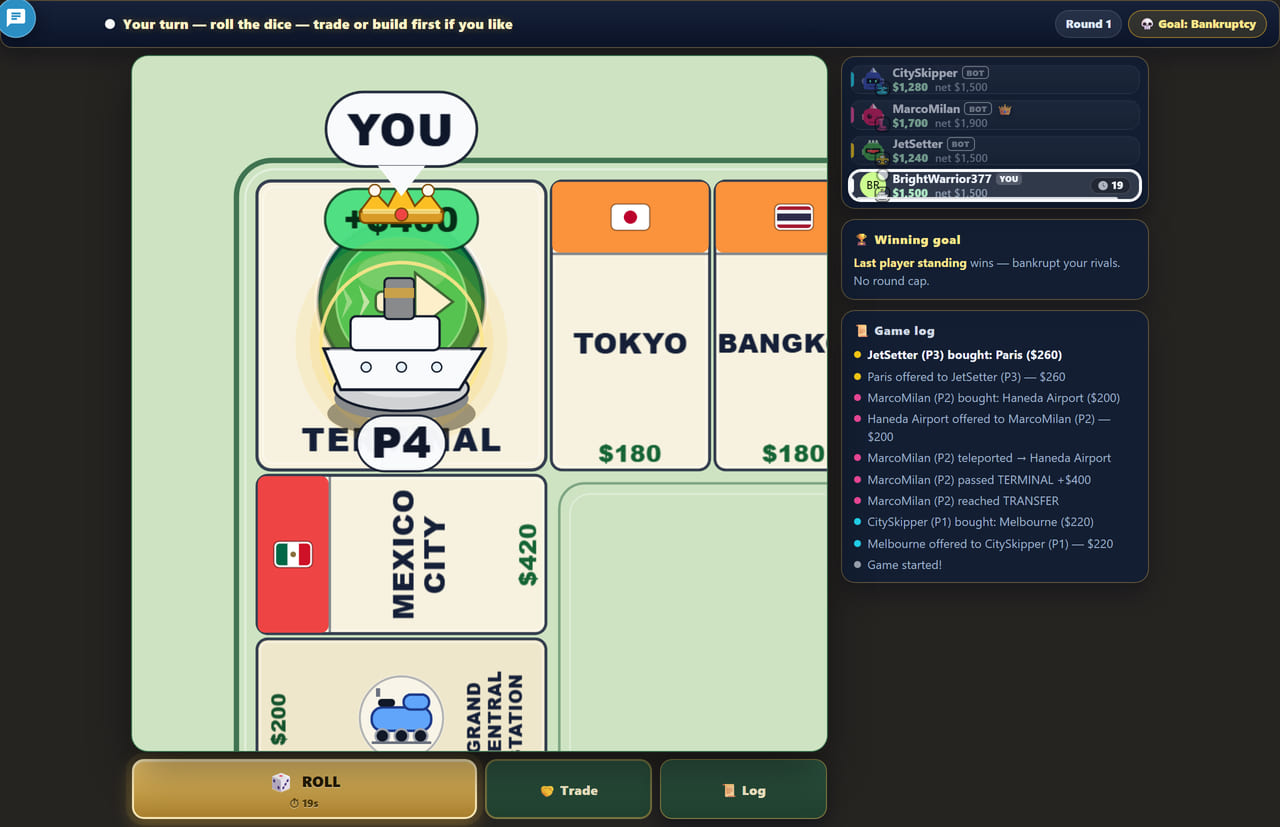
The loop you already know is all here. Roll two dice, move around a 32-tile ring, and either buy the city you land on or watch it go to a live auction. Land on the Terminal corner, or simply pass it, and you collect $400; land on Jail without being sent there and it's just a visit — no penalty. Draw from the Treasure or Surprise deck and something happens immediately (cash in or out, a forced move, a payout from every rival), or you're handed a card to play whenever you like: a free house on one of your monopoly cities, a demolition that knocks a level off a rival's building, or a Get-Out-of-Jail card. More than half of each deck is one of those two, and a demolition turns up three times as often as a free build. Each card type has its own hand limit — draw over it and you get a flat $50 instead. Pick your token before the match starts, too: top hat, race car, ship, dog, boot or plane, each with its own fixed colour. Weighing this against the classic board version? See our side-by-side comparison.
Five real-world boards, one shared rulebook
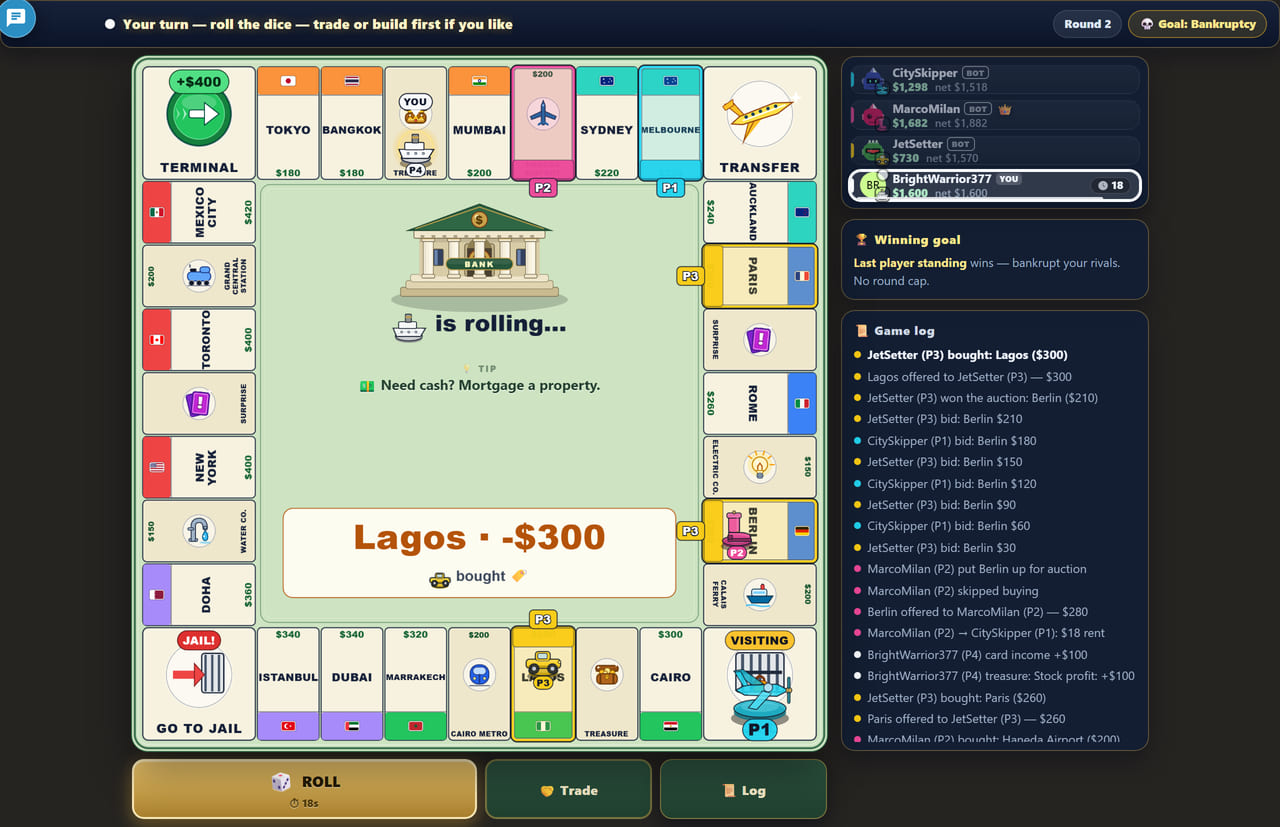
Room setup lets you choose the map: World (the default), Europe, USA, Türkiye or Asia. Every one of them is built from the exact same 32-tile layout — the same six rent tiers, the same $100–$200 build costs, the same four transport hubs and two utilities, the same Treasure and Surprise decks. What changes is the geography: 18 city names and prices, six region groups per map, and whether flags are shown at all — the single-country USA and Türkiye boards skip them.
| Map | Region groups | Flags shown |
|---|---|---|
| World (default) | Asia, Oceania, Europe, Africa, Middle East, Americas | Yes |
| Europe | Balkan, Iberia, Mitteleuropa, Nordic, Britain, Capitals | Yes |
| USA | South, Midwest, Mountain, West Coast, East Coast, Megacity | No |
| Türkiye | Karadeniz, Doğu, İç Anadolu, Akdeniz, Ege, Marmara | No |
| Asia | South Asia, Southeast Asia, India, China, East Asia, Pacific | Yes |
On the default World map, the four transport hubs are Haneda Airport, Calais Ferry, Cairo Metro and Grand Central — different names, the same $200 to buy, and one shared rent table: own any two of the four and rent is $150, own all four and it's $600. Electric Co. and Water Co. cost $150 each; own one utility and rent is your rival's dice roll ×10, own both and it's ×30.
Rent, building and mortgages, in one place
Own every city in a colour group and you've formed a monopoly — rent doubles immediately, before you've built a thing. From there it climbs with houses: ×5 with one, ×15 with two, ×30 with three, and ×50 once you've upgraded to a hotel, the fourth and final building level. Build cost is set per tier and runs from $100 up to $200 across the six colours, and you can't build at all while any tile in that group is mortgaged. Short on cash? Mortgage an unbuilt property for half its price; buying it back later costs that mortgage value plus 10% interest.
Live auctions and trading keep the table moving
Skip a city, or can't afford it, and it goes straight to a live auction: 12 seconds to open, every accepted bid pushes the deadline out by 7 more seconds, and the minimum raise is $10 — a bid inside the last half-second still counts, so nobody gets sniped by a slow connection. Decline a purchase and you're barred from bidding on it yourself once it hits the block.
Trading runs alongside all of that: offer cash, unbuilt property or held cards for whatever a rival has, and any open offer expires after 60 seconds if nobody answers. Offering is normally your-turn-only, with one exception — stuck trying to raise cash for a debt, any other player can pitch you a rescue trade out of turn, the one moment a deal can land outside its owner's own turn.
A bad roll doesn't end your game on the spot
Can't cover a rent bill, a card's cost or the Jail fine? You don't go bankrupt automatically. Estates opens a fundraising window first: pay what you owe outright, tap auto-raise (it mortgages and sells buildings back at half price for you, but refuses up front rather than push you into bankruptcy if it still won't cover the debt), auction off a property or a held card, or wait for a rescue trade. Only declaring bankruptcy yourself — or running out of every option — takes you out of turn order; your land and cards pass to whoever you owed, buildings razed with no refund.
How the match ends is a room setting, not a fixed rule. By default it's last player standing: no net-worth target, no round cap, everyone plays until only one active player is left. Set a numeric target instead — 6,000, 8,000 or 10,000 net worth — and the first player to reach it wins immediately. Or cap it at a fixed round limit (15, 20, 25, 30, 35 or 40), or leave it unlimited; when the cap hits, the highest net worth wins, ties broken by whoever's holding more cash.
Solo, with friends, or against bots
Estates seats 2 to 6, and a new room opens at 4 by default. The first four seats are open to anyone, guests included; a 5th or 6th chair needs a signed-in room owner, not a guest host. No friends online? Bots fill any empty seat at whatever difficulty you pick. Your turn runs on one shared clock — 120 seconds by default, with 60, 90 or 150 also on offer and no unlimited option — and it covers everything: rolling, buying, building and clearing a debt all draw from the same budget. A live auction shows its own countdown while it's open, but your turn clock keeps running underneath it, so a long one can eat most of your remaining time before you get to act again. Lose your connection mid-match and a bot takes your seat temporarily; reclaim it within two minutes of coming back and you resume right where you left off — only a deliberate exit hands the seat away for good.
New to Estates? Start on the default World map with the bankruptcy win condition — it's the version every rule above is written against. Once the rent ladder and the auction timing feel natural, our full Estates guide walks the whole turn structure step by step, and our Estates strategy tips cover when to buy, when to sit on cash, and when to let a property go to auction on purpose. Ready to play? Jump into Estates for free — no download, no sign-up, just a link.
Any third-party brand or game names mentioned are trademarks of their respective owners. Playgridia is an independent platform and is not affiliated with or endorsed by them.
Frequently Asked Questions
How many players can play Estates?
Estates seats 2 to 6 players, with new rooms opening at 4 by default. The first four seats are open to anyone, including guests; a 5th or 6th seat needs a signed-in, registered room owner rather than a guest host. You can also play solo against bots at any difficulty.
Do you get eliminated if you go bankrupt?
Not immediately. Estates opens a fundraising window first: pay what you can, use one-tap auto-raise to mortgage and sell buildings back at half price, auction off a property or a held card, or accept a rescue trade another player can offer you out of turn. Only declaring bankruptcy yourself, or running out of every option, removes you from turn order, and by default the match ends the instant only one player is left standing.
How does winning work if I do not want to play to bankruptcy?
Set a numeric net-worth target of 6,000, 8,000 or 10,000 instead, and the first active player to reach it wins immediately. Or pick a round limit of 15, 20, 25, 30, 35 or 40, or leave it unlimited; once the cap hits, the highest net worth wins, with ties broken by cash on hand.
How much does it cost to build houses and hotels?
Build cost is set per colour tier and runs from $100 up to $200 across the six tiers, the same numbers on every map. You need to own every city in a colour group, with none of it mortgaged, before you can build at all. Rent then climbs from double the base rate with no buildings to fifty times the base rate once a city has a hotel.
Can I play on different city maps, not just one board?
Yes. Pick from five real-geography boards when you set up a room: World (the default), Europe, USA, Türkiye or Asia. They all share the exact same 32-tile layout, prices and card decks; only the 18 city names, the six region groups and the board's colours change.
How long does a turn last, and what happens during an auction?
The move clock defaults to 120 seconds, with 60, 90 or 150 also selectable and no unlimited option, and it covers your whole turn including buying, building and clearing any debt. A live auction shows its own separate countdown while it's open, but your turn clock keeps counting down underneath it, so a long auction can burn through most of your remaining time before you get to act again.