Sea Battle Strategy Tips: Win Naval Battle | Playgridia
The fastest way to win Naval Battle is to stop shooting at random and start spending every turn on the widest shape you own. Your opponent hides exactly 14 hull cells in 80 squares of fog, and whoever uncovers those 14 first wins. These sea battle strategy tips cover the sweep that clears a row in four shots, which signature ability to spend on which piece of evidence, and why finishing a wounded ship beats spreading your fire.
The numbers you are actually playing against
Each side owns a separate ocean: 10 columns wide and 8 rows deep, 80 squares in total. Your fleet occupies just 14 of them — a 5-cell carrier, a 4-cell battleship, a 3-cell cruiser and a 2-cell destroyer. That is barely a sixth of the board, so a blind shot into open water misses roughly five times out of six. Every tactic below exists to beat that number.
There is no deployment screen: both fleets are arranged at random by the server every match, so there is no "favourite corner" habit to exploit or to give away. Your entire edge lives in how efficiently you search and how well you spend your abilities. The match ends the moment all four enemy ships are sunk.
Your battleship is your search engine
When you tap enemy waters, the game automatically picks the strongest gun you still have afloat and locks the target for you; the strip at the bottom names the ship, the shot and the square, and nothing fires until you confirm. The pattern depends on that ship's class: the battleship fires a 3-cell horizontal broadside, the cruiser a 2-cell line, and the carrier and destroyer a single square each.
The consequence is the most under-rated fact in the game: your scanning speed is tied to which of your own ships are still alive. With the battleship afloat, every ordinary shot inspects 3 squares. Lose it and you drop to 2; once the cruiser goes down as well you are back to opening one square per turn, the same rate as the pen-and-paper original. That is why sinking the enemy battleship is worth far more than the 4 hull cells it costs them — you also halve how fast they can find you.
Clear whole rows, four shots at a time
The broadside always delivers three squares, even at the board edge — aim at column 1 and it covers columns 0-2; aim at the outermost column and the pattern slides inward to take the final three. So a full row of 10 costs exactly four shots (aim at columns 1, 4, 7 and 9), and the entire 80-square ocean can be checked in 32 shots with nothing skipped.
Compare that with the classic trick everyone knows. Because the smallest ship is 2 cells long, it must always cover one dark and one light square of a checkerboard, so sweeping a single colour — 40 single shots — is guaranteed to touch every hull. That is the right method once your battleship is gone; while it is afloat the broadside sweep is faster and gapless. What you must never do is bunch shots next to each other in open water: adjacent single shots simply repeat information you already have.
Spend an ability on contact, never on a hunch
Every hull carries one signature weapon, and the cooldown is counted in your own turns: Air Strike needs five, Heavy Bombardment four, Cross Salvo and Torpedo Run three each. Across a match that is a small budget, so match the shape to the evidence you actually have:
- One hit, orientation unknown → Cross Salvo. The cruiser's plus covers the hit square and all four neighbours at once. Probing those by hand can take four turns; this takes one. It is the highest-value ability in the game and recharges in three.
- A confirmed hit with room around it → Air Strike. Nine squares in one turn, and the centre snaps inside the board so it never wastes cells over the edge. Aim it at the unexplored side of a wounded ship, not at squares you already burned.
- A tight two-by-two suspicion → Heavy Bombardment. The 2x2 forms around the square you tap rather than centring on it — the board paints the exact block before you fire, so read the highlight, not your intuition.
- A vertical hull to finish → Torpedo Run. Two cells: the square you choose and the one vertically adjacent to it. Cheap at a three-turn cooldown, and the right shape for a ship running down the board.
Cross Salvo is a plus, which makes it the one ability that loses cells at the board edge — fire it away from the outer rows and columns whenever you can.
Finish the wounded hull before you look elsewhere
Damage in this game is not a debuff. A carrier with four of its five cells burning fires exactly as well as an untouched one and can still call a full 3x3 air strike; only sinking it takes that weapon off the board. Spreading damage across three ships therefore buys you nothing — you have removed neither a gun nor an ability from the fight.
So the moment you land a hit, commit: work out the orientation and run the line until the wreck appears. With a choice of wounded targets, kill the battleship first (it costs them their sweep rate and a 2x2), then the carrier (the 3x3, and the biggest target on the board), then the cruiser. Leave the 2-cell destroyer for last: hardest to find, least dangerous afloat.
Let the fog take your notes
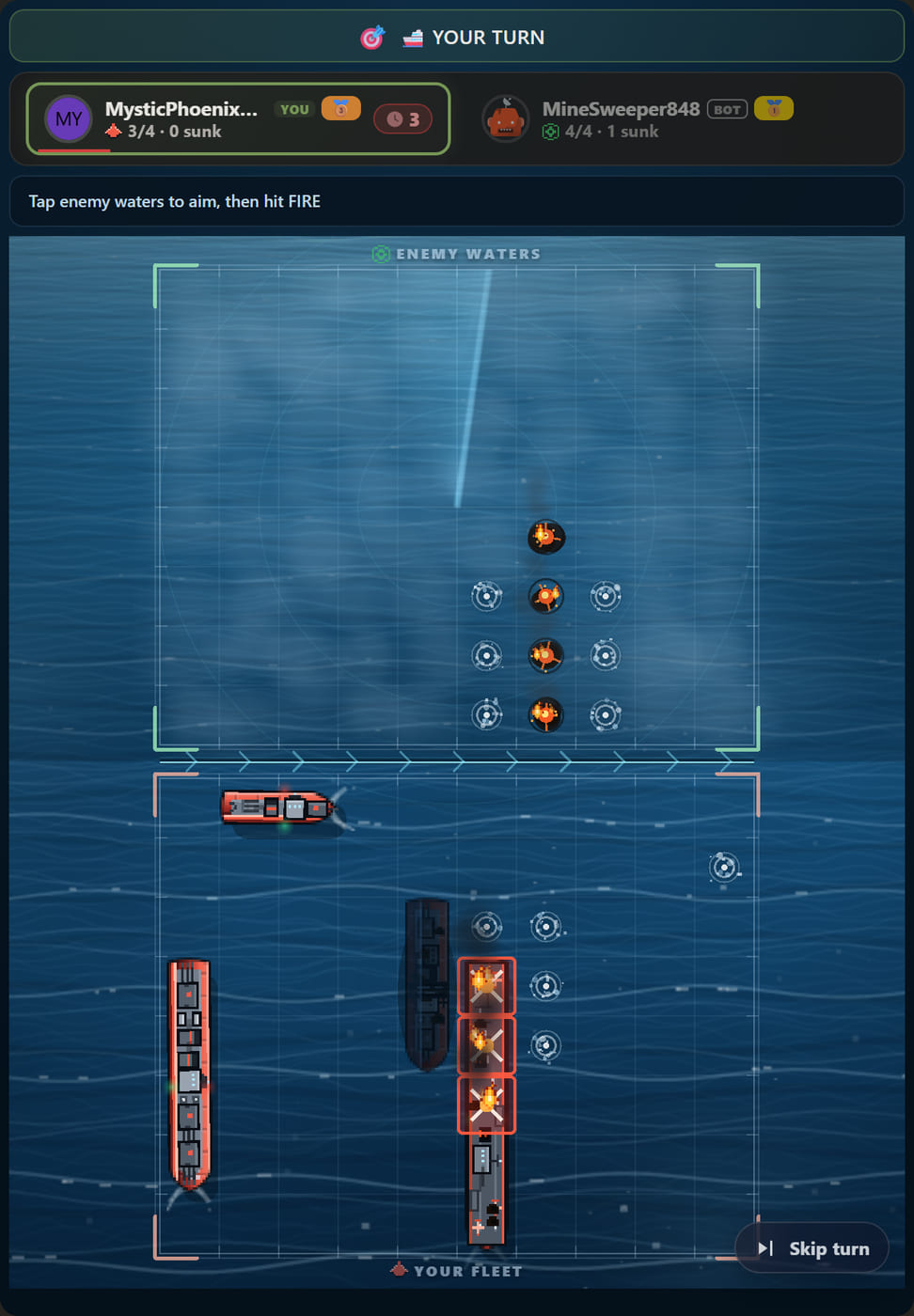
Enemy waters start covered edge to edge, and every square you fire at burns a permanent hole in the fog. Misses leave a splash crater, hits leave a burning ember mark, and a sunk ship leaves a whole wreck behind. You never need to remember where you have already looked — the board itself is the record. Before each shot, find the largest unbroken patch of fog and aim there.
Your own half is just as informative. You see exactly which cell of which ship was struck, which tells you what your opponent knows: if they have landed one hit on your cruiser, assume a plus or a 3x3 lands there next turn. You cannot move the ship out of the way — there is no defensive move in this game — so convert that knowledge into tempo instead. The race is simply who empties the other's 14 cells first.
Tempo: one ship, one action, turn passes
Exactly one ship acts each turn, either firing or using its ability, and the turn always passes afterwards — even on a hit. There is no lucky chain, which is what makes this a planning game rather than a streak game. Your only currency is cells inspected per turn: 1 for a single shot, 2 for the cruiser's line, 3 for the broadside, 2 for the torpedo, 4 for the bombardment, 5 for the cross salvo and 9 for the air strike. Keep that average high and you will find their fleet first. The default move clock is 30 seconds, and running it out hands your turn to a fog-aware bot — so decide, confirm, fire.
Squares opened per turn: every pattern
The only currency in this game is how much water you inspect in one turn. Here is what each option on your board is actually worth:
| Shot | Ship | Squares opened | Cooldown |
|---|---|---|---|
| Single shot | Carrier / Destroyer | 1 | — |
| 2-cell line | Cruiser | 2 | — |
| Broadside | Battleship | 3 | — |
| Torpedo Run | Destroyer | 2 (vertical) | 3 turns |
| Heavy Bombardment | Battleship | 4 (2×2) | 4 turns |
| Cross Salvo | Cruiser | 5 (plus) | 3 turns |
| Air Strike | Carrier | 9 (3×3) | 5 turns |
An opening plan you can copy
Sweep one of the middle rows with the broadside: columns 1, 4, 7 and 9, four shots. The 5-cell carrier is the longest ship and has the fewest ways to fit near an edge, so the centre is where it most likely lies. Treat your first hit as the signal to stop searching: drop the Cross Salvo on it to reveal the orientation in one turn, then run the line with the broadside until the wreck appears. Hold the Air Strike until two hits show up near each other in a zone you have not opened yet — nine squares at once on a live cluster is usually the shot that decides the match.
If you want the rules from scratch first, our how to play Naval Battle guide walks through the board, the four ships, the scoring and the clock. Ready to try it? Play Naval Battle free in your browser, against a friend or a bot — no download, no sign-up — or see how to set up an online match with a friend.
Any third-party brand or game names mentioned are trademarks of their respective owners. Playgridia is an independent platform and is not affiliated with or endorsed by them.
Frequently Asked Questions
How do you win at sea battle every time?
Nothing wins every time, but three habits raise your win rate sharply. First, never bunch your shots: while your battleship is afloat its 3-cell broadside clears a full row in four shots. Second, stop searching the instant you land a hit and finish that hull before you look anywhere else. Third, spend abilities on evidence rather than hunches — a Cross Salvo dropped on a single confirmed hit compresses four turns of manual probing into one.
Is Naval Battle just luck?
Fleets are placed at random, so the very first shot is a coin toss, but everything after it is information management. Each square you fire at burns a permanent hole in the fog, so the board keeps your notes for you, and how many squares you inspect per turn depends entirely on which pattern you choose. In the same number of turns you can open one square or nine — that gap is what decides matches.
Where should you shoot first in a sea battle game?
Start in the middle rows. The 5-cell carrier is the longest ship and has the fewest ways to fit near an edge, so it is more likely to cross the centre of the board. With your battleship afloat, aiming at columns 1, 4, 7 and 9 sweeps an entire row end to end in four shots.
Can you move your ships in Naval Battle?
No. A turn is exactly one decision: where do I fire? Tapping your own hull only opens that ship's signature ability panel. Because there is no defensive move, the game becomes a pure tempo race — whoever empties the opponent's 14 hull cells first wins.
Can I play Naval Battle free with a friend?
Yes. It runs free in the browser with no download and no install. Open a private room and send your friend the link, or start immediately against an Easy, Medium or Hard bot. A full match usually finishes in under ten minutes.