Best Starting Words for a 5-Letter Word Game (Measured)
The best starting words for a five-letter word game are common words that cut the list of possible answers down the fastest, and in the English word list we measured, the best of them is ARISE. On average it leaves 27.7 of 1155 possible answers, against about 99 after an average common word. Every number on this page comes from a script run over the real word lists of Word Duel, not from a list of popular openers.
How we measured it
For every possible guess, the script played it against each of the 1155 possible answers, applied the game's own colour rule, and counted how many answers still fit the colours that came back. Green means the right letter in the right place, amber means the letter is in the word but somewhere else, and grey means it is not in the word. The average of that count is the avg answers left figure in the tables: the lower it is, the better the opener.
We also counted distinct colour patterns, the number of different colour results an opener can produce. More patterns usually means a finer split, but the ranking follows the average: a word can produce many patterns and still leave one big group of answers behind.
Two choices are worth stating plainly. First, the openers in the tables are limited to words that are themselves on the answer list, so they are all common words. Such an opener also has a one-in-1155 chance of being the hidden word, a first-guess solve worth 60 points. Less common words that the game accepts as guesses but never uses as answers can sometimes split the list slightly better, yet they can never win on the spot. Second, these rankings belong to Word Duel's own lists; a different game with a different answer list would rank the words differently.
The best opening words
| Opening word | Avg. answers left | Distinct colour patterns |
|---|---|---|
| ARISE | 27.7 | 104 |
| RAISE | 28 | 114 |
| CRATE | 28.1 | 133 |
| TRACE | 28.8 | 135 |
| STARE | 30.1 | 122 |
| ALERT | 31.8 | 121 |
| REACT | 32.2 | 121 |
| CRANE | 32.2 | 127 |
The words at the top of the table share two habits. They are built from common letters, so each tile has a good chance of lighting up, and nearly all of them use no letter twice, so all five tiles test a different letter. RAISE and CRATE sit close behind ARISE, so pick whichever you find easiest to type and remember. Rivals see only the colour rows you earn, never your letters, so a habitual opener gives nothing away.
The best second word
An opener is only half of a plan. After ARISE, the best follow-up we found is CLOTH. Played as a pair, the two words leave 3.04 answers on average, and together they test up to ten different letters in just two guesses. By the third row you are choosing between a handful of candidates instead of scanning the whole list.
When to keep the pair
In a race, a fixed pair is fast because you do not have to think on guess two. Word Duel rewards speed: the first three players to solve a round earn +15, +10 and +5 on top of their guess points, and the first solve starts a closing window of up to 20 seconds for the rest of the table.
When to break it
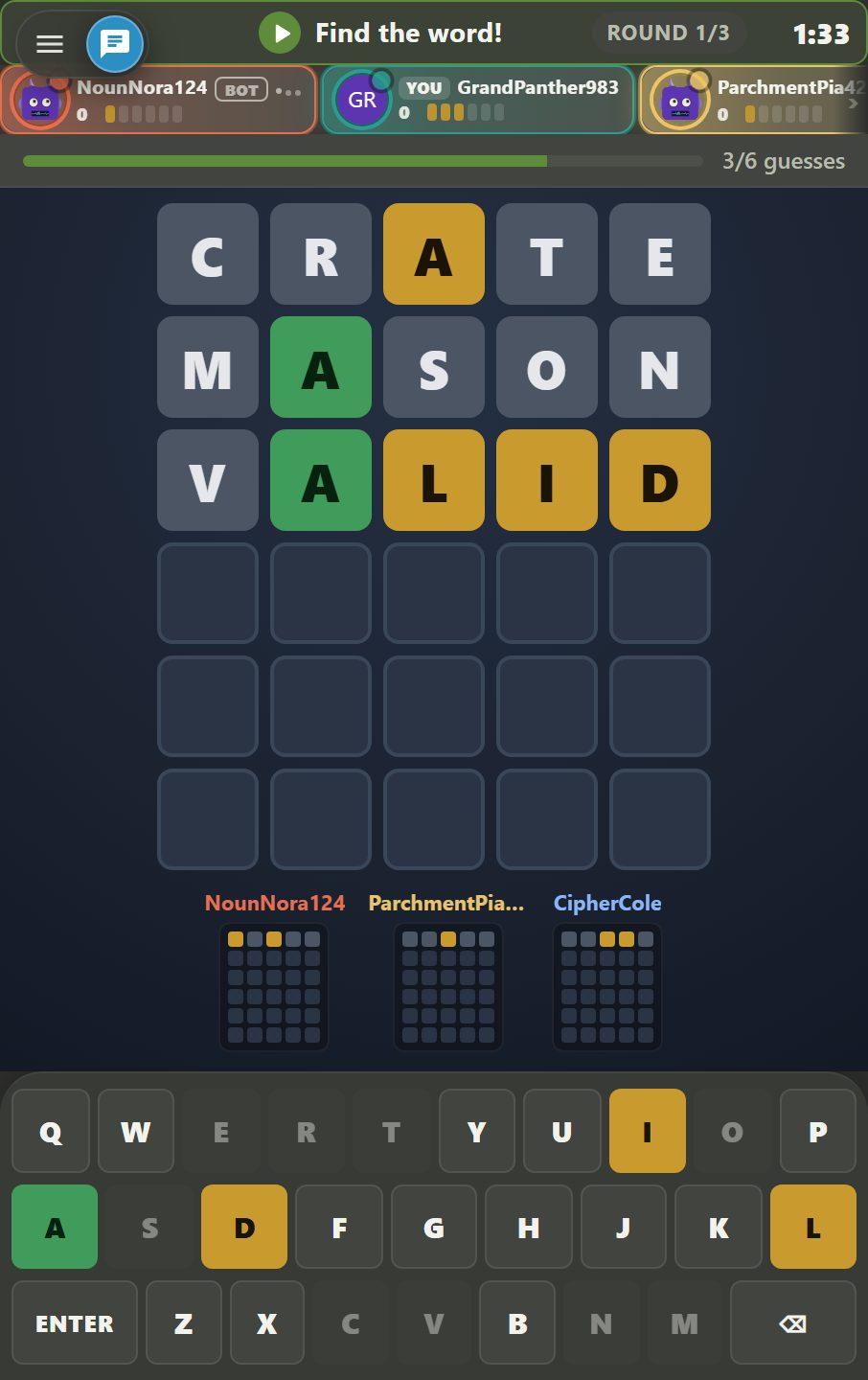
The real round in the figure went the other way: the second guess was picked after reading the first row’s colours, not from a fixed plan. If your opener already lit up green or amber tiles, a fixed second word can waste information by re-testing letters you know and ignoring the positions still open. Word Duel does not force you to reuse earlier clues, so you can always play a word that fits what the board has told you.
Which letters matter
| Letter | Share of answers containing it |
|---|---|
| E | 47% |
| A | 42% |
| R | 41% |
| T | 30% |
| O | 29% |
| L | 29% |
| I | 28% |
| S | 27% |
| N | 23% |
| C | 22% |
The table lists the ten letters that appear in the largest share of the answers; an opener made of common letters gets the most out of every tile. Repeated letters are the other side: 29% of the answers contain one, so once you are down to a few candidates, do not rule doubles out just because your opener used five different letters.
The colour rule handles doubles in a way worth knowing. Exact matches are settled first; amber clues are then handed out from left to right, one for one, against the hidden word's letters that are still unmatched. If you guess a letter twice and the hidden word has it once, only one copy can light up and the other turns grey. So a grey tile does not always mean the letter is absent: if the same letter is green or amber elsewhere in that row, the grey copy only tells you the word has fewer copies than you typed.
Every word language compared
| Word language | Answer pool | Left after a random opener | Best common opener | Left after guess 1 | Best second word | Left after 2 guesses |
|---|---|---|---|---|---|---|
| Turkish | 822 | 100 | KENAR | 22.2 | TALİH | 3.26 |
| English | 1155 | 99 | ARISE | 27.7 | CLOTH | 3.04 |
| French | 822 | 61 | TAIRE | 22.2 | POULS | 2.93 |
| Spanish | 850 | 56 | LATIR | 22.8 | CENSO | 2.35 |
| Russian | 783 | 83 | ЛАРЁК | 23.6 | ПИТОН | 2.83 |
| Korean | 528 | 48 | 가위 (ㄱㅏㅇㅜㅣ) | 11.3 | 서른 (ㅅㅓㄹㅡㄴ) | 1.87 |
Word Duel offers six word languages, and the table puts them side by side: the answer pool, how many answers are left after a random opener, and the best opener and second word with what each leaves. The word language is a room option chosen when the table is created, independent of the interface language.
Each list has its own best opener because letter frequencies differ between languages, so an opener that is excellent in one list can be ordinary in another. The random-opener column shows how much the choice matters: the wider its gap to the best opener, the more the choice is worth in that list. One note on Korean: it is played in jamo, five basic letters of the two-set keyboard (사람 is ㅅㅏㄹㅏㅁ), so Korean answers are two-syllable words.
What good play looks like
The perfect-memory solver is the benchmark. It opened with ARISE, then always guessed the remaining answer that best split the remaining answers, and solved in 3.33 guesses on average over every answer in the list. That is a ceiling, not a target: it knows the whole list and never forgets a clue, and you do not. A human who does not know the list will need more, so a solve in four guesses is solid and a solve in three is excellent.
Scoring sets the same bar. A round is worth more the fewer guesses you use, and you have six.
| Solved on guess | Points |
|---|---|
| 1 | 60 |
| 2 | 50 |
| 3 | 40 |
| 4 | 30 |
| 5 | 20 |
| 6 | 10 |
| Not solved | 0 |
On top of those points, the first three players to solve earn +15, +10 and +5, whatever number of guesses they used. A word that is not in the list is refused without costing a guess, so you can safely try a spelling you doubt. For tactics beyond the opening, see the word guessing strategy guide.
Putting it to use
Choose one opener from the first table, learn its best follow-up, and keep the rule for breaking the plan in mind: stay with the pair while the board is quiet, adapt once greens and ambers narrow the field. The fastest way to build the habit is to play it. Start a table in Word Duel, fill empty seats with bots and run the same opening for a few rounds. For a real race, create a room and share its link; friends join without an account (see playing a word game with friends). New to the format? The how-to-play guide covers the rules.
Frequently Asked Questions
What is the best first word for a five-letter word game?
In Word Duel's English word list, ARISE came out best: it leaves an average of 27.7 of 1155 possible answers, against about 99 after an average common word. RAISE and CRATE are close behind. The ranking was measured by playing every candidate against every answer with the game's own colour rule.
Should my first word have no repeated letters?
Usually yes. Five different letters test five letters at once, which is why nearly all of the best openers in the measurement avoid repeats. Repeats still turn up in answers, though: 29% of the answers contain a repeated letter, so keep doubles in mind once you are down to a few candidates.
Is the best second word always the same?
No. CLOTH is the best follow-up to ARISE on average, and the pair leaves 3.04 answers, so a fixed pair is fast because you do not have to think on guess two. If your opener already lit up green or amber tiles, a word that fits those clues can beat the fixed one, because the fixed one may re-test letters you already know.
Do these starting words work in other word games?
They were measured on Word Duel's own lists, so they are the right answer for this game. Another game with a different answer list may rank words differently, and the table of word languages shows a different best opener for each list. The idea of testing common letters first carries over, but check it against that game's list.
How many guesses is a good result?
A solver with perfect memory of the whole list needs 3.33 guesses on average with this opener. A human who does not know the list will need more, so four guesses (30 points) is a solid result and three (40 points) is excellent. You have six guesses per round, and a solve on the sixth is still worth 10 points.