How to Play Word Duel: Rules of the Five-Letter Word Race
Word Duel is a multiplayer five-letter word guessing game: two to six players hunt the same hidden word at the same time, each with six guesses and colour clues after every guess, and fewer guesses plus a faster solve score more. Here is every rule in the order you meet it; you can open a table on the Word Duel game page.
The goal in one minute
Every player is chasing the same hidden word, and each gets a grid of six rows of their own. There are no turns: everybody types at once, and each guess is checked the moment you press Enter. Your own grid shows your letters in colour. Your rivals appear as small colour-only grids that fill in live, so you can see someone is on their fourth row and closing in, but never which letters they tried.
A table has two to six seats. Empty seats can be filled with bots, and a friend only needs the room link to join, with no account. Each round brings a new hidden word, and the highest points total at the end wins.
What the colours mean
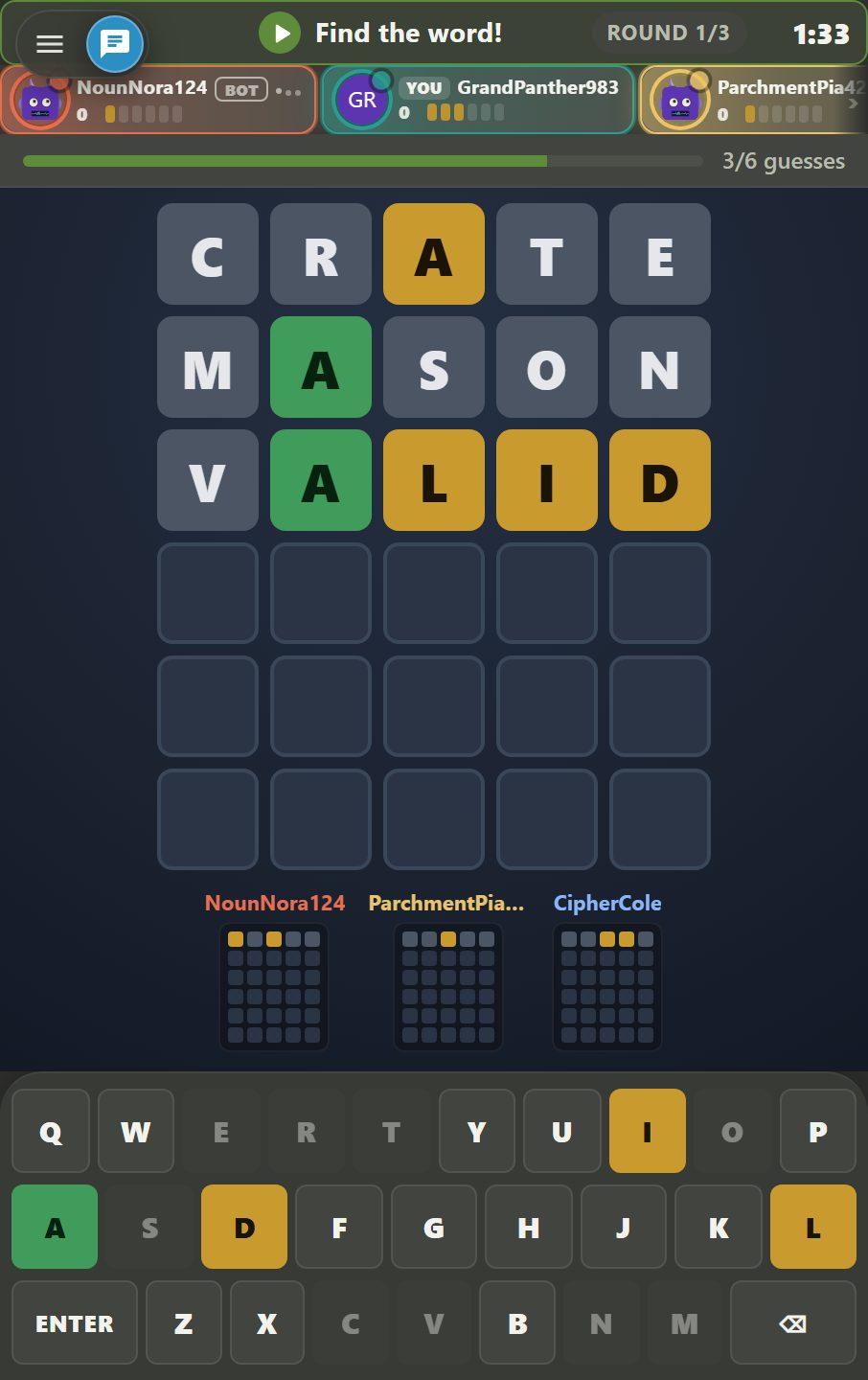
- Green: the right letter in the right place.
- Amber: the letter is in the word, but somewhere else.
- Grey: the letter is not in the word, or the hidden word has no unclaimed copy of it left.
The on-screen keyboard keeps score for you: each key shows the best clue its letter has earned so far (green beats amber, amber beats grey), and ruled-out letters dim down but stay typeable.
Repeated letters
When a letter appears twice in your guess, the game settles the clues in two passes. First, every exact hit is marked green and uses up its copy of that letter in the hidden word. Then the rest of your guess is read from left to right: a letter turns amber only if the hidden word still has an unclaimed copy of it, and otherwise it turns grey. So a letter never earns more green and amber marks than the hidden word has copies of it.
Take the hidden word ABBEY and the guess AHEAD. The guess has A twice, the hidden word only once, so one A turns green and its twin turns grey. That grey does not say the letter is missing; it says you have already found every copy there is.
What counts as a guess
A guess must be exactly five letters and a real word from the room's word list; proper nouns are not on it. The list is wider than the pool of possible hidden words: hidden words are common base forms, while guesses also accept forms such as plurals and conjugations, so you can legally play a word that can never be the answer just to test letters.
If you submit a word that is not on the list, the row shakes and a short message says the word is not on the list. Nothing is used up: no row, no guess, no penalty. You also cannot play the same word twice in one round; the game refuses it, and again the guess is free.
There is no hard mode: a guess does not have to use the clues you already hold, so a probing word that reuses nothing is always allowed.
The round clock and the closing window
Each round runs on a round clock of 60, 90 or 120 seconds, chosen by the host as a room option, with 90 as the default. There is no per-guess timer, only this one clock. A short round card (about 2.6 seconds) opens each round while nobody can type, and then the clock starts for everyone at once.
The first solve changes the clock. As soon as any player finds the word, a 20-second closing window opens for everyone else, announced on the banner, and play continues as normal inside it. The window can only shorten a round: if less than 20 seconds of the round clock were left, the round clock still decides.
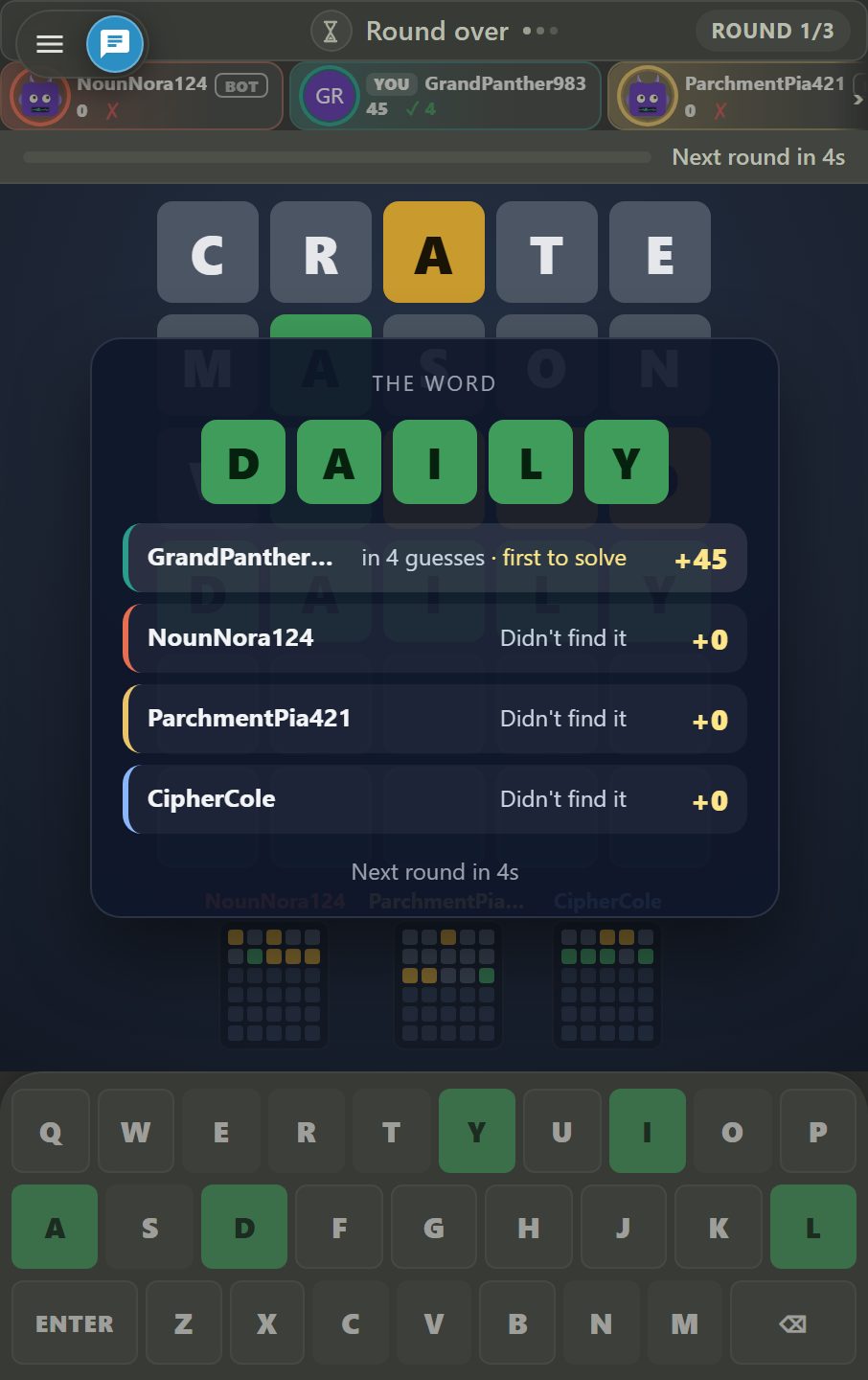
A round also ends the instant every seat has either solved the word or used all six guesses. A reveal card of about 6.5 seconds then shows the word and what each player needed and earned, before the next round begins.
Scoring
Points depend mainly on how few guesses you use, with a small bonus for the order in which players solve.
| Result in a round | Points |
|---|---|
| Solved in 1 guess | 60 |
| Solved in 2 guesses | 50 |
| Solved in 3 guesses | 40 |
| Solved in 4 guesses | 30 |
| Solved in 5 guesses | 20 |
| Solved in 6 guesses | 10 |
| Not solved (out of guesses or out of time) | 0 |
| Bonus: first player to solve | +15 |
| Bonus: second player to solve | +10 |
| Bonus: third player to solve | +5 |
The most a single round can pay is 75: a first-guess solve that also lands first. The bonus follows solve order, not guess count, so a player who needs six guesses but is first to land the word still collects +15. A round you do not solve scores nothing, even with all six rows used. Time is not scored directly; speed matters through the order bonus and the closing window.
Fewer guesses beat a faster finish. Solving in 3 guesses as the second solver earns 40 + 10 = 50 points, more than solving in 5 guesses as the first solver (20 + 15 = 35). The biggest bonus is worth only a guess and a half.
Rounds, winning and ties
The host picks 1, 3 or 5 rounds, with 3 as the default. Every round starts with a fresh hidden word and empty grids, and no word repeats inside a match. A newcomer's first quick match is a single round, so the first game stays short. At the defaults (three rounds of 90 seconds) a match lasts just under five minutes at most, and usually less.
Totals add up across the rounds, and after the last reveal card the highest total wins. Players who tie on the top score share the win. Only when every seat finishes on the same total is the match a draw.
Six word languages
The word list is a room option, separate from the language of the site: choose Turkish, English, French, Spanish, Russian or Korean when the room is created. It defaults to your interface language, so a player on a French interface can open a Korean room. Each language has its own on-screen keyboard and its own idea of what counts as one letter.
| Word list | Keyboard | How letters are read |
|---|---|---|
| Turkish | Turkish layout without Q, W and X | I and İ are two different letters |
| English | QWERTY | Plain A–Z; accents fold to the base letter |
| French | AZERTY | Accents fold to the base letter (É = E) |
| Spanish | QWERTY with Ñ | Ñ is a letter of its own; other accents fold |
| Russian | ЙЦУКЕН | Ё counts as Е |
| Korean | Two-set Hangul keyboard | Played in jamo, the basic consonant and vowel parts |
Korean works differently from the rest. The game splits every syllable into its basic jamo, so 사람 becomes ㅅㅏㄹㅏㅁ, which is five letters. Clues and repeated-letter rules are applied per jamo, and in practice the hidden Korean words are two-syllable words.
Putting the rules to work
The next question is what to type first. The best starting words guide ranks openers, the strategy tips cover how to spend six rows, and playing with friends explains how to set up a table by link.
Frequently Asked Questions
How many people can play Word Duel?
A table seats two to six players, and everyone guesses the same hidden word at the same time. Empty seats can be filled with bots, and friends join by opening the room link, with no account needed. A guest who hosts can open up to four seats, a signed-in host up to six.
How does Word Duel colour repeated letters?
Exact hits are marked green first and use up their copy of the letter in the hidden word. Then the remaining letters are read left to right, and each turns amber only if the hidden word still has an unclaimed copy of it; otherwise it turns grey. So if you guess a letter twice and the hidden word has it once, one copy turns green or amber and the twin turns grey.
Does a word that is not on the list cost me a guess?
No. A word that is not on the room's word list is refused, the row shakes and nothing is used up. Playing the same word twice in a round is also refused for free. Proper nouns are not on the list.
How is the winner decided in Word Duel, and what happens in a tie?
Each round pays 60, 50, 40, 30, 20 or 10 points for solving in 1 to 6 guesses, plus 15, 10 and 5 bonus points to the first three solvers, and 0 if you do not solve. After the last round the highest total wins. Players tied on the top score share the win, and only a tie across the whole table is a draw.
Can I play Word Duel in a language other than English?
Yes. The word list is a room option with Turkish, English, French, Spanish, Russian and Korean to choose from, and it defaults to your interface language. Each list has its own keyboard layout. Korean is played in jamo, so a word like 사람 is read as ㅅㅏㄹㅏㅁ.