Multiplayer Word Game With Friends: Race to the Same Word
Word Duel is a free online multiplayer word game with friends: two to six players race to guess the same hidden five-letter word at the same moment, right in the browser. Open a room, send the link, and everyone is guessing within seconds — start from the Word Duel page.
Why racing the same word is different
There are no turns, so nobody sits and waits. Every player gets the same hidden word and the same six guesses, and everyone types at once. Each guess comes back with a colour per letter: green for the right letter in the right place, amber for a letter that is in the word but elsewhere, grey for a letter that is not in it. A word that is not on the word list is simply refused and does not use up a guess.
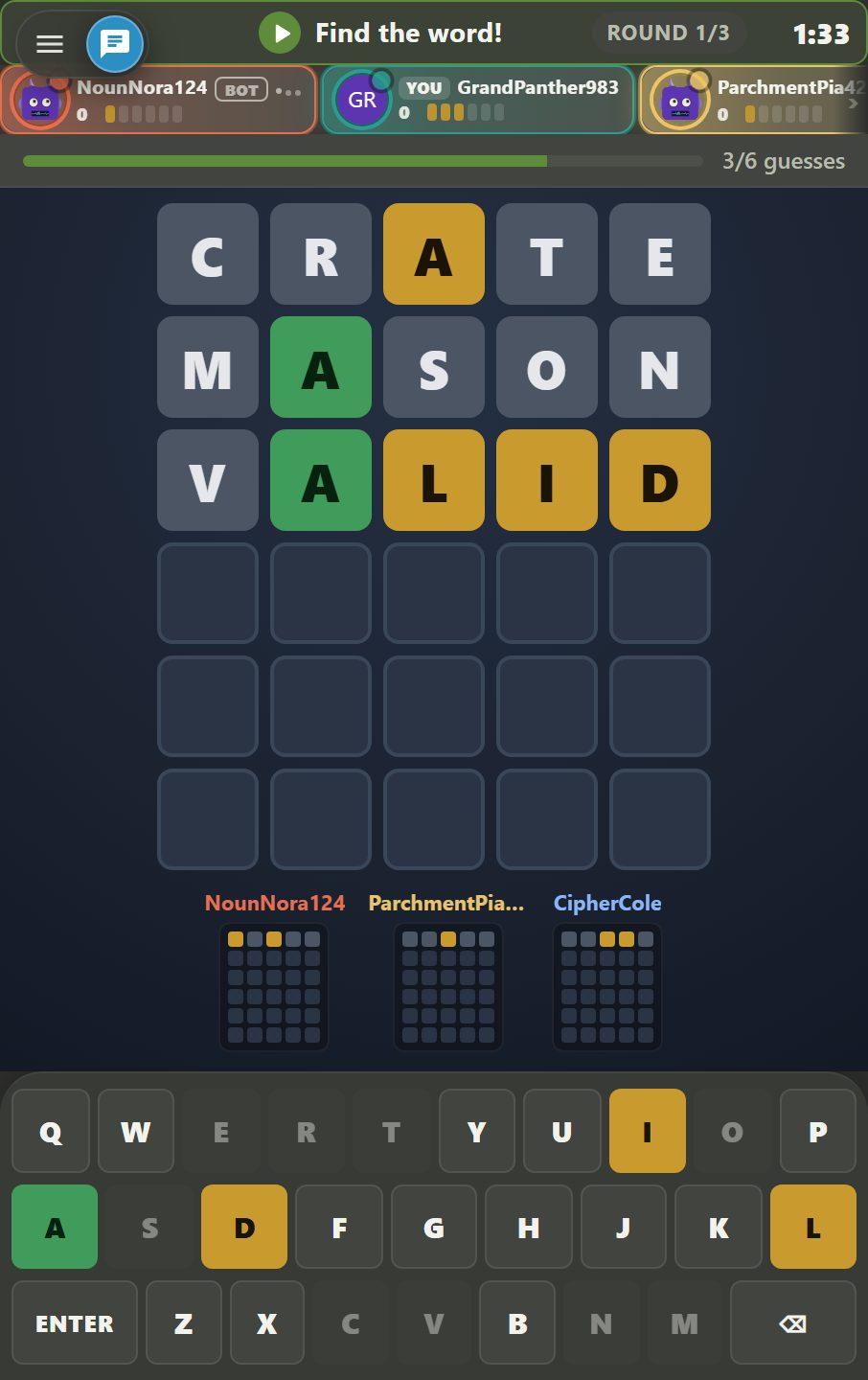
What turns it into a group game is what you can see. Your rivals' boards sit beside yours as small colour-only grids that fill row by row as they guess, but their letters stay hidden. You know who is close — a rival with a row of green is nearly there — without knowing what they know, so there is pressure but nothing to copy.
The first solve starts a 20-second closing window for everyone else. They can keep guessing until it runs out, but the window can only shorten a round, never stretch it: if less than 20 seconds were left on the round clock, the clock decides. A round also ends at once when every player has either solved or used all six guesses.
Setting up a game for your group
Create a room from the game page, choose the options in the table below, and share the room link. Friends who open the link join the table without registering — the game gives them a guest profile — and you can fill any empty seat with a bot. A match can start once at least two seats are filled, and bots count as seats.
Seats are the host's call: 2 to 6, with one limit worth knowing about. A host playing as a guest can open up to four seats; a signed-in host can open all six. The create screen suggests three, and the host can change the seat count and the options in the room before starting.
| Option | Choices | Default | Good for |
|---|---|---|---|
| Players | 2–6 seats (up to 4 for a guest host) | 3 | Two for a head-to-head, four to six for a loud table |
| Rounds | 1, 3 or 5 | 3 | 1 for a quick try, 5 for a longer evening |
| Round time | 60, 90 or 120 seconds | 90 | 60 for a fast table; 120 for younger players or a word list in a language you are still learning |
| Word language | Turkish, English, French, Spanish, Russian, Korean | Your interface language | Playing in a language other than the one you read the site in |
The one-tap quick-play button is something else: it opens a table of you plus two bots — handy as a warm-up before your friends arrive, not as a group night.
What a round looks like at the table
A round opens with a 2.6-second card announcing the round number, then the round clock starts. When the round ends, a reveal card shows the hidden word and one row per player: the name, how many guesses they needed (or that they did not find it), whether they were first, second or third to solve, and their points. It stays up for 6.5 seconds before the next round begins.
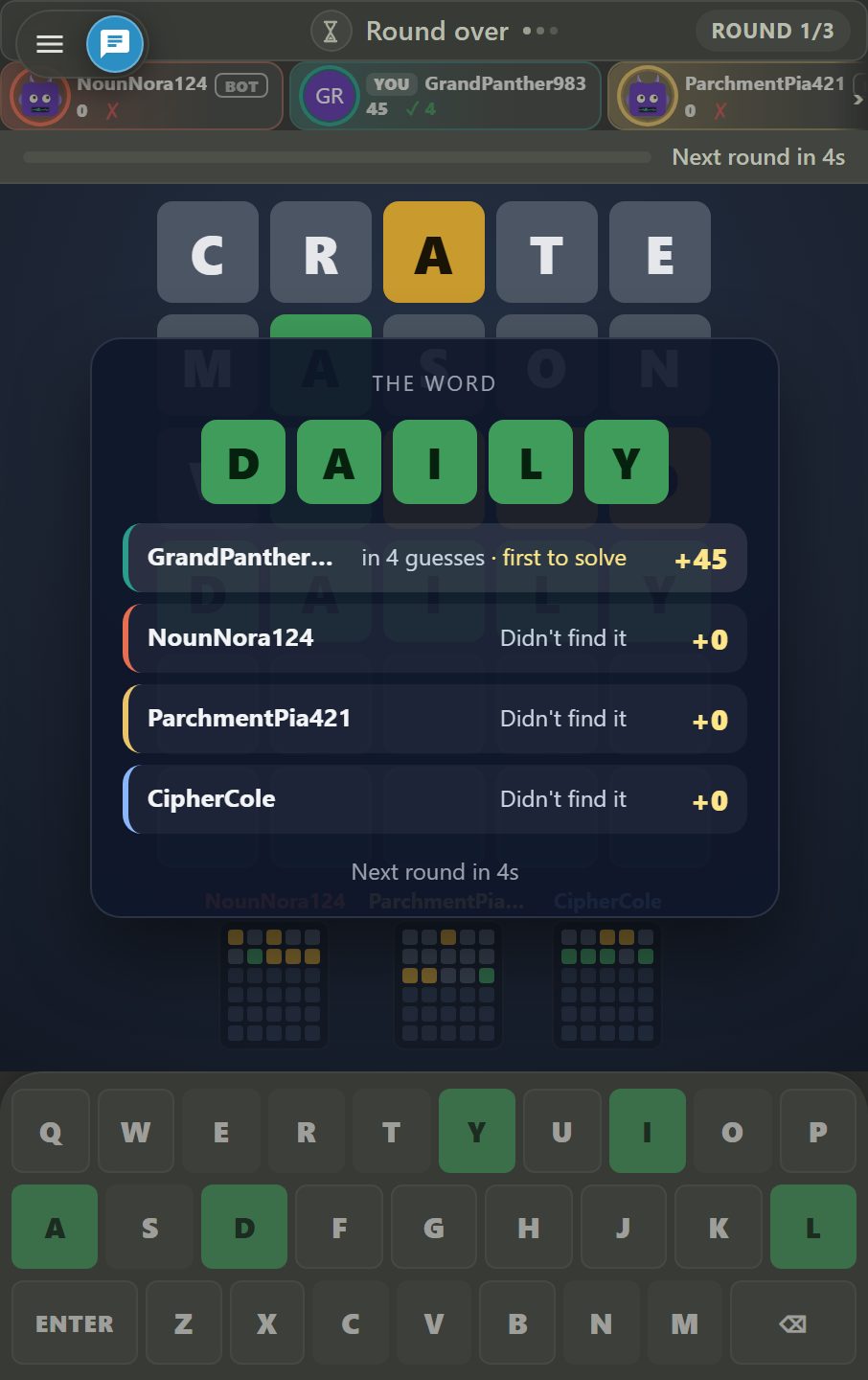
Points reward fewer guesses first: 60 for a solve on the first guess, then 50, 40, 30, 20 and 10 down to the sixth, and 0 for a word you did not find. On top of that, the first three players to solve earn a speed bonus of +15, +10 and +5. Bots score like everyone else and can take the bonus.
Speed matters, but fewer guesses matter more: each guess you save is worth 10 points, while each place in the solving order is worth 5. Solving in three guesses as the second finisher earns 40 + 10 = 50, which beats a five-guess solve that lands first (20 + 15 = 35). A round is worth 75 points at most.
The highest total after the last round wins. If two friends tie on the top score they share the win; only when every player finishes level is the match a draw.
Playing in another language with friends
The word list is a room option, separate from the language of the interface. Choose Turkish, English, French, Spanish, Russian or Korean, and the whole table guesses from that list. Each language has its own on-screen keyboard: the Turkish layout, QWERTY, AZERTY, QWERTY with Ñ, ЙЦУКЕН, and a standard Korean 2-set keyboard. A physical keyboard types into the grid in every language.
Korean is played in five basic jamo rather than five syllables — 사람 is ㅅㅏㄹㅏㅁ — so Korean answers are two-syllable words. If anyone at the table is new to that, agree on the word language before the first round.
Because the list is independent of the interface, a group that is learning French or Spanish can simply pick that list and play it. A 120-second clock gives everyone more time to think in a language that is not their first.
If someone's connection drops
A player who loses connection has two minutes to come back. After that a bot keeps the seat so the match carries on, and the player takes the seat back by returning. Leaving on purpose is final: the bot keeps the seat.
One more thing to know is rating. A match is rated when at least two human players are seated at the start, however many bots fill the other seats; one person against bots is unrated practice. A pair of friends plus a bot is therefore a rated game, while the quick-play table of one human and two bots is not.
A simple plan for your first game night
For a first game night, keep the defaults: three rounds on a 90-second clock. A round never runs longer than its clock plus roughly nine seconds of intro and reveal, so three rounds fit in just under five minutes — about a coffee break — and usually less, because a round ends as soon as everyone is done or 20 seconds after the first solve. Send the link, agree on a word language, and see who reads the colours best.
If you want an edge, the how-to-play guide covers the rules in full, the starting-words guide helps with your first guess, and the strategy guide goes deeper on the middle of a round.
Frequently Asked Questions
How many people can play this word game together?
Two to six players can share a table. A host playing as a guest can open up to four seats, and a signed-in host can open all six. Empty seats can be filled with bots, and a match can start once at least two seats are filled.
Do my friends need an account to join my game?
No. They open the room link you share and join the table, and the game gives them a guest profile. A guest profile is also enough to host, though a guest host is limited to four seats.
Can we play a word game with friends in English or another language?
Yes. The word list is a room option with six choices: Turkish, English, French, Spanish, Russian and Korean. It is independent of the interface language, so your group can pick any list; Korean is played in five basic jamo, so its answers are two-syllable words.
What if there are only two of us?
Two is enough: a match can start as soon as two seats are filled. You can also add bots to the empty seats if you want a fuller table.
How long does a game with friends take?
At most the number of rounds times the round time plus roughly nine seconds per round for the intro and reveal. At the default of three rounds on a 90-second clock that is just under five minutes, and the longest setting, five rounds at 120 seconds, is under eleven minutes. Most rounds end sooner, because a round closes as soon as everyone has finished or 20 seconds after the first solve.