Word Guessing Game Strategy: 9 Tips to Solve in Fewer Guesses
The best word guessing game strategy for a race is accuracy first, speed second. In Word Duel, where everyone at the table hunts the same hidden word at once, every extra guess costs 10 points while the whole solve-order bonus is worth 15 at most: solving in 3 guesses as the second player scores 50, but solving in 5 guesses as the first scores only 35. These nine tips help you solve in fewer guesses without handing the table a head start.
How the scoring turns guessing into a trade-off
Everyone gets six guesses at the same word, and a solved round pays by guess count: 60, 50, 40, 30, 20 or 10 points for solving in 1 to 6 guesses. On top of that, only the first three players to solve earn a bonus of +15, +10 and +5. A round you do not solve pays 0, even if you used all six rows. The seconds on the clock are never scored; only the order in which solves land counts, and that order does not depend on how many guesses you used.
| Guesses used | Solve order | Points |
|---|---|---|
| 2 | first | 50 + 15 = 65 |
| 3 | first | 40 + 15 = 55 |
| 3 | second | 40 + 10 = 50 |
| 4 | first | 30 + 15 = 45 |
| 3 | third | 40 + 5 = 45 |
| 4 | second | 30 + 10 = 40 |
| 5 | first | 20 + 15 = 35 |
| 6 | any place | 10 to 25 |
| not solved | none | 0 |
Read the table sideways. Moving from third place to first is worth 10 points, exactly one guess, so a 4-guess solve in first place ties a 3-guess solve in third place at 45. Speed cannot make up for sloppiness, though: the biggest prize it can add is 15 points, while two extra guesses cost 20. Take the extra look when it saves a guess, and race only when you hold a solid candidate.
Opening: plan your first two guesses
Tip 1: open with a tested word
Your first guess is the only one you can plan before you see a single clue. The best common opener in the English list is ARISE, measured to leave 27.7 possible answers on average. Pick one tested opener and type it on autopilot, so your thinking starts at the second row. Our best starting words guide goes deeper.
Tip 2: make the second word test new letters
If the opener leaves you no clear lead, use the second guess to test different letters from the first, so the two rows together cover as much of the alphabet as possible. The best pairing we measured is ARISE followed by CLOTH, which leaves 3.04 possible answers on average. If the first row already hands you several greens, build on them instead.
Reading the clues
Tip 3: count repeated letters carefully
29% of the possible answers contain a repeated letter, so you will meet this often. The game settles exact matches first, then marks the remaining copies amber one at a time from the left, and only while the hidden word still has an unmatched copy. Take AHEAD against the hidden word ABBEY: one A turns green and its twin turns grey, because the word has only one. A grey copy next to a green or amber copy of the same letter is therefore a count: the word holds exactly as many of that letter as are coloured.
Tip 4: trust the keyboard colours
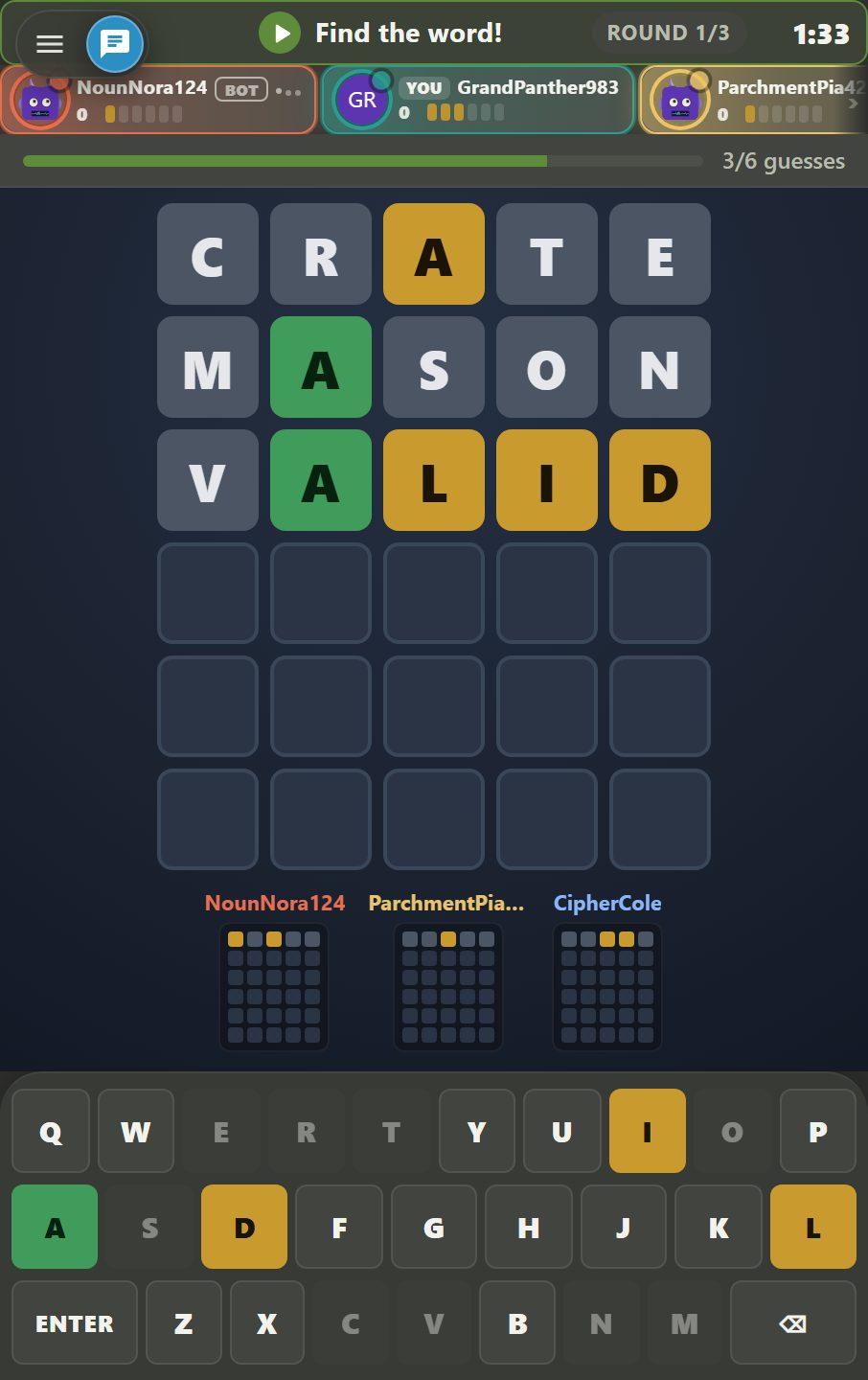
The on-screen keyboard shows the strongest clue each letter has earned across all your guesses, and green beats amber beats grey. A letter that scored amber once stays amber even if a later duplicate came back grey, so you do not need to scan your own rows. Grey keys are dimmed but still typeable, because the game never forces you to follow your clues.
Spending your six guesses
Tip 5: a refused word costs nothing
If a word is not on the list, the row shakes, a message says so, and no guess is used: no row, no count, no penalty. Retyping a word you already tried this round is also refused without using a guess. So test a doubtful spelling freely. The list that accepts your guesses is much larger than the shorter list of common words the hidden word comes from, so when an everyday word and an odd form both fit, bet on the everyday one.
Tip 6: there is no hard mode, so probe when it pays
Nothing forces you to reuse your clues. Any word on the list is a legal guess, even one that contradicts a green. That allows the probe. Say your clues leave four candidates that are identical except for their first letter. Guessing them one by one takes 2.5 guesses on average and up to 4. A word that contains at least three of those four letters usually shows you which one is right, and then you solve: exactly 2 more guesses. With two candidates left, just guess (tip 7); with three it is a toss-up; from four up, the probe wins, if such a word exists.
Tip 7: with two candidates left, guess one
A probe cannot beat a coin flip here. Guessing one of two words solves the round immediately half the time and on the next guess otherwise, 1.5 guesses on average, while any third word costs a guaranteed two. Choose the more everyday of the pair, since the hidden word comes from the list of common words.
Racing the table
Tip 8: read your rivals’ grids
Each rival appears as a small grid of colour blocks with their name above. You never see their letters, but you can see how many rows they have used and how green those rows are. A solved rival gets a green ring, and the first solve of a round starts a 20-second closing window for the whole table: the clock strip turns orange and counts down, and the round can only get shorter, never longer. You can keep guessing inside the window, and second place still pays +10 and third +5. Once it opens, commit to your best candidate. An unsolved round scores 0 however many rows you used, so a probe you cannot follow with a solve is usually wasted.
Tip 9: set the round clock for your table
The host picks 60, 90 or 120 seconds per round (90 is the default) and 1, 3 or 5 rounds (3 is the default). A 60-second clock rewards quick, confident play; a 120-second clock gives you time to check every row and rewards accuracy, so choose it while you are learning. Empty seats can be filled with bots, and a table with one human and bots is unrated, so you can practise without touching your rating.
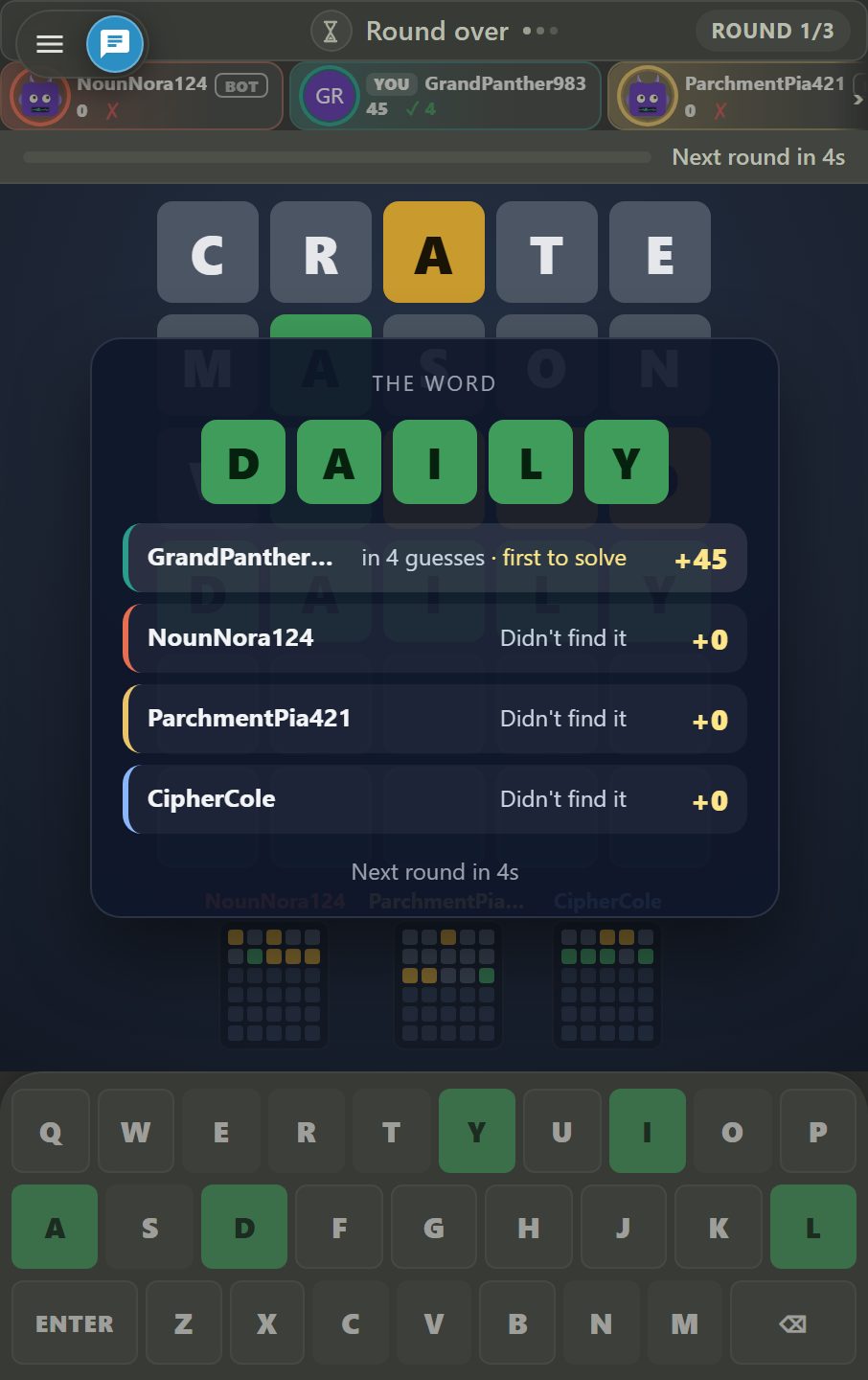
After every round the reveal card shows the word, each player’s guess count, who solved first, second and third, and the points won, so you can see where yours went.
The rule of thumb
Be accurate first and fast second: plan the first two guesses, spend the middle ones on information, and sprint only when you hold one strong candidate. New to the game? Start with how to play Word Duel, and to bring a table along, read about playing a word game with friends. Then open Word Duel and try these tips on a real clock.
Frequently Asked Questions
Is it better to be fast or accurate in a word guessing game?
Accurate. In Word Duel each extra guess costs 10 points, while the solve-order bonus is only +15, +10 and +5 for the first three solvers. Three guesses as the second solver (40 + 10 = 50) beat five guesses as the first (20 + 15 = 35). Race only when you hold one strong candidate.
What should I do when two words both fit the clues?
Guess one of them. Half the time you solve the round at once, and otherwise you solve on the next guess, so 1.5 guesses on average; any third word costs a guaranteed two. Pick the more everyday word, because the hidden word comes from a shorter list of common words.
Does a wrong word cost me a guess?
It depends on why it is wrong. A word that is not on the list is refused and costs nothing: the row shakes and no guess is used. A real word that is simply not the answer uses one of your six guesses.
How do repeated letters show up in the colours?
Exact matches are settled first, then the remaining copies are marked amber one at a time from the left, only while the hidden word still has an unmatched copy. Every other copy turns grey. A grey copy next to a green or amber copy of the same letter means the word has exactly as many of that letter as are coloured.
How can I solve in fewer guesses?
Decide your first two guesses before the round starts, using a tested opener and a second word that tests new letters. Read the keyboard colours instead of rescanning your rows. When four or more candidates differ by one letter, a probe word that separates them beats guessing them one by one.