Card Games for Kids: Easy Matching Games to Learn First
 Play Color Match
The best card games for kids are matching games like Crazy Eights: you play a card that matches the top card by colour or suit, or by number, and the first player to empty their hand wins. A parent can sit at the same table, online or at home, and play along.
Why matching games are the classic first card game
Every turn asks the same small question: does anything in my hand match the top card? You are looking for the same colour (or suit) or the same number. If nothing matches, you draw one card and either play it, if it fits, or keep it. That is the whole loop, and it works with a child who can only read numbers and colours.
The special cards come in one at a time. A Skip, a Reverse or a Wild is a single rule you can learn in one sentence, and a game with only a few of them is a good place to start. Nothing needs counting or remembering across rounds: one hand, and whoever empties theirs first wins.
Step one: the colour deck
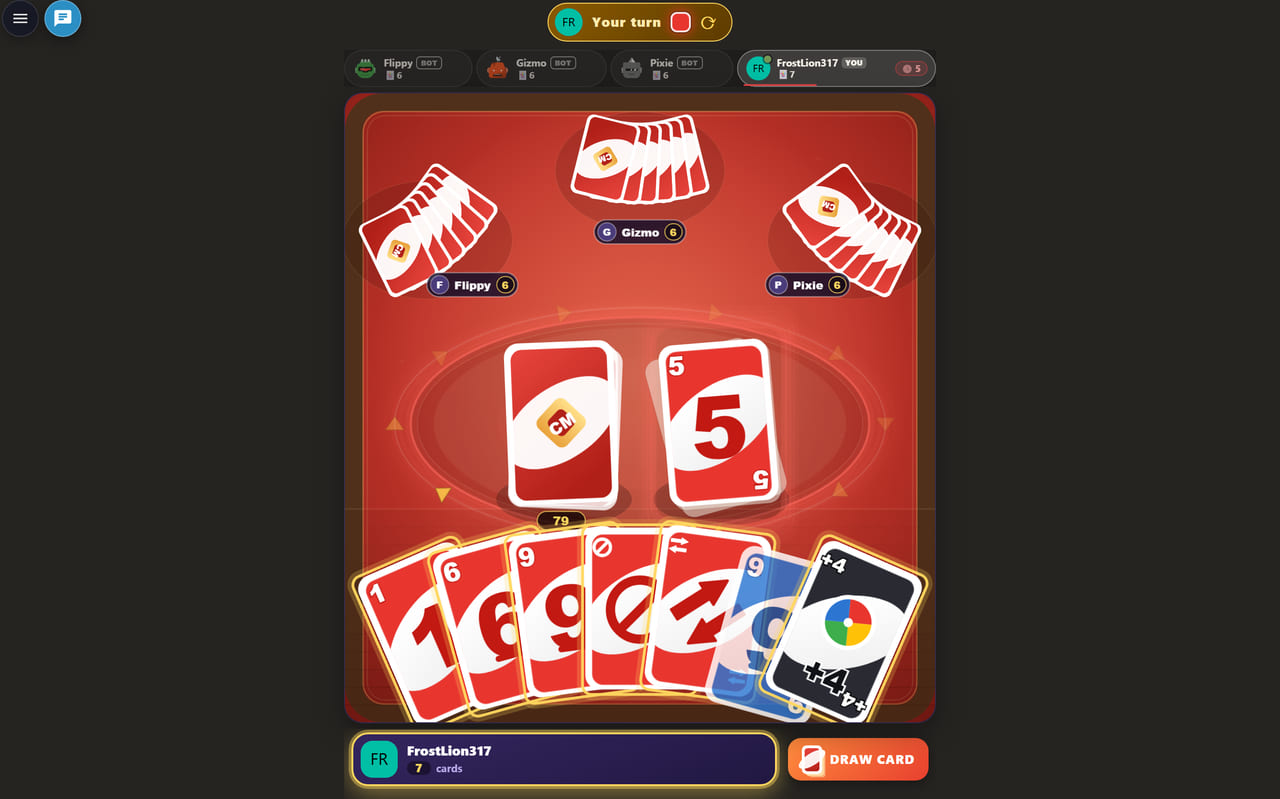
Our own Color Match is a good first table because the cards are coloured and the numbers are big. The colour deck has 108 cards and each player is dealt 7. Besides the number cards it has five kinds of action card: Skip, Reverse, +2, Wild and +4 Wild. Teach them one at a time: first colour and number only, then Skip, then Reverse, and leave the draw cards for later.
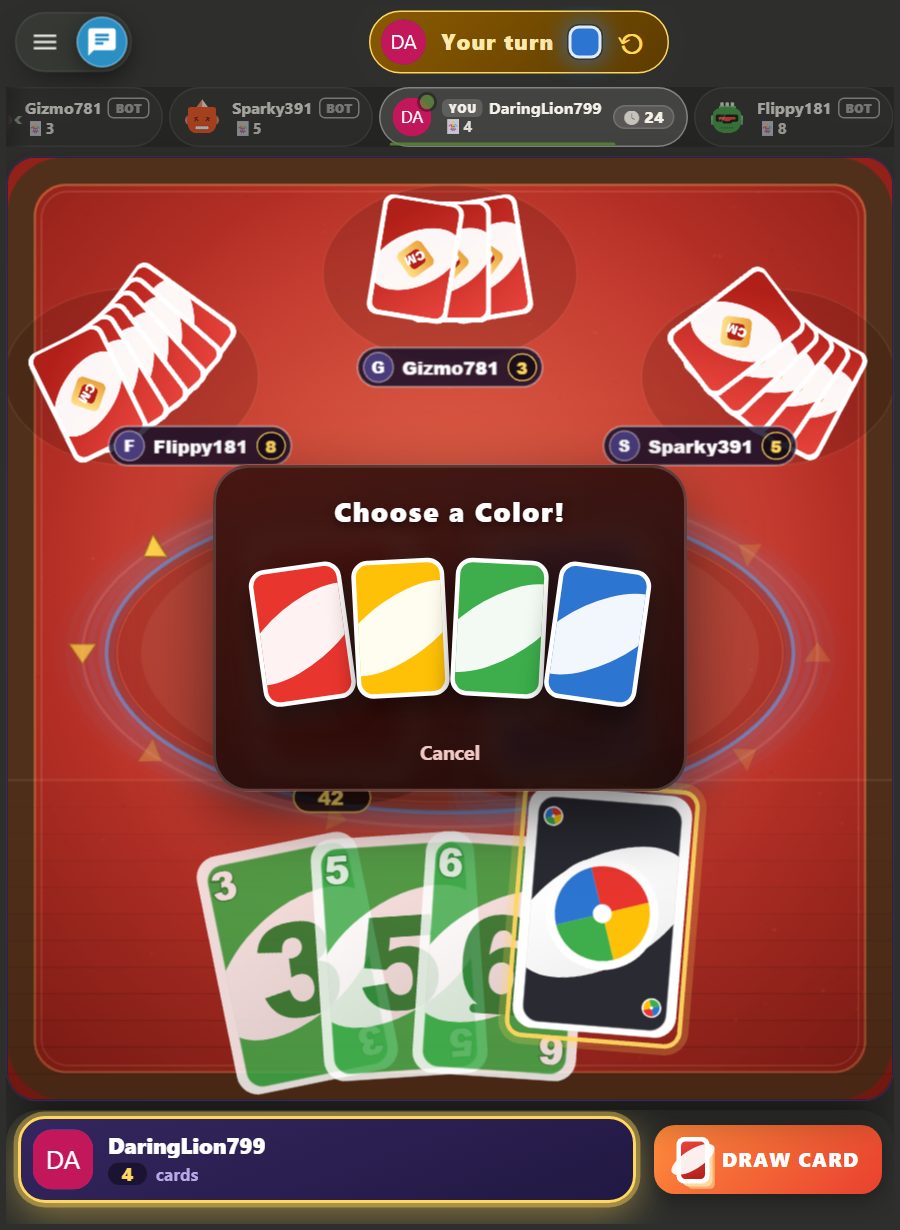
When a Wild is played, the player picks the next colour from a window with four colour cards, so nobody has to remember anything. Full rules are in how to play Color Match.
Step two: Crazy Eights, Mau-Mau and Pis Yedili
When the colour deck feels easy, move to an ordinary pack of cards. These three are free options called "Map" in the room settings. They are the same matching game with different special cards, so the order below goes from fewest to most.
Crazy Eights
The simplest of the three: a 52-card pack, and the only special card is the 8. An 8 is wild, so it can be played on anything and the player names the suit that follows. Nothing else has an effect. It is dealt 7 cards each at a two-player table and 5 cards each at three to six players. (The same family is called Ocho Loco in Spanish and 8 américain in French.)
Mau-Mau
A short 32-card pack, the 7s to the Aces, and 5 cards each. A 7 makes the next player draw 2, an 8 skips the next player, and a Jack is wild. A 7 can be answered with another 7, so the draw pile grows 2, 4, 6 and the player who cannot answer takes it all. That stacking is the first rule that takes a minute to explain.
Pis Yedili
A 52-card pack with 7 cards each and the most specials of the three. A 7 makes the next player draw 3 (and 7s can be stacked: 3, 6, 9), an 8 skips, a 10 reverses and a Jack is wild. See the Crazy Eights-style family explained and whether draw cards can be stacked before you teach it.
| Deck | Cards | Specials to learn | Cards dealt |
|---|---|---|---|
| Color Match (colour deck) | 108 | 5: Skip, Reverse, +2, Wild, +4 Wild | 7 |
| Crazy Eights | 52 | 1: the 8 is wild | 7 at two seats, 5 at three to six |
| Mau-Mau | 32 | 3: 7 = draw 2, 8 = skip, Jack = wild | 5 |
| Pis Yedili | 52 | 4: 7 = draw 3, 8 = skip, 10 = reverse, Jack = wild | 7 |
One caution: at bigger tables a second pack is shuffled in (Crazy Eights at 6 seats, Mau-Mau at 5 or 6, Pis Yedili at 5 or 6), so the card counts in the table are for the smaller tables. Home rules for these games vary from family to family; this is one fixed set.
Playing together online
You can start without an account: a guest can play straight away. The "Play Now" button on the game page seats you against two bots and always opens the colour deck. Bots start on easy, and an easy bot plays the first legal card it finds and answers a draw penalty only about half the time, so a beginner has a fair chance.
For a family table, the host can switch the room to "Link only" in the waiting room. The room is then hidden from the public list and people join through the shared link. There is no password. A guest-created room seats up to 4 players. To play a folk deck, pick it in "Create Room" under "Map".
Playgridia does not ask for or check age, so how and when a child plays is your call. Sitting beside them for the first games is the simplest way to be sure. With only two players, see card games for 2 players.
The move clock
Each turn has a clock: 30 seconds by default, with options of 15, 20, 30, 45 and 60 seconds, or 600 seconds. For a young child choose 60 seconds, or 600 if you want no pressure at all. If the clock runs out, a bot plays that turn for the seat.
What to do with this
Start with the colour deck against easy bots and teach only colour and number. Add Skip and Reverse after a game or two. When that feels easy, try Crazy Eights, which has one special card, then Mau-Mau, then Pis Yedili. Open Color Match and play a round beside your child.
Frequently Asked Questions
What is the easiest card game to teach a child?
Crazy Eights is the easiest. You play a card that matches the top card by suit or number, and the only special card is the 8, which is wild. Color Match works the same way with coloured cards, and the first player to empty their hand wins.
Can kids play card games online without signing up?
On Playgridia a guest can play without an account, and the quick-play button seats you against two bots. Bots start on easy. The site does not check age, so it is up to the parent to decide whether a child plays.
Which card games for kids work with a normal deck of cards?
Crazy Eights uses a 52-card pack with one special card, the 8. Mau-Mau uses a 32-card pack, 7 to Ace, with three specials. Pis Yedili uses 52 cards and four specials. All three are free "Map" options when you create a room.
How many cards do you deal in Crazy Eights?
Here it is 7 cards each at a two-player table and 5 each at three to six players. Home rules vary, so some families deal differently. Agree the deal before you start.
How can I keep a family game to people I know?
The host can switch the waiting room to "Link only". The room then disappears from the public list and people join through the link you send them. There is no password.
How long does a turn last for a slow beginner?
The default move clock is 30 seconds, and the host can choose 15, 20, 30, 45 or 60 seconds, or 600 seconds. If time runs out, a bot plays that turn. A longer clock suits a young child.