How to Win Crazy Eights: Strategy and 8 Timing
 Play Color Match
To win Crazy Eights, keep your eights for the moments they get you out of trouble, shed your high-point cards first, and watch how many cards each rival holds, because the first empty hand ends the game on the spot.
What the rules give you to work with
Strategy only matters where the rules leave a choice, so here is what is fixed on our Crazy Eights table. A card is legal if it matches the active suit or the rank of the top card, and an 8 is always legal and lets you name a suit. Nothing else in the pack does anything: no skip, no reverse, no draw-two. Each draw is exactly one card, and you may draw even when you hold a playable card. If the drawn card can be played, you choose to play it or keep it; if not, the turn passes.
The first player to empty their hand wins at once. There is no last-card call and no penalty for not announcing one. Hands are 7 cards at two seats and 5 cards at three to six seats. The full setup is on the printable rules sheet. House rules differ between groups, so if you learned a version with a skip card or a stacking penalty, that is a different rule set from this one.
When to spend an 8
The 8 is the one card that is always legal, so it is your insurance against a hand that matches nothing. It is also the most expensive card to be caught holding: when someone else goes out, an 8 left in your hand counts 50 points, against 10 for a face card and 1 for an ace.
- Hold it while you have other plays. If another card in your hand matches, play that and keep the 8 as your way out of a dead end.
- Spend it when the alternative is drawing, especially if a rival is down to two or three cards and a draw gives them another turn.
- Spend it when it takes you out. Going out wins immediately, so an 8 as your last card is a clean finish.
- Do not burn two 8s out of habit. Each one you keep is a guaranteed legal move later.
Which suit to name
When you play an 8, you choose the suit, so choose the one you hold most of. Your next turn then has several legal plays instead of one. Count the suits in your hand before you play the 8, not after.
Holding suits and changing them for free
You can change suit in two ways: with an 8, or by matching the rank of the top card in a different suit. The second costs nothing. If the top card is a 9 and you hold a 9 in your longest suit, playing it switches the game to that suit without spending an 8.
That makes rank pairs valuable. A rank you hold in two suits gives you a way to move the game between them, so keep those over singletons. A lone card of a short suit is the easiest to get stuck with, so play it when it is legal and cheap to do so.
Reading the table
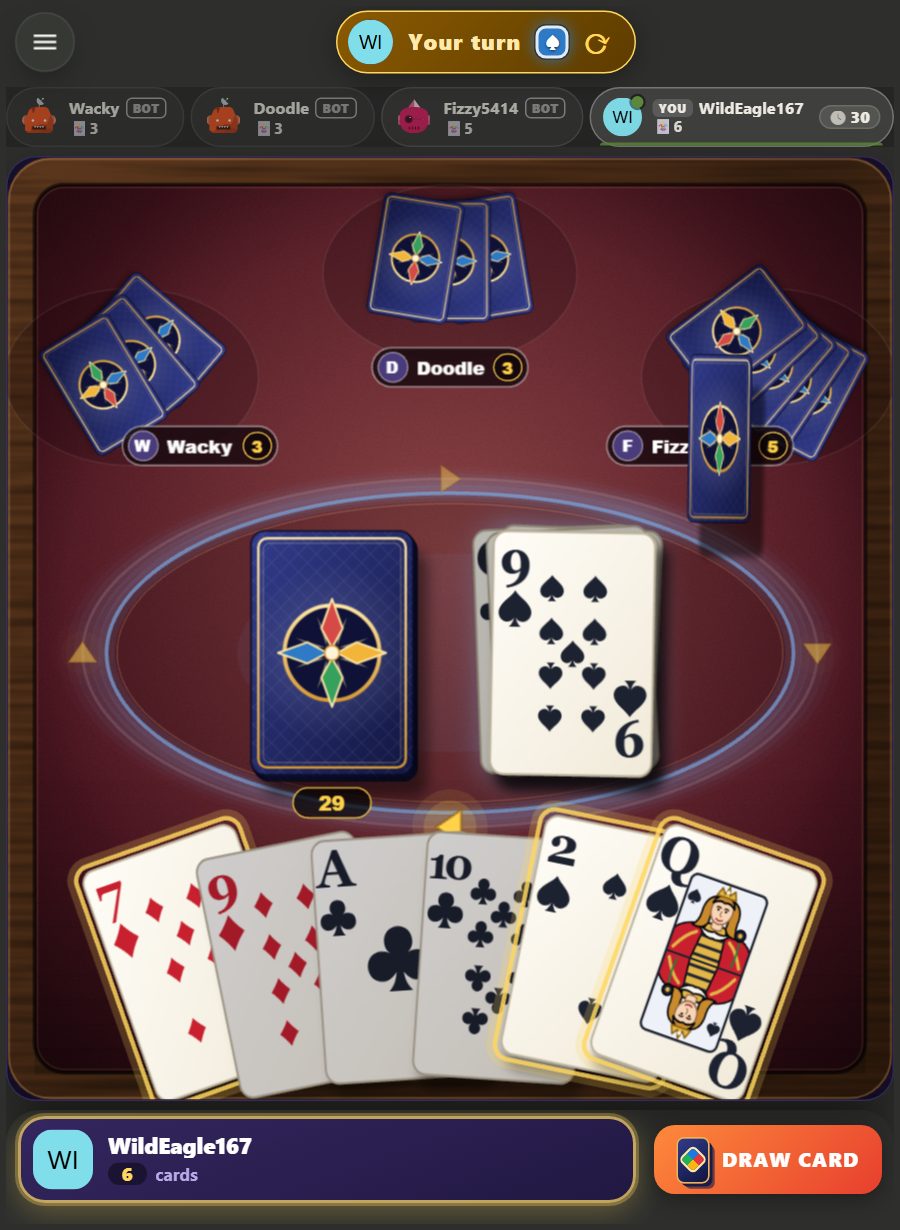
You cannot see rival cards, but every turn you can see how many cards each seat holds and what has just been played. The seat chips at the top of the screen show those counts.
- A seat on one or two cards can win on its next turn. If you cannot go out first, get rid of your most expensive cards now, because a loss costs you whatever you still hold.
- A seat that just drew may have had no legal card, or may have drawn by choice, since drawing is allowed even with a legal card. Treat it as a hint, never a certainty.
- The discard is your memory. When the draw pile runs out, the discards except the top card are reshuffled into a new draw pile, so in a long game the cards you saw earlier come back.
Going low on points before someone goes out
The game ends the moment one hand is empty. The engine ranks the finish by a score: the card points still held by all seats, minus the points you hold yourself. The winner holds nothing, so the winner always has the top score. If you are not going to win, your job is to hold as little as possible.
| Card left in hand | Points |
|---|---|
| 8 | 50 |
| 10, J, Q, K | 10 each |
| 2 to 7 and 9 | face value |
| Ace | 1 |
When two legal cards are otherwise equal, play the one worth more points. A king gone is 10 points you cannot be charged; a three gone is 3. The 8 is the exception: it is worth the most, but it also protects you from drawing, so keep it on purpose until you see a way to go out.
What the bot games showed
We ran bot-only games to see how the table plays out. These are bot results, not human ones: 300 games per row, all medium bots, with the first seat to move tracked.
| Seats | First mover wins | Fair share | Average winner score |
|---|---|---|---|
| 2 | 50.3% | 50% | 18 |
| 3 | 36.7% | 33.3% | 33 |
| 4 | 22.7% | 25% | 50 |
| 5 | 22.0% | 20% | 67 |
| 6 | 19.3% | 16.7% | 82 |
Going first is never a large edge at a Crazy Eights table, and the room shuffles seats at random anyway. In a separate run of 120 bot games across two to six seats, a Crazy Eights game took about 30 actions, where an action is any play, draw or keep decision rather than a turn. The test script itself calls the game mostly luck by design. You cannot control the deal, but you can control how many points you carry when it ends.
Put it into practice
The Play button above opens a Crazy Eights table against bots, and bots default to the easy level, so it is a gentle place to try these habits. Count your suits before every 8, shed your 10s and face cards early, and watch the seat counters. Heads-up play changes the rhythm, so read Crazy Eights for 2 players next. For the other members of this family, see the match-and-shed games by country, or the Color Match guide for the colour deck.
Crazy Eights is a traditional card game with many house rules; this guide describes the rules of the table on Playgridia.
Frequently Asked Questions
When should I play my 8 in Crazy Eights?
Keep it while you have other legal plays, and spend it when the alternative is drawing or when it takes you out. An 8 left in your hand when someone else goes out costs 50 points, so do not sit on it forever.
Which suit should I name with an 8?
Name the suit you hold the most of. That gives your next turn several legal plays instead of one. Count your suits before you play the 8.
Do you have to say last card in Crazy Eights?
Not at our table: there is no last-card call and no penalty for not announcing one. The first player to empty their hand wins at once. Other groups use house rules with a call, so check before playing elsewhere.
Does going first help in Crazy Eights?
Only a little. In 300 bot games per table size, the first mover won 50.3 percent at two seats and 22.7 percent at four seats, close to a fair share. Seats are shuffled at random in a room anyway.
How are points counted when someone goes out?
Cards left in hand count against you: an 8 is 50, a 10, jack, queen or king is 10, a 2 to 7 or 9 is its face value and an ace is 1. The winner holds nothing, so the winner always has the best score.