How to Play Color Match: Rules, Cards and Tables
How to play Color Match: every player starts with 7 cards, and on your turn you play one card that matches the top card of the pile by color or by number or symbol. The first player to get rid of every card wins. This guide to the color-and-number matching card game covers a turn, every Classic Table card, penalties, the Bomb and the score.
Setting up a match
A room seats 2 to 6 players and opens with 4 seats by default; a room created by a guest seats up to 4. Quick play opens a 3-seat table: you and 2 bots.
Every player is dealt 7 cards, and the room cannot change that. The first card on the pile is always a number card, and its color is the color to match. A random player moves first, and play goes clockwise.
Each move has a clock: 30 seconds by default, and the host can choose 15, 20, 30, 45 or 60 seconds, or 10 minutes. If it runs out, a bot plays that turn for you.
Your turn: what you can play
A card is playable when it fits the top card in one of two ways:
- By color: it has the same color as the top card, or the color a Wild declared.
- By value: it has the same number, or the same symbol, in any color. A 7 goes on a 7, and a Skip goes on a Skip.
A Wild can always be played unless a penalty is waiting for you, and a +4 Wild is legal even when you hold a matching card. After you play a Wild, you pick one of the four colors.
If you have nothing to play
Press DRAW CARD yourself: you draw exactly one card. If it can be played, choose PLAY to put it on the pile or KEEP to hold it and end your turn; after 6 seconds without a choice, the game plays it for you. If it cannot be played, the turn passes. You may also draw while you hold a playable card.
The Classic Table's cards
The Classic Table is the free default table. Its deck has 112 cards: 76 number cards (in each color one 0 and two of each number from 1 to 9), 28 colored action cards (8 Skip, 8 Reverse, 8 +2 and 4 Bomb) and 8 Wilds (4 Wild and 4 +4 Wild).
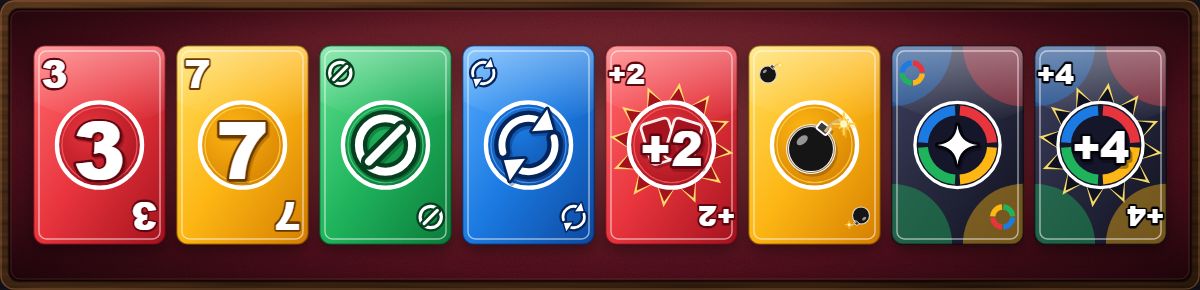
| Card | What it does | Can it be answered? |
|---|---|---|
| Number 0-9 | No effect. It matches by color or by number. | Not a penalty |
| Skip | The next player loses their turn. With 2 players the turn comes back to you. | Not a penalty |
| Reverse | Turns the direction around. With 2 players you simply play again. | Not a penalty |
| +2 | The next player must draw 2 cards. | Yes, by another +2 in any color |
| Wild | You choose the next color. | Not a penalty |
| +4 Wild | You choose the next color, and the next player must draw 4 cards. | No, not by a +2 and not by another +4 |
| Bomb | Lights a fuse. Three hand-offs later the player holding the turn draws 4 cards. | No, the blast is dealt on the spot |
For the whole range of special cards, read every special card explained.
Penalties: +2 and +4 Wild
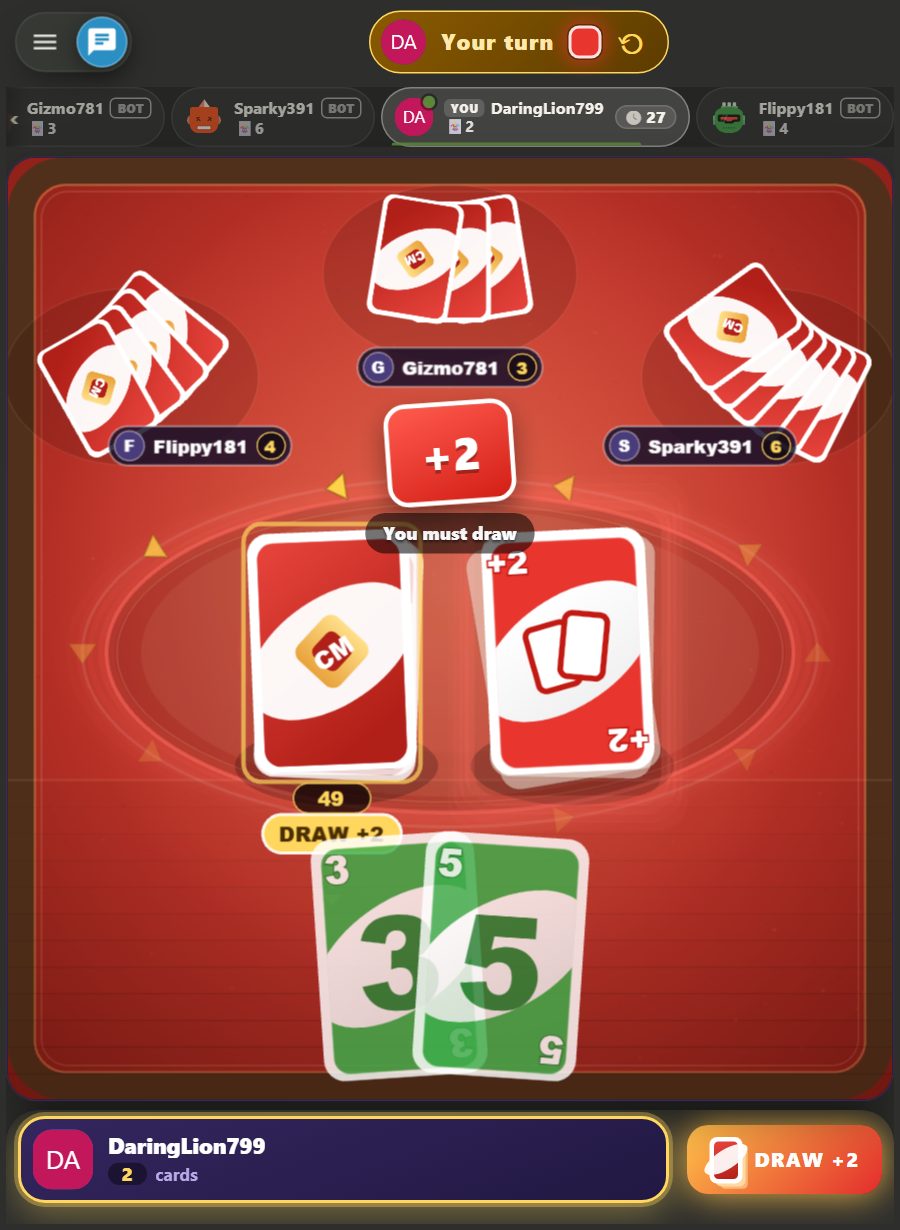
A +2 or a +4 Wild is not dealt at once. It is queued on the next player, who either answers it or collects it. On the Classic Table the only answer is a +2 played onto a +2, in any color, and the pile grows: 2, 4, 6, 8. A +4 Wild cannot be answered at all.
While a pile is waiting for you, nothing else is playable: not a number, a Skip, a Reverse, a plain Wild or a Bomb. If you cannot answer, press the draw button: you take the whole pile at once, and your turn ends. More in the guide to stacking draw cards.
The Bomb
The Bomb is the Classic Table's own card. It matches by color or by symbol, so a Bomb goes on any Bomb. Playing it shows FUSE LIT and starts a fuse of 3. The fuse counts hand-offs of the turn, not seconds; the hand-off that ends your own play is not counted, and a Skip counts as one.
When the count reaches 0 the banner reads BOOM: the player who has just been handed the turn draws 4 cards on the spot, then plays their turn. Nothing can answer a blast, and a blast can never end the match.
Another Bomb played onto a burning one adds 2 to the blast (4, then 6, then 8) and lights the fuse again at 3. After a plain round, with 3 players the blast lands on the player after you, and with 2 or 4 players you are hit by your own Bomb. Skip and Reverse change who gets it, so count first.
Winning and the score
The first player to empty their hand wins at once. A match is a single hand: no rounds, no points target, no tie. The last card does not use its effect, so going out on a +2, a +4 Wild or a Bomb ends the match and nobody draws. A Wild as your last card asks for its color first, then you win.
You do not have to call your last card. The board shows a ONE CARD! banner by itself, and there is no penalty to forget.
The score at the end uses card points: a number is worth its face value (0 to 9), every action card 20 and every Wild 50. Your score is the points everybody still holds minus the points you hold, so the winner scores the most. Example with 3 players: you go out, one rival holds a Skip, a Wild and a 9 (79 points) and the other holds a Bomb and a 0 (20 points). You score 99, the first rival 20 and the second rival 79.
The other two tables
The Classic Table is free for everyone. Day & Night and Siege are premium tables: the host opens one for the room and everyone who joins plays it. Each changes the rules, not only the look; the full comparison is in what makes Color Match different.
Day & Night
Every card has a day face and a night face, and the table opens on the day face. Day cards are gentle (+1, Skip, Reverse, Wild); night cards are harsh (+5, All Pass, Color Hunt). You see the far side of every rival's cards, never your own. A Turnover flips the whole table at once, and a wound Midnight Clock flips it after 3 hand-offs. Only the same penalty answers a penalty: +1 on +1, +5 on +5.
Siege
Siege has the Classic deck with a Shield in place of the Bomb. A Shield cancels a waiting penalty pile of any size, or stands in front of you and absorbs the next pile handed to you. Penalties climb a ladder: a +2 answers a +2, and a +4 Wild answers a +2 or another +4, but a +2 cannot answer a +4.
What to do next
Start on the free Classic Table: play Color Match from quick play, sit down with 2 bots and watch for the ONE CARD! banner and the fuse of the Bomb. Then read the Color Match tips, and if you mostly play head to head, the notes on the two-player card game.
Frequently Asked Questions
How many cards do you start with in Color Match?
Every player starts with 7 cards, and the room cannot change that number. The first card on the pile is always a number card, so a match never opens on an action card. A random seat moves first.
Can you stack a +4 Wild?
On the Classic Table, no. A +4 Wild cannot be answered at all, not by a +2 and not by another +4, and only a +2 can be played onto a +2. On Siege a +4 Wild can answer a +2 or another +4, and on Day & Night only the same penalty answers a penalty.
Do you have to call your last card?
No. There is no call and no penalty for forgetting one. When a player has one card left, the board shows a ONE CARD! banner by itself.
What happens if I have no card I can play?
Press DRAW CARD to draw exactly one card. If it can be played, you choose PLAY or KEEP; if not, your turn passes. If a penalty is waiting for you and you cannot answer it, you take the whole pile and your turn ends.
What if my last card is a +2, a +4 Wild or a Bomb?
You win at once and the card does not use its effect, so the next player draws nothing. A Wild as your last card still asks for a color first, then you win.
Which Color Match tables are free?
The Classic Table is free for everyone. Day & Night and Siege are premium tables: the host opens one for the room, and everyone who joins plays it.