Color Match Special Cards: +4, Wild, Skip
This special cards guide for Color Match explains what each wild, +2, +4, skip and reverse card does in the standard game, how many are in the deck, and how many points they cost you if left in hand. Everything described here is what the engine actually does—not a house rule or assumption, but what you will see when you sit at the table.
Special cards and what they do
The standard game uses a 108-card deck: 76 number cards and 32 special cards. Action cards (SKIP!, REVERSED, +2) are colored and follow the normal color-number matching rule; wilds (Wild and +4) are colorless and can always be played whenever you want, regardless of the card on top or what color is needed. The table below shows how many of each special card are in the deck, what it does, and how many points it costs you if left in your hand at the end of a round.
| Card | In Deck | What It Does | In Hand At End |
|---|---|---|---|
| Number card | 76 | Played when it matches the color or number on top; no extra effect | Points equal to card number |
| SKIP! | 8 (2 per color) | Next player loses a turn | 20 points |
| REVERSED | 8 (2 per color) | Reverses the direction of play | 20 points |
| +2 | 8 (2 per color) | Next player draws 2 cards; can be stacked with another +2 | 20 points |
| Wild | 4 | Player picks a color; no penalty | 50 points |
| +4 | 4 | Sets the color and next player draws 4; cannot be stacked | 50 points |
The difference between +2 and +4
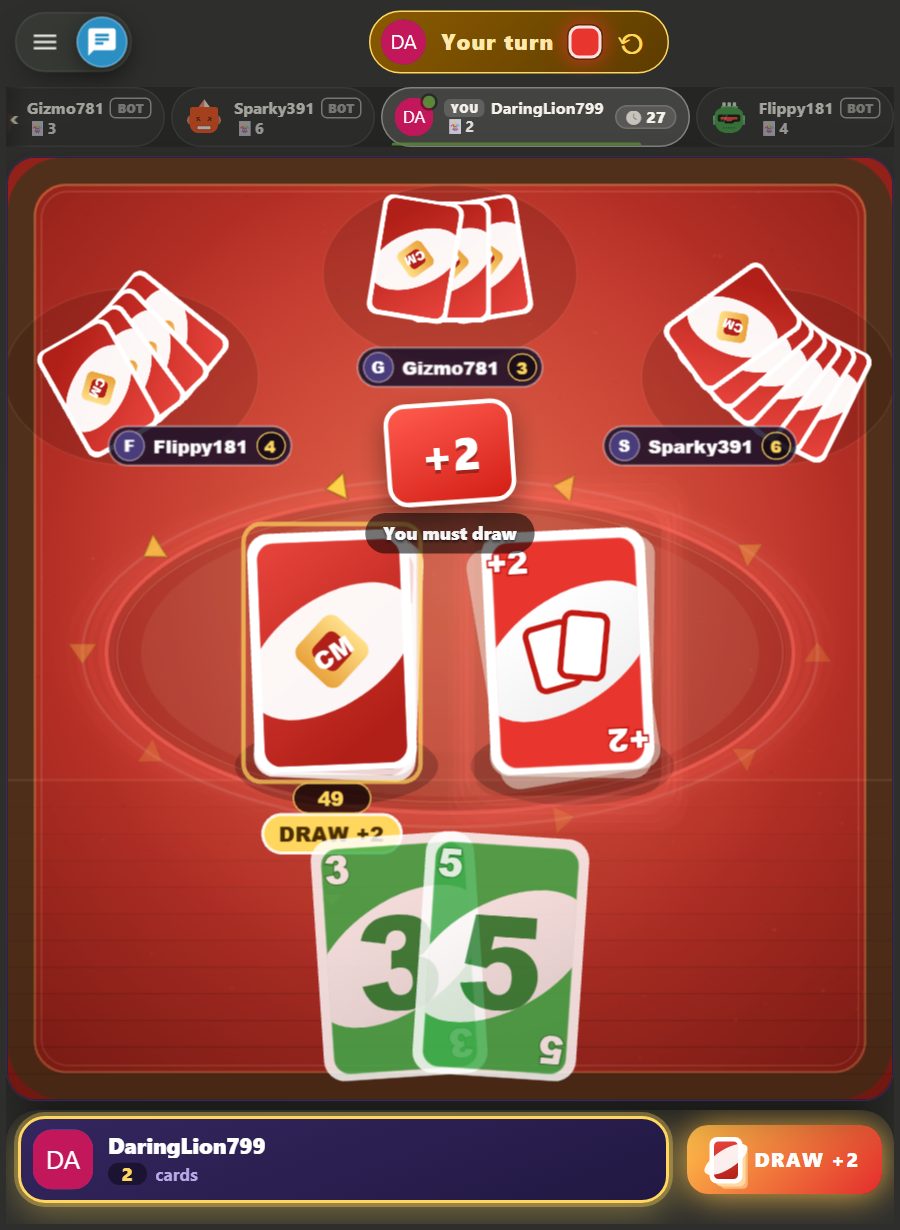
This is the most debated rule in the genre, and Color Match's answer is clear: a +2 can only be answered by another +2, and the chain grows 2 → 4 → 6 → 8 until someone runs out of +2s to throw. For example, at a four-player table, you get a +2 and you have another +2 in hand—you can throw it on top to pass the penalty forward as 4 cards instead of 2 to the next player, who can add to the chain if they also have a +2. The chain only breaks when someone has no more +2s left, and that player then draws all the accumulated cards. A +4, however, never chains at all in the standard game—the mechanism that enforces stacking only checks for +2 matching +2; when it sees a +4 it does not look for a match, it simply makes you draw. In practice this means: if you have a +2 and one comes to you, holding it instead of playing it right away can sometimes work because you might chain it and pass the penalty to the next player; when +4 comes to you, there is no such option, you must draw. The engine does have a setting that turns off stacking entirely, but that setting can only make a game softer, never harder; and today it is not an option offered to players when creating a room, so in the standard game +2 stacking is always on.
Wild and color picking
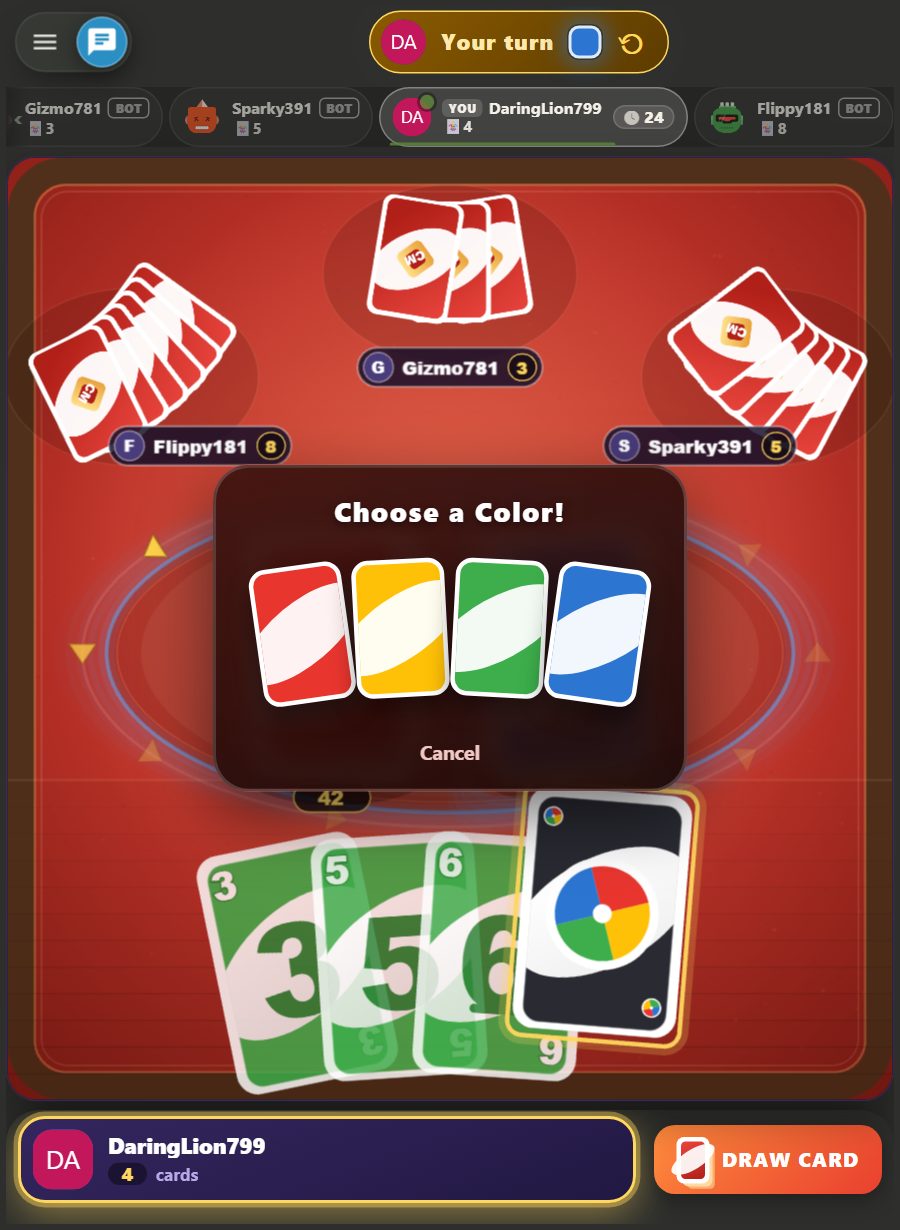
When a Wild is played, the turn does not advance automatically: instead a window titled "Choose a Color!" opens on the table and the player must pick one of four colors before the turn continues. The colors are Red, Yellow, Green, and Blue. If a Wild is played without a color being set, the turn freezes at that point and is resolved with a separate color-picking move; the same window opens for +4, except that after picking the color, the target player also draws four cards. Because Wild and +4 are colorless, you can always play them from your hand regardless of what color or number is on top; this makes them the most flexible way to lighten your hand. Generally a good choice is to pick whichever color you have most of—your next turn, you will have more cards you can play.
Skip and reverse
SKIP! is straightforward: the next player loses that entire turn, and play moves to the player after. REVERSED changes the direction of play; it does not skip anyone directly, only flips which direction the turn order goes. At a three-or-more-player table this means the turn goes to the player who would have been next, but in the opposite direction. At a two-player table this card has no third player to reverse to, so its practical effect becomes like SKIP!: the player who plays it keeps their turn and the opponent loses their turn.
The ONE CARD! announcement
When a player has one card left, the screen shows an ONE CARD! announcement. There is no separate move needed to trigger it; the moves the game recognizes are: play a card, draw a card, pick a color, play a drawn card, keep a drawn card, and pass—nothing among them includes an "announce one card" move. Unlike many house rules at paper tables, there is no catch mechanic here that penalizes a forgotten announcement. As a result, no one can score points off an opponent forgetting to announce; the hand ends the moment the last card is played, no matter what anyone said.
How many points cards left in hand cost you
When a hand ends, each player loses points equal to the total value of cards remaining in their hand. Number cards cost points equal to their number, colored special cards like SKIP!, REVERSED, and +2 are worth 20 points each, and colorless cards like Wild and +4 are worth 50 points each. For example, if at the end of a hand you have a Wild (50 points) and two number cards showing 4 and 5 (total 9 points), you lose 59 points from that hand. So holding a single +4 costs you much more than holding four number cards; this makes the risk of needlessly keeping a Wild or +4 much higher than holding playable number cards.
The practical lesson: do not hoard wilds and +4s because they are the most expensive cards if left in your hand at the end; when a +2 comes to you and you have another +2, chaining it is your only way to pass the penalty on—when +4 comes, there is no room for negotiation, you must draw. For all the rules and everything you need to know before sitting down, see the how to play guide; for tactics to speed up your hand, see the tips article. If you want to try other card games from the same family, check out Crazy Eights–style games and two-player card games. To play the game itself, head to the Color Match table.
Frequently Asked Questions
Can you stack a +4 on top of a +4?
No. In the standard game, +4 cannot be answered by any card; the mechanism enforces stacking only for +2 matching +2. When +4 comes to you, your only option is to draw four cards.
Can you stack a +2 on top of a +2?
Yes. In the standard game, +2 can be stacked: throw another +2 on top to grow the penalty from 2 to 4 to 6 and pass it to the next player. The chain continues until someone runs out of +2s and has to draw all accumulated cards.
When can a Wild card be played?
A Wild can be played by the current player on top of any color or number, whenever they want. When played, a color-picking window opens and the player must choose from Red, Yellow, Green, or Blue; the turn does not advance until a choice is made.
What does the reverse card do in a two-player game?
In a two-player game, there is no third player to reverse the turn order to, so the practical effect is like SKIP!: the player who plays the reverse card keeps their turn and the opponent loses their turn.
When I have one card left, do I have to say 'one card'?
No, you do not have to say anything. When you have one card left, the screen automatically shows ONE CARD!; there is no separate move to trigger it, and if you forget there is no penalty.
How many points do cards left in your hand cost you?
When a hand ends, each card remaining in your hand reduces your score: number cards cost points equal to their number, colored special cards like SKIP!, REVERSED, and +2 cost 20 points each, and colorless cards like Wild and +4 cost 50 points each.