Color and Number Matching Card Game for Kids and Families
A color and number matching card game asks a player to do one thing on every turn: play a card that matches the top card by color or by number. Color Match is built on that single move. Everyone gets 7 cards and the first player to play their last card wins, so the rules fit in a few sentences. Bots can sit at the table for practice, and an adult can open a private room and invite the family with a link.
The rules an adult can explain in five sentences
- Each player gets 7 cards, and one number card is turned over to start the pile.
- On your turn, play a card with the same color as the top card, or with the same number or symbol: a 7 goes on a 7, and a Skip goes on a Skip.
- If nothing fits, press DRAW CARD: you take one card, and if it fits you choose PLAY or KEEP.
- Special cards change what happens next, and a Wild fits any card when no penalty is waiting, with you choosing the color.
- The first player to play their last card wins at once.
Two details save arguments. First, nothing draws for you: you press DRAW CARD yourself, and a normal draw is one card only, never "until something fits". Second, there is no last-card call to remember: the board shows a ONE CARD! banner by itself when a player is down to one card, and nobody is penalized for forgetting. The full turn-by-turn rules are in how to play Color Match.
The special cards on the Classic Table
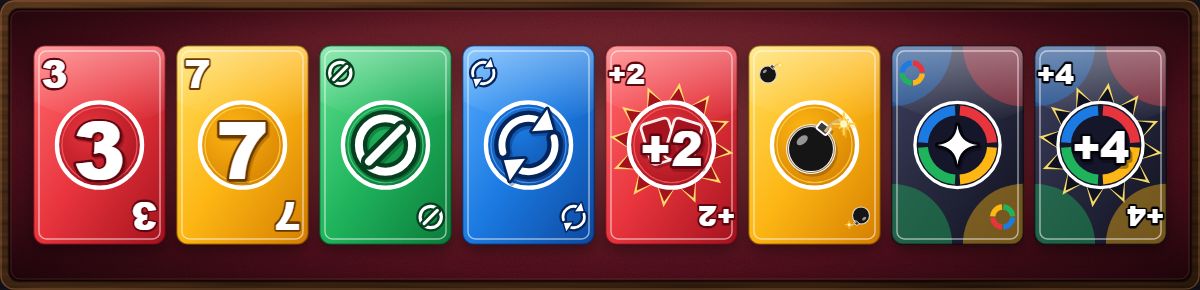
The Classic Table is the default table and the free one. Next to the number cards its deck has six kinds of special card, and it helps to add them one at a time. The guide to card game special cards explains each one in more depth.
| Card | What it does | How to say it in one sentence |
|---|---|---|
| Skip | The next player misses a turn. With two players, you play again. | "The next player loses a turn." |
| Reverse | Play changes direction. With two players, you play again. | "We go the other way around." |
| +2 | The next player draws 2, unless they play a +2 of their own, which makes the pile 4. A player who draws takes the whole pile. While a +2 is waiting, only another +2 can be played. | "Draw 2, or pass it on with your own +2." |
| Wild | Fits any card when no penalty is waiting. Its player picks the color that comes next. | "Choose any color you like." |
| +4 Wild | Like a Wild, and the next player draws 4. It can be played even when you hold a matching card. Nothing can be played on top of it, and there is no challenge rule. | "Choose a color, and the next player draws 4." |
| Bomb | Lights a fuse of 3 turn changes. Then whoever has just been given the turn draws 4 cards at once and still plays their turn. | "In three turns, someone draws 4." |
With two or four players, a Bomb that nobody steers with a Skip or a Reverse comes back to the player who lit it. Also, going out ends the match before the last card does anything, so a +2, a +4 Wild or a Bomb played as the final card never makes anyone draw.
Playing together as a family
A private room and an invite link
An adult can open a private room and share the invite link. Whoever taps the link joins the table: nobody has to download, install or sign up, and the game plays in a phone browser the same way as on a laptop. We suggest that the adult opens the room, sends the link only to the people who are meant to play, and stays at the table during the match.
A room seats 2 to 6 players and opens with 4 seats by default. A room created by a guest seats up to 4; five or six seats need a host with a registered account. The notes on the two-player card game cover a table of two.
Practice against bots
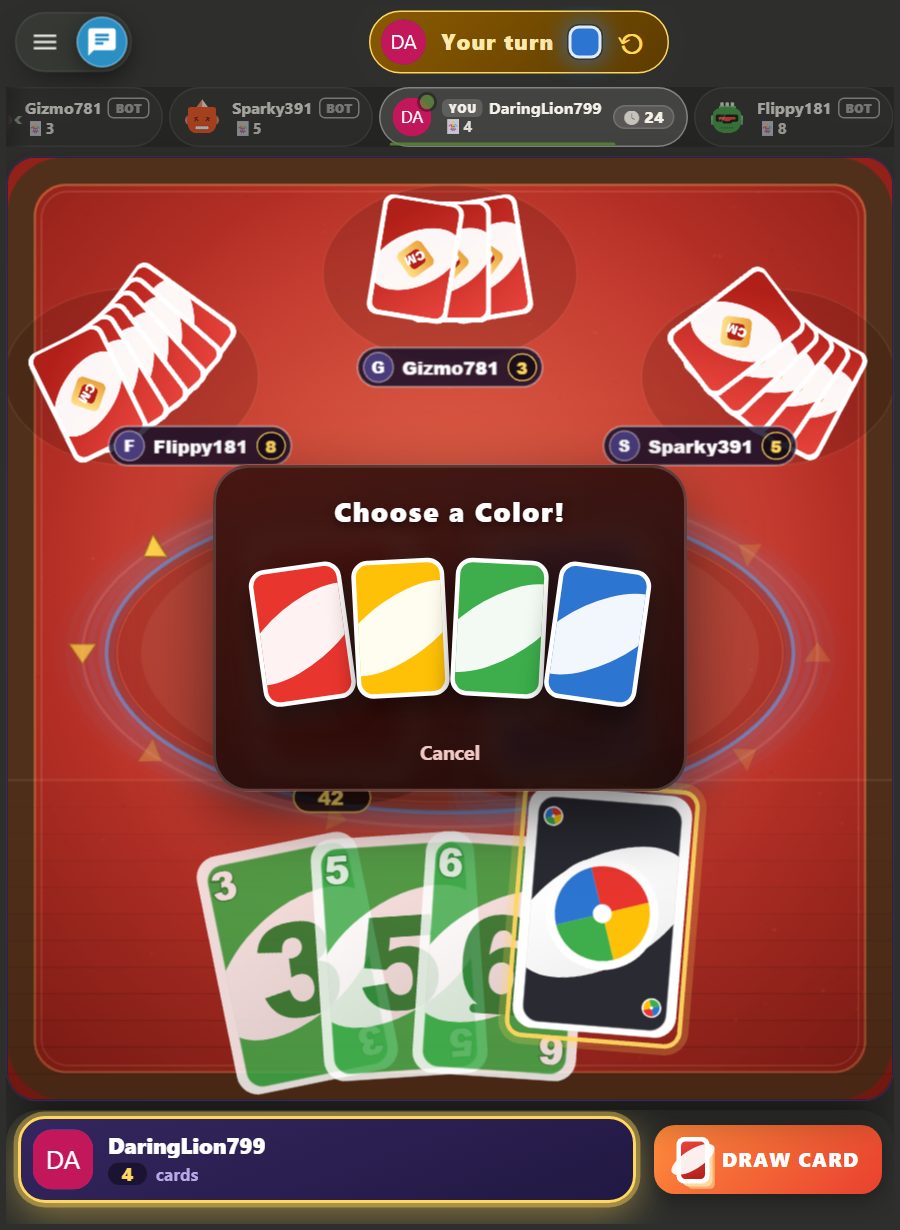
The Play Now button (quick play) opens a table with 3 seats: you and 2 bots. A child can practice there without waiting for anyone, ideally with an adult nearby.
Setting the move clock
Each move has a clock, 30 seconds by default. The host can choose 15, 20, 30, 45 or 60 seconds, or 10 minutes; a longer clock gives a slower player more time. If it runs out, a bot plays that turn for the player.
Making the game gentler or tougher
Start on the Classic Table. The Classic Table is free for everyone. Day & Night and Siege are premium tables: the host opens one for the room and everyone who joins plays it. A table changes the rules, not only the look.
- Day & Night: every card has a day face and a night face, and the table starts on the day face. The day face is the gentle one: its penalty card is +1. The night face is harsher: its penalty card is +5, and Color Hunt makes the next player draw cards until the chosen color turns up, up to 12. A Turnover card, or the Midnight Clock three turn changes after it is played, turns the whole table over.
- Siege: the Shield takes the place of the Bomb. A Shield cancels a waiting penalty of any size, or stands in front of its player and cancels the next penalty that player is handed.
For a first family match, stay on Classic. The guide to what makes Color Match different compares the three tables.
A few habits worth showing a new player
These come straight from the rules:
- Read the top card first. Look at its color and its number: a card can fit by either one.
- Keep a card for later. When a card you draw fits, you may keep it and end your turn. A Wild fits any card when no penalty is waiting, so it can rescue a turn where nothing else fits.
- Count the cards in rivals' hands. The player bar shows how many cards each rival holds. When the next player is close to going out, a Skip or a +2 slows them down.
- Expect luck. Much of a match comes from the cards drawn, so these habits help without deciding every match.
Where to start
Open the free Classic Table, sit down with 2 bots through Play Now, and play one match with an adult at the table so the six special cards show up in real play. Then open a private room, send the invite link to the family, and set the move clock to suit the slowest player. Questions about a card are answered in the full rules.
Frequently Asked Questions
Is this card game easy to explain to a child?
The core move is one action: play a card with the same color or the same number as the top card. The rules fit in five sentences, and the Classic Table adds six kinds of special card that you can introduce one at a time. How fast a new player picks it up depends on the player.
How many people can play together?
A room seats 2 to 6 players and opens with 4 seats by default. A room created by a guest seats up to 4, and five or six seats need a host with a registered account.
Can a child play alone against bots?
Yes. The Play Now button (quick play) opens a table with 3 seats: one player and 2 bots. We suggest that an adult stays nearby while a child plays.
Do you have to say "one card"?
No. The board shows a ONE CARD! banner by itself when a player has a single card left. There is no call to make and no penalty for forgetting.
What happens if a player takes too long?
Each move has a clock: 30 seconds by default, and the host can choose 15, 20, 30, 45 or 60 seconds, or 10 minutes. If the clock runs out, a bot plays that turn for the player.
Does the family need to download an app or sign up?
No. An adult opens a private room and shares the invite link, and whoever taps it joins the table. Nothing has to be downloaded or installed, nobody has to sign up, and the game plays in a phone browser the same way as on a laptop.