Two-Player Card Games: How Heads-Up Play Works
For players looking for a two-player card game: Color Match is a two-player online card game where you sit across from your opponent in your browser, trying to empty your hand with color and number cards. You can open a private room and invite a friend, or warm up with a match against the computer first—no downloads needed.
What changes in two-player
In a heads-up card game, some cards produce different results than they do at a crowded table, because there is only one person waiting for their turn after you, and no third or fourth player for the card's effect to reach. The table below compares what the same card does in a three-or-more-player table versus a two-player table.
| Card / Situation | In 3+ player table | In two-player table |
|---|---|---|
| REVERSED | The game direction reverses, and the turn passes to the previous player. | There is no third direction to reverse to, so the same player continues playing, effectively acting like an extra turn. |
| SKIP | The next player is skipped; the player after that plays. | Since the only next player is your opponent, SKIP passes their turn, and the turn comes straight back to you—the same result as REVERSED. |
| Penalty card: +2 / +4 | The penalized player draws if they cannot counter it; the penalty can cascade around the table. | Since you are the only one penalizing your opponent, if they cannot counter it, the penalty lands on them directly—it does not circulate. |
| Card tracking | 108-card deck spread across three to six hands makes tracking difficult. | Only two hands exist, with 7 cards each at the start; everything else is in the draw pile or discard pile. |
Why penalty cards hit harder in two-player
In a classic multiplayer game, when a +2 card is played, the next player either draws the cards or, if they have another +2 in hand, stacks it to pass a 4, 6, or 8-card penalty forward. The +4 wild never enters this chain—it always draws exactly four cards. This holds true at a crowded table too.
The difference emerges in two-player: there is no third player to pass the penalty to. Every penalty you play goes straight to your opponent, and if they counter it, the penalty bounces back to you—cards only move between your two hands. Holding a +4 wild is also riskier in two-player: when the game ends, each wild card in your hand counts as 50 points, each action card as 20 points, and number cards count their face value; your final score is the table total minus the points in your remaining hand.
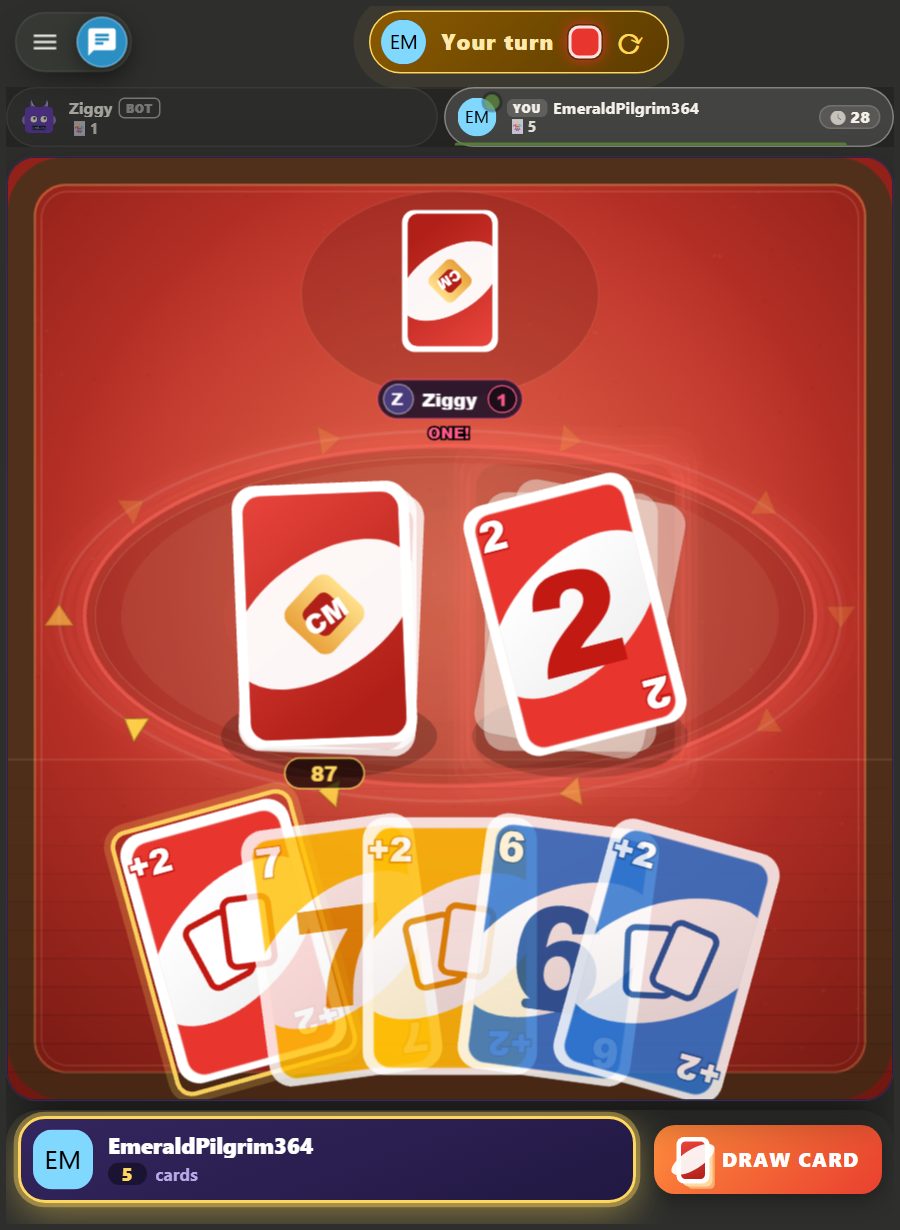
Card tracking actually works
Color Match belongs to the Crazy Eights family of games, but instead of a standard 52-card deck, it uses its own color and number deck. In a classic game, the deck contains 108 cards: 76 number cards; 24 action cards (2 SKIP, 2 REVERSED, and 2 +2 in each of four colors—red, yellow, green, blue); and 8 wild cards (4 basic wilds and 4 +4 wilds). Each player is dealt 7 cards at the start.
This makes card counting genuinely useful in a two-player table: the players' hands hold only 14 cards total, leaving 94 cards in the draw pile or discard pile. If both +2s in a color have been played, you know your opponent has no penalty cards left in that color; if you track which wilds have been played, you can decide when to hold your last +4. When your opponent's hand is down to a single card, the game shows the ONE CARD message, and knowing which colors have been exhausted helps you predict which color their last card might be. For a complete list of cards and their meanings, see the article on card effects.
Play the bot first
Before inviting a rival, a match against the computer is good practice. Three difficulty levels exist. Easy plays the first valid card it can and chooses whether to stack its penalty about half the time. Medium (the default) prioritizes number cards first, then action cards, then wilds, and always stacks its penalty if it has one. Hard goes on the offensive the moment your hand is down to two cards or fewer, clears its largest color early, and saves its strongest wild for an emergency. In a real two-player match, you cannot see your opponent's cards; playing a few hands against the Hard bot builds intuition about when to hold a penalty and when to play it immediately.
Inviting a friend
Once you are comfortable, open a private room and send the link to your friend; when they join, the table starts as two-player. When setting up the room, you can choose the move timer from several options—15, 20, 30, 45, 60 seconds, or 10 minutes, with 30 seconds as the default; there is no unlimited option.
If your opponent loses connection mid-match, the table does not cancel. The game gives them a 2-minute grace window to reconnect; if they do, they reclaim their seat. If time runs out, a temporary bot takes their seat and the match continues uninterrupted; if they rejoin later, they can reclaim their seat again. For an opponent who is simply idle and not playing, there is a separate threshold: seat takeover activates after a total of 10 minutes of inactivity.
Does a match affect your rating
The rating rule is simple: if at least two humans are seated when the match starts, the match counts toward your rating. In a two-player table, this means it boils down to whether your opponent is human. Matches you play against the computer never affect your rating.
In summary: in a two-player table, REVERSED leaves the turn with you, SKIP passes your opponent's turn and returns it to you, penalty cards do not circulate—they bounce directly between the two of you, and with only 14 cards in play across two hands, deck tracking is a genuinely viable tactic. Start by playing a few hands against the Medium bot to get comfortable with card counting; then open a private room and invite a friend. For a broader list of two-player games, see the article on two-player online games; to read your cards better, see the tips article.
Frequently Asked Questions
Can you play with two players?
Yes, the game can be played between 2 and 6 players, and the minimum is exactly two. Each player is dealt seven cards when seated, and the first to empty their hand wins that round.
What does the REVERSED card do in two-player?
In a crowded table, the REVERSED card flips the game direction and passes the turn to the previous player. In a two-player table, there is no third direction to flip, so the card makes the same player continue playing—effectively acting as an extra turn.
Can you play against the computer?
Yes, there are three bot difficulty levels: Easy, Medium (the default), and Hard. The Medium bot prioritizes number and action cards and always plays its penalty if it has one; the Hard bot attacks when you are down to two cards or fewer.
How do you invite a friend?
Open a private room and share the link with your friend; when they join, the table starts as two-player. When setting up the room, you can choose the move timer from several options—15 seconds to 10 minutes—with 30 seconds as the default.
What happens if your opponent loses internet?
The match does not cancel. The game gives your opponent a 2-minute grace window to reconnect; if they do, they reclaim their seat. If time runs out, a temporary bot takes their place and the match continues uninterrupted.
Do two-player matches count toward your rating?
The rule is: if at least two humans are seated when a match starts, it counts toward your rating. In a two-player table, this means your opponent must be human; matches you play against the computer never count toward your rating.