Crazy Eights-Style Online Card Game: Color Match
Crazy Eights-style online card game — if that is what you are looking for, Color Match is a solid landing spot: a deck game from the same family, played free in the browser, 2 to 6 players at the table and the computer fills the empty seat if there is no opponent.
Same family, different deck
Shedding games like Crazy Eights, where you empty your hand by playing cards that match the top card, all stand on the same skeleton: a standard deck, you play a card that matches the one face-up, sometimes a color is used instead of a suit, there is usually one value in the deck that acts as a wild, and in most house rules there is a separate card that penalizes the remaining hand. The goal is always the same: whoever empties their hand first wins. Color Match is a member of that family, a relative, not a copy; its cards carry color and number instead of suit, and the deck is not a standard 52.
Traditional deck game versus Color Match
Same family, but plenty changes when you sit at the table. The table below compares the traditional deck game family with a standard Color Match game.
| Traditional deck game | Color Match (standard game) | |
|---|---|---|
| Deck | Standard 52-card suited deck | 108 cards: 76 number, 24 action, 8 wild |
| What you match | Suit or rank | Color or number |
| Wild card | Usually one rank playable in every suit | 50-point wild card; the player who plays it picks the new color |
| Penalty card | Usually one in most house rules | +2 DRAW; on the standard game it stacks: 2-4-6-8 |
| Player count | Varies by table and house rules | 2 to 6 |
| Deal and shuffle | One player deals by hand | The engine deals automatically; the opening card is always a plain number card |
| Where disagreements are settled | Debated at the table | One rule engine approves every move, no room for argument |
The last two rows in the table are where the real difference lies: the engine automatically deals and shuffles the cards, and one rule engine decides whether each move is legal. The "does this card count" argument that comes up often at a table does not happen here — the decision is not in your hand or your opponent's, it is in the engine's.
How a turn works
When it is your turn, you play a card from your hand that matches the top card either by color or by number; Color Match uses four colors (red, yellow, green, blue), and is a color-and-number shedding game. If you have no card to play, the move does not come automatically — you have to tap DRAW CARD yourself, the engine does not draw for you. Once you draw, the engine offers you a real choice if the card is playable: play it now or keep it; if it is not playable, it is the next player's turn; if both the deck and the discard pile run out at the same time, the turn passes silently. A wild card pauses the sequence before the color pick; the color you choose becomes the table's new color. When a penalty card is on top, your options narrow: you can only stack a +2 on top of a +2, not on a +4, and you have to take the full penalty. The screen makes this clear: the player whose turn it is either sees a "+2 or draw." prompt or, if they have no matching card, it says outright "You must draw".
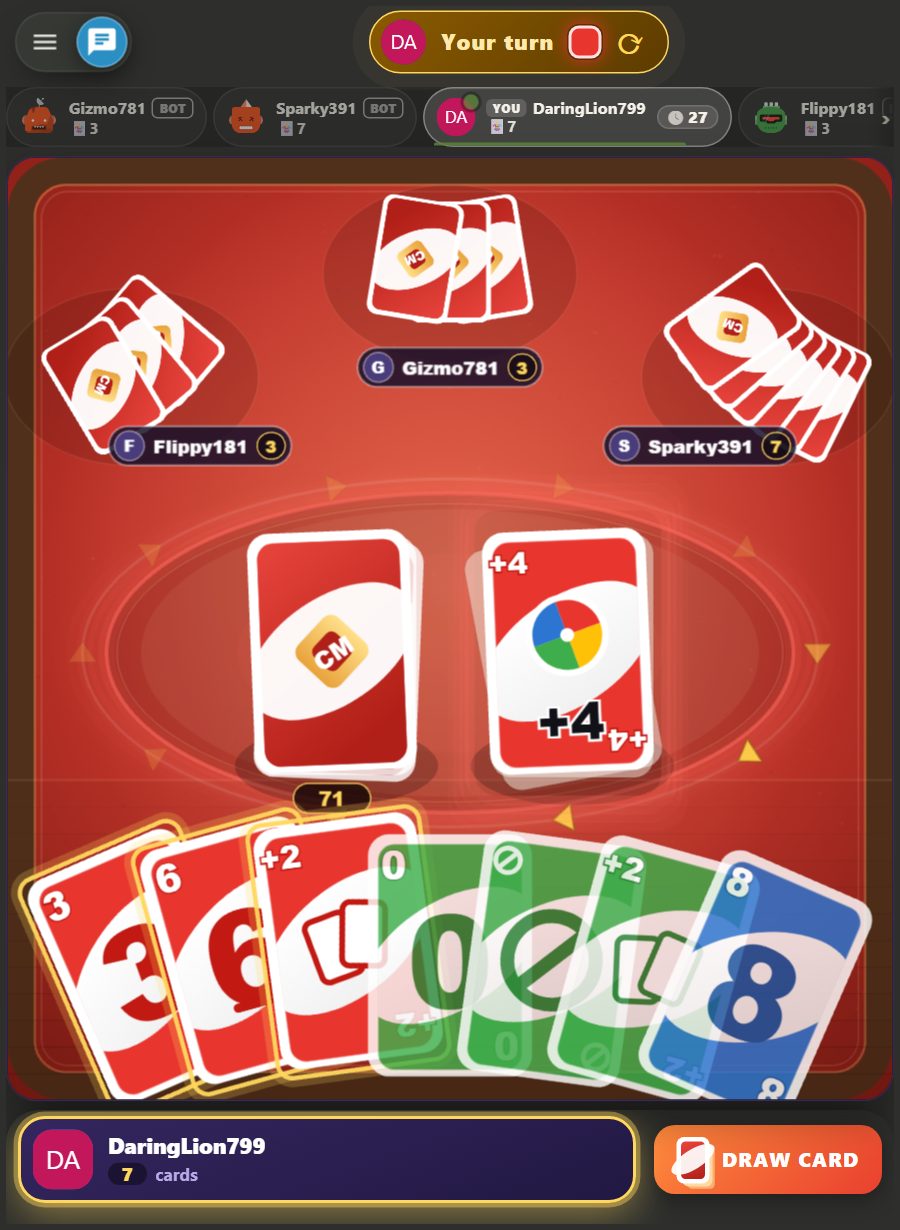
When you have one card left, the screen shows ONE CARD! automatically — this is not a moment you have to shout about, and forgetting to call carries no penalty. The engine makes the announcement itself and there is no penalty for missing it. Compared to the version played around a table, this is the most concrete difference: the spoken call and the forgetting penalty vanish, and your full attention stays on playing cards.
Special cards in brief
On a standard table, there are four kinds of special cards: SKIP. (skips the next player), REVERSED (turns the direction around; on a two-player table it takes your turn back), +2 DRAW (gives the next player two cards to draw; on the standard game it can stack), and wild cards. Wilds come in two kinds: plain PICK A COLOR sets the new color with no penalty, while +4 DRAW does both the color pick and forces the next player to draw four cards, and that penalty cannot be chained with any card. Each card is worth a fixed point value by its type: number cards are worth their face value, action cards are worth 20 points, and wild cards are worth 50; when the game ends, the points of any cards left in your hand are subtracted from your score. The deck's largest group is 76 plain number cards: they have no special effect, they just pass the turn to the next player. For a complete card list and stacking rules in detail, see special cards and their meanings.
Setting up the table
A table is set for 2 to 6 players and everyone gets seven cards dealt. Turn time is 30 seconds by default; the person who opens the table can set it to 15, 20, 30, 45, 60 seconds or 10 minutes (600 seconds) — there is no unlimited option. As a guest at a table opened by another player, you can sit up to four seats; the fifth and sixth seats require the table to be opened by a registered account.
If no one sits in an empty seat, the person who opened the table can fill those seats with Add Bot and play solo against the computer. If your connection drops during a game, you do not lose your seat right away: there is a two-minute grace period, and if you come back within that time, you get your seat back; if you stay connected but do not make a move for a long time, once ten minutes total elapse, a bot can take over that seat. If you want to play an online card game with friends, multiple people can sit at the same table; empty seats are filled with bots only if no one is there. Bots themselves have three difficulty levels; measured win rates are roughly 21% on easy, 26% on medium, 26% on hard — the difference is noticeable but the bulk of the game still comes down to card luck. These practice matches you play against bots do not affect your rating: for a match to count toward your rating, at least two human players must be seated when the game starts.
Where to play
You can play Color Match as a guest without signing up. If you want to see the rules step by step, check out the how to play guide. If you want to look at how balance shifts on a two-player table, read the two-player online card game article. If you want to check out other browser card games, browse the online card games list. For someone used to Crazy Eights, the biggest difference is the automatic ONE CARD. announcement and the fact that every move is approved by the engine; once you sit at the table, the rest already feels familiar.
Frequently Asked Questions
Is Color Match the same game as Crazy Eights?
No, it is from the same family but not a copy. Crazy Eights is played with a standard 52-card suited deck, while Color Match uses its own 108-card deck with four colors (red, yellow, green, blue); the idea of matching color or number and emptying your hand to win is a continuation of the same family.
How many players can play?
A table is 2 to 6 players and everyone gets seven cards. As a guest at a table opened by another player, you can sit up to four seats; the fifth and sixth seats require the table to be opened by a registered account.
Do you need an account?
No, you can sit as a guest up to four players. For a five or six player table, it is enough that the person who opens it has a registered account.
Can you play from a phone?
Yes; the game interface works on a narrow, vertical phone screen, with the seat rail laid out horizontally at the top, the card hand and draw button at the bottom.
Do you have to announce when you are down to one card?
No. The ONE CARD. announcement appears on the screen automatically, and the player does not have to make a separate call or face any penalty for missing it.
Can you play solo against the computer?
Yes. The person who opens the table can fill empty seats with Add Bot; during a game, if a seat's turn time runs out or if you stay connected but make no move for a long time, a bot can take over that seat too. Matches you play against bots do not affect your rating.