Catan Dice Odds: Best Numbers, Pips and Resources
Catan dice probability comes down to one fact: two dice make a 7 six ways out of 36, and every number moves down from there, so 6 and 8 (five ways each) are the best numbers to settle on. Claimridge is a separate, independent game of the same genre, and its dice work exactly the same way, which lets us show you real counts instead of folklore. Everything below about our game was measured in bot-only matches, not human play.
What pips mean
The little dots under each number token are pips. One pip means one of the 36 dice combinations lands on that number. A 6 has five dots, a 5 has four, a 2 or a 12 has one. Count the dots on the hexes next to a corner and you have that corner's chance of paying out on any given roll, out of 36.
There is no 7 token. A 7 produces nothing for anyone, so the 7 is the most common roll and the only one that never pays.
| Sum | Combinations | Chance per roll | Pips | Expected hits in 94 rolls |
|---|---|---|---|---|
| 2 | 1 | 2.8% | 1 | 2.6 |
| 3 | 2 | 5.6% | 2 | 5.2 |
| 4 | 3 | 8.3% | 3 | 7.8 |
| 5 | 4 | 11.1% | 4 | 10.4 |
| 6 | 5 | 13.9% | 5 | 13.1 |
| 7 | 6 | 16.7% | no token | 15.7 |
| 8 | 5 | 13.9% | 5 | 13.1 |
| 9 | 4 | 11.1% | 4 | 10.4 |
| 10 | 3 | 8.3% | 3 | 7.8 |
| 11 | 2 | 5.6% | 2 | 5.2 |
| 12 | 1 | 2.8% | 1 | 2.6 |
The 94 is the median number of dice rolls in a 4-seat match between medium bots on Frontier Valley. Each expected hit is 94 times the combinations over 36, so a 6 or an 8 comes up about 13 times in a whole match and a 2 or 12 about 2 or 3 times.
Why 6 and 8 are red, and how much it matters
The 6 and the 8 are printed in red because they are the two best producing numbers. On a 2 to 4 seat board there are two 6s and two 8s among the number tokens. Our screen draws them in red with five dots, as in the picture below.
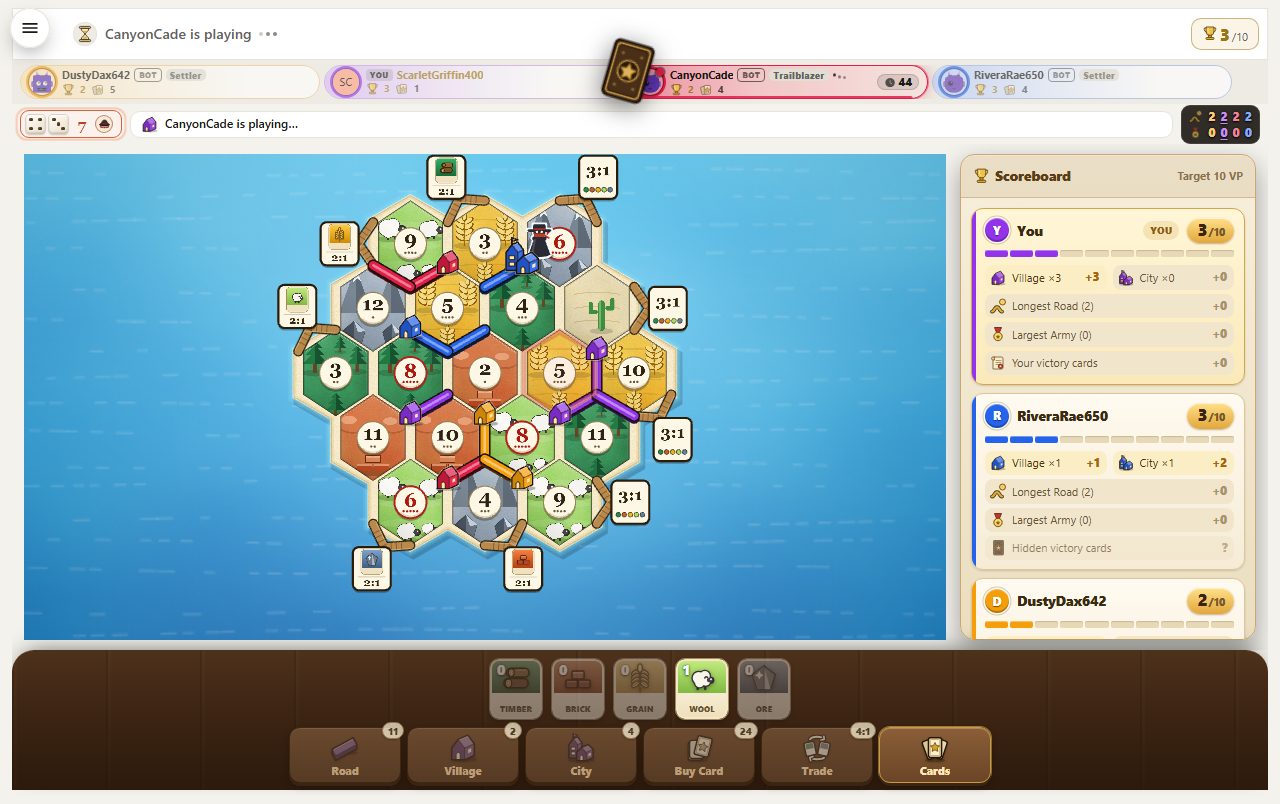
Do they matter? In our bot-only matches (2000 four-seat games, all medium bots), seats whose two opening villages touched no red hex won 13.2% of the time. Seats touching one red hex won 23.0%, and seats touching two or more won 27.6%. An even split at four seats would be 25%. So a red number is worth having, and two is better, but it is a tilt and not a guarantee.
The surprising part: total pips barely separate openings
Most guides tell you to add up the pips on your opening corners. We did, and the bots almost always landed between 18 and 23. Seats at 18 to 20 pips won 24.0% of the time, and seats at 21 to 23 won 25.9%. That gap is not statistically significant.
The bots already aim for high totals, so nearly every seat lands in the same narrow band, and inside that band the total stops telling you who is ahead. What did separate the bots was how many different goods their two opening villages touched.
| Different goods touched by the two opening villages | Win rate of those seats (4 seats, even split 25%) |
|---|---|
| 2 goods | 12.6% |
| 3 goods | 19.3% |
| 4 goods | 25.9% |
| 5 goods | 34.6% |
The same pattern held at six seats, where an even split is 16.7%: seats touching 2 goods won 6.3% of the time, and seats touching 5 goods won 26.1%. This is a correlation from bot play, not proof of cause, but the shape is hard to ignore. Pips tell you how often you get paid. Variety tells you whether what you get paid can be spent.
Which resource is best
Ore and grain. Seats whose opening touched both won 31.7% of the time, against 17.1% for seats that did not. Timber and brick together were a much smaller edge: 26.3% against 23.5%.
The reason shows up in how matches end. Cities supplied 56.6% of a winner's points, about 5.69 of 10. Villages gave 16.4% (1.64 points), Victory Cards 10.7%, Longest Road 9.4% and Largest Army 6.9%. A city costs 2 grain and 3 ore, so the goods that build cities are the goods that win.
One caution on trading posts: seats with an opening village on a post won 22.1% of the time against 25.5% without. In these bot games a post was not worth chasing over good numbers. For how to place those first two villages, read our opening placement guide.
Are the dice fair? The 216,589-roll check
We counted every sum across 216,589 rolls from the bot matches. Each one landed within what theory predicts, with a chi-square p-value of 0.71, a comfortable pass. A four-seat match averaged 18 sevens. If a streak of 7s feels unfair, that is usually just how 6-in-36 behaves over a few dozen rolls.
When a 7 comes, nobody collects, and anyone holding more than the hand limit (default 7) gives back half their cards, rounded down. The roller then moves the Bandit. The full sequence is in our rules for rolling a 7.
The Balanced Deck option
Claimridge has a room option for players who dislike streaks. The default is classic: two independent dice. Balanced Deck instead shuffles a deck of all 36 ordered combinations and deals it without replacement, reshuffling only when the deck is empty. Every full cycle of 36 rolls therefore contains exactly six 7s, one 2 and one 12.
The host picks it in the room options. Your own match's roll counts are also drawn in the in-game guide, so you can check the spread against the table above.
What to do with this
Take red numbers when they come, but do not count dots alone: aim for four or five different goods, and ore plus grain if you can. Then read how to turn that opening into points in the winning strategy guide, and try it in a free Claimridge match, no signup needed.
CATAN® is a registered trademark of CATAN GmbH. Playgridia and Claimridge are not affiliated with, sponsored or endorsed by CATAN GmbH, its licensees or publishers. The name is used only to identify the game readers are searching for and to describe the genre; Claimridge is an independent game with its own rules, names and artwork.
Frequently Asked Questions
What is the best number in Catan?
The 6 and the 8, with five of 36 dice combinations each, or 13.9% per roll. The 7 is more common (6 of 36) but it never pays out, because there is no 7 token. In our own Claimridge bot matches, seats touching two or more red hexes won 27.6% of the time.
What do the dots under the numbers mean?
They are pips, and each pip is one of the 36 dice combinations that makes that number. A 6 or 8 has five pips, a 5 or 9 has four, and a 2 or 12 has one. Add the pips of the hexes next to a corner to compare corners.
Is it better to have high pips or many different resources?
In our bot-only matches, total opening pips barely mattered: nearly every seat landed between 18 and 23, and 24.0% against 25.9% was not a significant gap. The number of different goods mattered much more, with seats touching 2 goods winning 12.6% of the time and seats touching 5 goods winning 34.6%. That is a correlation, not proof.
Which resource is the most valuable?
Ore and grain, because cities cost 2 grain and 3 ore. In our bot matches, cities supplied 56.6% of a winner's points, and seats whose opening touched both ore and grain won 31.7% of the time against 17.1% without.
Are the dice in Claimridge fair?
We checked 216,589 rolls and every sum matched theory, with a chi-square p-value of 0.71. The default is two independent dice, the same as the classic game.
Can I turn off dice streaks?
Yes, the host can choose Balanced Deck in the room options. It deals a shuffled deck of all 36 combinations without replacement, so every full cycle has exactly six 7s, one 2 and one 12.