Catan With 5 or 6 Players: Bigger Map, Setup and Rules
Catan with 5 or 6 players needs more than the base box: the classic game seats 3 to 4, and an extension covers 5 to 6. Claimridge is a separate, independent game of the same genre, and it handles big tables differently: it takes 2 to 6 players and swaps to a larger board by itself. Below is what the 6-player map looks like there, how setup works, and what changes once six people sit down.
What changes with a 6-player map
If you know the Catan-style island, you know the small board: a single hexagon of 19 land hexes. Claimridge calls its default map Frontier Valley, and it keeps two layouts. Four seats or fewer get the 19-hex island. Five or six seats get a 30-hex board with two deserts, 28 number tokens and 11 trading posts. Everything that is shared between players grows with it.
| Frontier Valley | 2 to 4 seats | 5 to 6 seats |
|---|---|---|
| Land hexes | 19 | 30 |
| Deserts | 1 | 2 |
| Number tokens (no 7) | 18 | 28 |
| Corners | 54 | 80 |
| Trading posts | 9 | 11 |
| Bank, per good | 19 | 26 |
| Development Card deck | 25 | 36 |
| Villages per player | 5 | 6 |
| Cities per player | 4 | 5 |
| Roads per player | 15 | 18 |
| Target ladder (default in bold) | 6, 8, 10, 12 | 8, 10, 12, 14 |
The terrain is dealt at random every match. The 30-hex board holds 6 forest, 5 hills, 6 fields, 6 pasture and 5 mountains, plus the two deserts. The 25-card deck becomes 36 cards: 20 Gunslingers, 7 Victory Cards, 3 Road Masters, 3 Supply Wagons and 3 Booms.
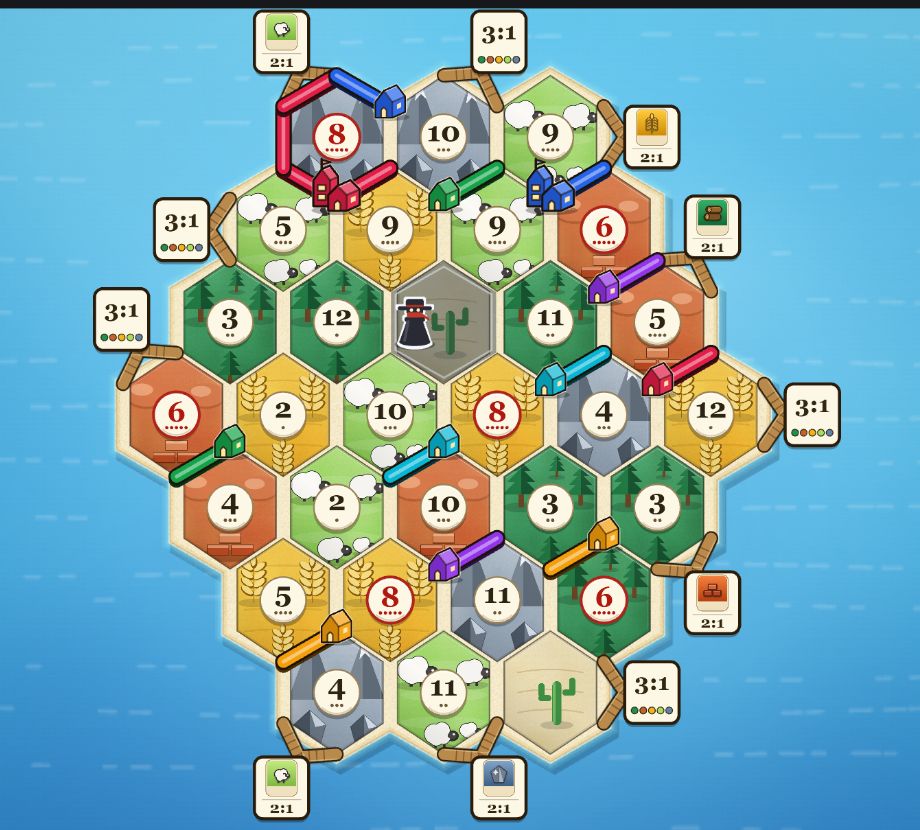
How the big board is chosen
The board follows the seats that actually sat down, not the seat cap of the room. A 6-seat room that starts with three players plays on the small board, and the bank and card deck reset to the small sizes with it. So nobody has to pick a size. You fill the table, press start, and the board matches the people at it.
Who can open a 5 or 6 seat room
Everyone plays free and guests need no signup, but there is one limit. A room owned by a guest holds at most 4 seats. The 5th and 6th seat need a registered room owner. Bots can fill empty seats, so a registered host can run six seats with any mix of people and bots. A match needs at least two seats of any kind.
Setup with six players
Setup is the same snake draft at any size: the first seat places, then the order runs forward to the last seat and backward again. Each placement is one village plus one road touching it. The distance rule holds everywhere: every neighbouring corner of a village must be empty. The second village pays one good per producing hex it touches, and that is your opening hand. The first seat rolls first, and seat order is a random shuffle. With 80 corners there is more room to find a good spot than on the small board, but six players also fill it faster.
Turns simply go round the table. You build and trade in your own turn, after you roll, and not before. There is no extra building moment between other players' turns.
How the game feels with six
These numbers come from bot-only matches through the real engine on Frontier Valley, target 10 VP, all seats medium bots: 2000 matches at 4 seats and 500 at 6. They describe bots, not people, and they show a pattern, not a cause.
Fewer turns for you
The median match lasts 14 rounds at six seats against 23 at four. The whole match uses about the same number of dice rolls (median 88 against 94), so the same rolls are shared among more people. You get far fewer turns, and each one has to count.
A 7 comes more often between your turns
Between two of your turns, three other players roll at a 4-seat table and five roll at a 6-seat one. The chance that at least one of those rolls is a 7 is 42.1% against 59.8%. On a 7 nobody collects, anyone holding more than the hand limit (default 7) discards half rounded down, and the roller moves the Bandit. At six seats, hold fewer cards or expect to lose some.
Your opening hand matters more
Win rate by how many different goods your two opening villages touch, against the even split for that table size:
| Goods touched by the opening | 4 seats (even split 25%) | 6 seats (even split 16.7%) |
|---|---|---|
| 2 goods | 12.6% | 6.3% |
| 3 goods | 19.3% | 11.4% |
| 4 goods | 25.9% | 17.6% |
| 5 goods | 34.6% | 26.1% |
Five goods is about 1.4 times the even split at four seats and about 1.6 times at six. With fewer turns, a thin start is harder to repair.
Cities carry more of the win
In the matches that reached 10 points, cities made 61.9% of the winner's points at six seats (6.23 points on average), against 56.6% and 5.69 points at four. Villages gave 1.46 points at six against 1.64 at four. Winners at a big table lean on cities, which fits the short match: upgrade early.
Picking a target
The target ladder at 5 to 6 seats is 8, 10, 12 or 14, default 10. A lower target shortens an already short match. If your group wants a long evening, try 12 or 14. Other maps cost the host 100 coins per match and everyone else still plays free, so the free Frontier Valley is the place to start.
What to do next
If you are planning a Catan-style night for five or six, read how many players the classic supports, the map layouts and the setup guide. To try a 6-seat table, register to host it, add bots or invite friends, and open Claimridge in your browser.
CATAN® is a registered trademark of CATAN GmbH. Playgridia and Claimridge are not affiliated with, sponsored or endorsed by CATAN GmbH, its licensees or publishers. The name is used only to identify the game readers are searching for and to describe the genre; Claimridge is an independent game with its own rules, names and artwork.
Frequently Asked Questions
How many players does Catan support?
The base box of the classic game seats 3 to 4 players, and an extension covers 5 to 6. Claimridge, a separate game of the same genre, takes 2 to 6 players.
How big is the Catan 6 player map?
In Claimridge's Frontier Valley, the 5 to 6 seat board has 30 land hexes, two deserts, 28 number tokens and 11 trading posts. The 2 to 4 seat board has 19 hexes, one desert and 9 posts.
Do I need to choose the big board for six players in Claimridge?
No. The layout follows the number of players who actually sat down, not the seat cap of the room. A 6-seat room that starts with three players plays on the small board.
Can a guest host a 6-player room?
Guests can play for free with no signup, but a room owned by a guest holds at most 4 seats. Seats 5 and 6 need a registered room owner, and bots may fill any empty seats.
Is a 6-player game slower than a 4-player one?
The match is shorter in rounds but not in rolls. In bot-only test matches the median was 14 rounds at six seats against 23 at four, with about the same dice rolls in total (88 against 94), so you get far fewer turns.
How often does a 7 come up with six players?
Between two of your turns, five other players roll at a 6-seat table against three at a 4-seat one. The chance that at least one roll is a 7 is 59.8% against 42.1%.