What Happens on a 7 in Catan? Discard and Steal Rules
On a 7 in Catan, nobody collects anything, every player holding more than 7 cards gives back half of them rounded down, and the roller moves the blocking piece and steals one card. Claimridge is a separate, independent game of the same genre, and this guide uses its screen because every number can be checked there. The classic game works the same way on a 7.
What a 7 does, step by step
In Claimridge the 7 resolves in a fixed order. Nothing about it is optional.
- No production. Nobody collects goods from the dice on that roll.
- Discard. Everyone holding more than the hand limit (7 by default, so 8 or more) discards half their hand, rounded down. The roller goes first, then turn order, one player at a time.
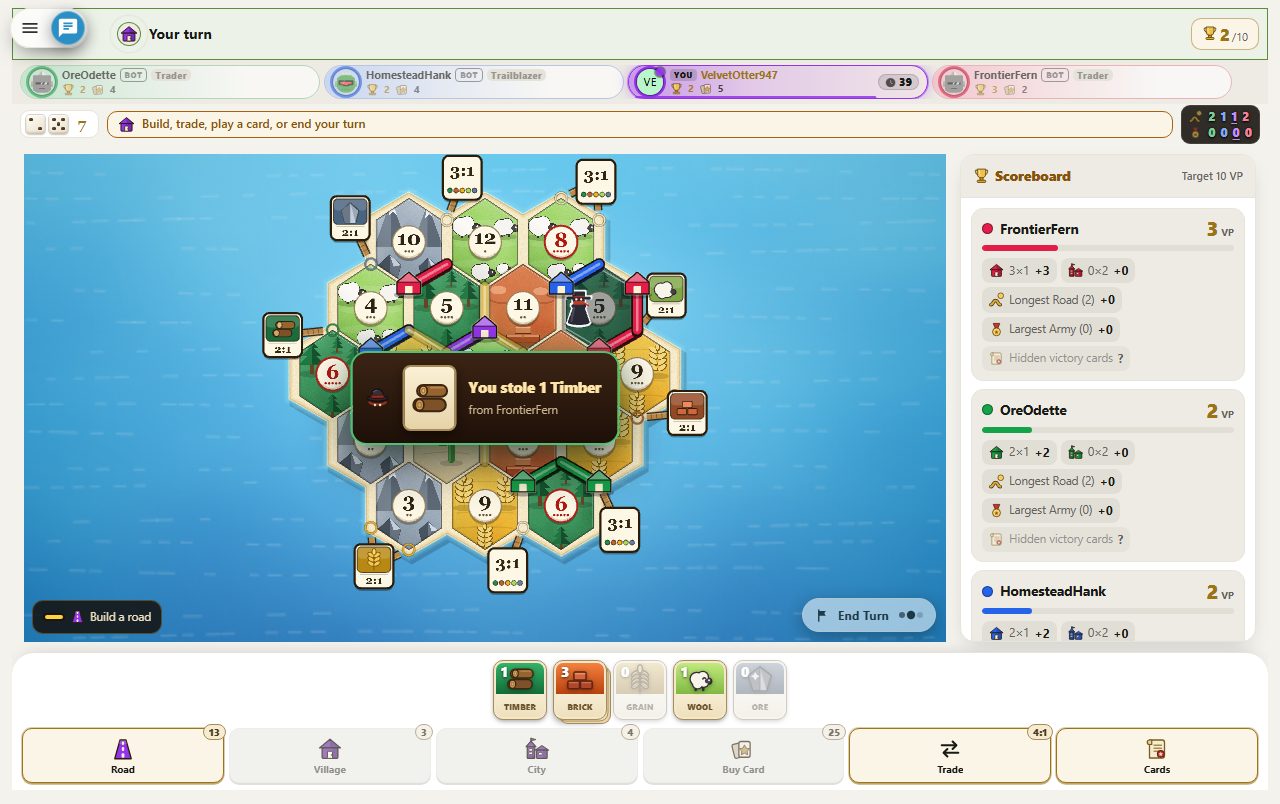
- Move the Bandit. The roller puts the Bandit on any land hex except the one it is already on. A desert or a gold field is allowed, water is not. That hex produces nothing while the Bandit sits on it.
- Steal. The roller takes 1 random card from one player who has a village or city on that hex and at least one card. If several players qualify, the roller names one. If nobody qualifies, nothing is stolen.
There is no "rob nobody" choice. If a victim exists, the steal happens. Only the thief and the victim see which good moved, everyone else just sees that a card changed hands. In the classic game the blocking piece does the same job: it sits on a hex, blocks its production and lets the mover steal.
How many cards you discard
The rule is "more than 7, then half, rounded down". Exactly 7 cards is safe. One more card is expensive.
| Cards in hand | Discarded | Kept |
|---|---|---|
| 7 or fewer | 0 | all |
| 8 | 4 | 4 |
| 9 | 4 | 5 |
| 10 | 5 | 5 |
| 11 | 5 | 6 |
| 12 | 6 | 6 |
Odd hands lose one card less than you might expect, because the half rounds down. Going from 8 to 9 cards costs you nothing extra on a 7. Going from 7 to 8 costs you four cards. That cliff is the whole reason to watch your hand size.
How often a 7 comes
With two dice, 6 of the 36 combinations make a 7, so it comes up on 16.7% of rolls, one in six. It is the most common single sum. In 4-seat matches played by bots through the real engine, the average was 18 sevens per match. Those were bot matches, not people, but they show the scale: in a typical game the 7 hits you many times, not once or twice.
Here is the chance that at least one 7 lands before your next turn, using 1 - (5/6)^n for the n rolls other players make.
| Seats | Rolls by others (n) | At least one 7 before your turn |
|---|---|---|
| 2 | 1 | 16.7% |
| 3 | 2 | 30.6% |
| 4 | 3 | 42.1% |
| 5 | 4 | 51.8% |
| 6 | 5 | 59.8% |
The more seats, the less safe a big hand is. At 4 seats a 7 arrives before your next turn about 4 times in 10. At 6 seats it is closer to 6 in 10. So at 8 or more cards, spend them: build, trade with the bank or buy a card. Holding 8 cards and hoping is a bet you lose more often than you win once the table has 5 or 6 players. In the bot matches the whole table discarded 103.6 cards per match on average, which is what hoarding looks like.
Where to send the Bandit
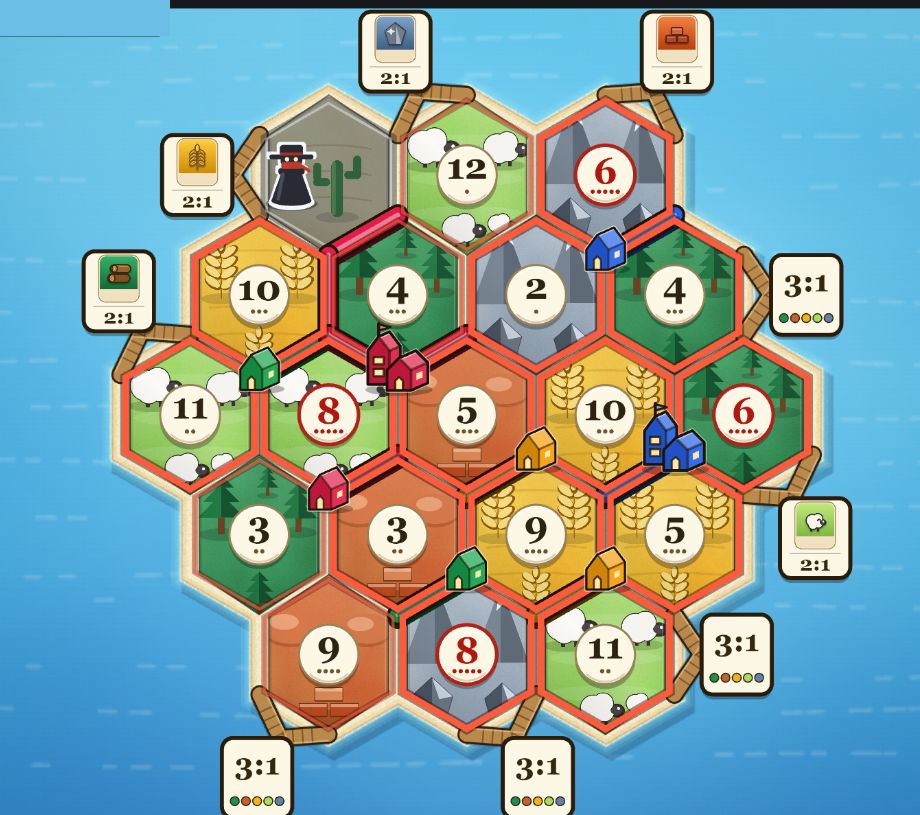
You pick the hex, so use it for two things at once: block a leader and steal from them. Look for a hex with these traits.
- The leader has a village or city on it. A city on the hex doubles what they lose, and you get a victim to steal from.
- A 6 or 8 number token. Those are the most common numbers after 7, so a blocked 6 or 8 hurts most.
- You are not on it. The Bandit blocks everyone, including you.
One more measured detail, again from bot matches only: the eventual winner had the Bandit land on a hex touching their own buildings 13.04 times per match, other seats 10.37 times. That is a correlation, and probably it just shows the leaders are the ones with the most buildings on the board. Do not read it as a reason to rob yourself. Also remember the Bandit must move off its current hex, so you cannot park it on the leader's best tile forever.
Whom you steal from matters too. You take 1 random card, so the best victim is whoever holds the most cards. More cards means a better chance of hitting something you need.
How to play your hand around a 7
- Count before you end your turn. If you hold 8 or more, and a 7 is plausible, spend down to 7 or fewer if you can do something useful with the cards.
- Spend on what you wanted anyway. A road costs 1 timber and 1 brick, a village 1 timber, 1 brick, 1 grain and 1 wool, a city 2 grain and 3 ore, a card 1 grain, 1 wool and 1 ore.
- Use the bank when stuck. The bank trades 4:1, or 3:1 and 2:1 with a trading post. Turning four spare cards into one you need costs less than losing half of them.
- Remember the order. Discards go before the Bandit moves, so you cannot dodge a steal by discarding first. A player who just discarded is a weaker victim, though, because they hold fewer cards.
- Gunslinger cards move the Bandit too. A Gunslinger does the move-and-steal on demand, before the roll or during your turn, without needing a 7. It also counts toward Largest Army.
The hand limit option
The room host can change the hand limit before the match: 7 (the default), 9, 12 or off. At 9 you only discard when holding 10 or more. At 12 only a hand of 13 or more discards. With the limit off, nobody ever discards. The Bandit still moves and steals, so a 7 stays dangerous even then, just in a different way. Pick the limit with the table in mind: a higher limit lets people save for a city, a low one forces constant spending.
What to do next
Learn the 7 first, because it comes every sixth roll or so. For the wider rules read the Catan rules explained, for strategy how to win Catan, and for the number maths Catan dice odds. When you want to practise a 7 in a real match, open Claimridge: it is free in the browser, guests play without signing up, and you can fill the table with bots. Keep your hand at 7 when the table is big, and put the Bandit where the leader hurts most.
CATAN® is a registered trademark of CATAN GmbH. Playgridia and Claimridge are not affiliated with, sponsored or endorsed by CATAN GmbH, its licensees or publishers. The name is used only to identify the game readers are searching for and to describe the genre; Claimridge is an independent game with its own rules, names and artwork.
Frequently Asked Questions
What happens when you roll a 7 in Catan?
Nobody collects goods on that roll. Anyone holding more than 7 cards discards half, rounded down. Then the roller moves the blocking piece to a new hex, which stops producing, and steals one random card from a player with a building there. Claimridge, a separate game of the same genre, follows the same sequence.
How many cards do you discard on a 7?
Half your hand, rounded down, but only if you hold more than 7. So 8 or 9 cards means discarding 4, 10 or 11 means 5, and 12 means 6. With 7 cards or fewer you discard nothing.
Do you have to move the blocking piece to a different hex?
In Claimridge, yes: the Bandit must go to a land hex other than the one it is on. It can go on a desert or gold field but never on water. The classic game works similarly, with the piece always moving when a 7 is rolled.
Can you rob nobody on a 7?
In Claimridge you cannot choose to skip the steal. If a player with at least one card has a village or city on the hex, the roller takes one random card from them. If nobody qualifies, nothing is stolen.
How often does a 7 come up?
On 6 of 36 dice combinations, which is 16.7% of rolls or one in six. In bot-only 4-seat matches on the real engine, there were about 18 sevens per match on average. Those are bot results, not human ones.
Can you play without a discard limit?
In Claimridge the room host picks the hand limit: 7, 9, 12 or off. With it off nobody discards, but the Bandit still moves and steals.