Catan Setup: How to Set Up the Board and the Distance Rule
Catan setup comes down to a 19-hex island, 18 number tokens, 9 trading posts and a two-round placement draft where each player puts down a village and a road twice. Claimridge is a separate, independent game of the same genre; the classic box uses the same 19-hex shape, and online the board is dealt for you, so this guide uses what you see on our screen.
What is on the board
The standard board in Claimridge is called Frontier Valley. At 2 to 4 seats it has 19 land hexes, 54 corners and 72 edges. Each land hex produces one good, and the desert produces nothing. The Bandit starts on the desert.
| Terrain | Hexes | Good it pays |
|---|---|---|
| Forest | 4 | Timber |
| Hills | 3 | Brick |
| Fields | 4 | Grain |
| Pasture | 4 | Wool |
| Mountains | 3 | Ore |
| Desert | 1 | Nothing |
That is 19 hexes in total. The 18 number tokens go on every hex except the desert. The numbers are 2, 3, 4, 5, 6, 8, 9, 10, 11 and 12. There is no 7 token, because a 7 triggers the Bandit instead of paying anyone. The 6 and the 8 are printed in red because they are rolled most often.
Around the coast sit 9 trading posts: 4 generic 3:1 posts, plus one 2:1 post for each good. Without a post you trade with the bank at 4:1.
How the board is dealt
Online you do not shuffle anything. Terrain and number tokens are dealt at random at the start of every match, so no two boards match. If two red hexes would touch, the dealer rejects that layout and tries again, up to 40 times. After 40 tries it keeps the last layout anyway, so it is best effort, not a promise. In 3000 test boards at 2 to 4 seats, 8 had two red hexes touching.
A bigger table gets a bigger board. With 5 or 6 players seated, Frontier Valley becomes 30 hexes with 2 deserts and 28 tokens, and the number of players who actually sat down decides which board you get. More on that in the 5 and 6 player guide. If you want to see other shapes, see the map layouts post.
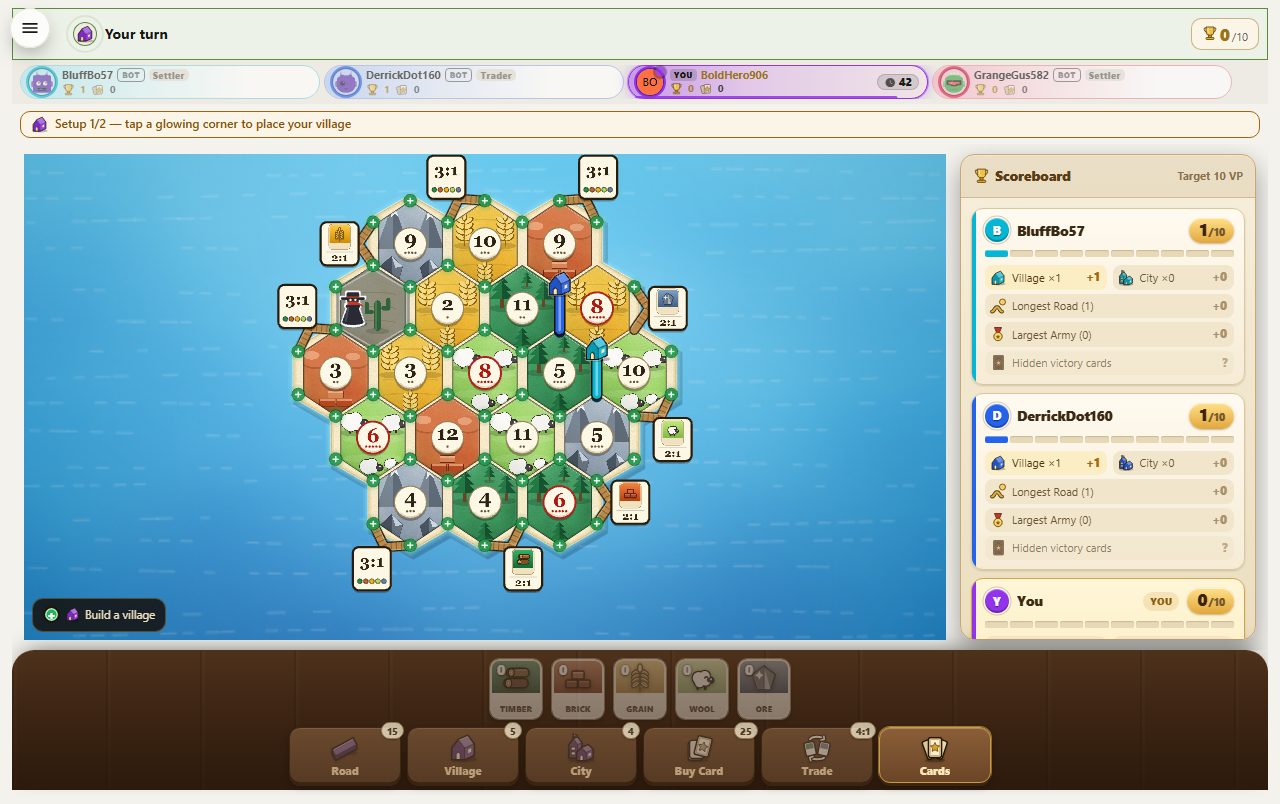
The snake draft, step by step
Seat order is a random shuffle. Each placement is one village plus one road that touches it. Everyone places twice, and the second round runs in reverse order.
- 3 seats: first, second, third, then third, second, first.
- 4 seats: first, second, third, fourth, then fourth, third, second, first.
The last seat in the order places twice in a row, and the first seat, which placed last, rolls first. Nobody can build or trade before their own roll. Your road has to touch the village you just placed, so pick the village first and the road second.
The distance rule
The distance rule says every neighbouring corner of a new village must be empty. You cannot put a village next to any other village or city, yours or a rival's, even if the road between them is free. On our screen the glowing plus marks only appear on corners that pass the rule, so a corner with no mark is simply illegal. That is also how a rival can block you: a village beside the corner you wanted removes it.
The second village pays your opening hand
When you place your second village, you immediately receive one good for every producing hex it touches. The desert gives nothing. That payout is your whole starting hand, so the second village decides what you can build on turn one. A village touching 3 productive hexes gives you 3 goods. A village on a coastal corner touching 2 hexes gives you 2.
What to look at when you place
These numbers come from bot-only matches run through the real engine, not from human games, and they show a pattern, not proof of cause. In 2000 matches at 4 seats with medium bots, the win rate depended on how many different goods the two opening villages touched. An even split would be 25%.
| Goods touched by both opening villages | Win rate at 4 seats |
|---|---|
| 2 | 12.6% |
| 3 | 19.3% |
| 4 | 25.9% |
| 5 | 34.6% |
Seats whose opening touched both ore and grain won 31.7% of the time, against 17.1% for seats that did not. Cities cost 2 grain and 3 ore, and cities supplied 56.6% of the winners' points in those matches. Touching timber and brick together mattered much less: 26.3% against 23.5%. Seat order made no significant difference, from 23.5% for the first seat to 26.4% for the fourth.
So the short version is to spread across goods and reach ore and grain. The full reasoning, with more numbers, is in the opening placement strategy post.
Fog Setup, an optional room setting
The host can change the Setup option in the room. The default is Open Map, the classic open draft. The other choices are Terrain Hidden, Numbers Hidden and Full Fog. Under fog you see only the island's shape, the corners and where each trading post stands during the whole draft. Then the board turns face up after the last opening road, and only then do the second villages pay out. It makes the draft a guess, so it suits a table that already knows the basics.
Setting up your first match
Open a room, add bots if you want company, and start: the board is already dealt. A guest-owned room holds at most 4 seats, and the 5th and 6th seats need a registered room owner. Put your first village where it touches three different goods, keep ore and grain in reach for your second, and mind the distance rule. Ready to place one? Play Claimridge.
CATAN® is a registered trademark of CATAN GmbH. Playgridia and Claimridge are not affiliated with, sponsored or endorsed by CATAN GmbH, its licensees or publishers. The name is used only to identify the game readers are searching for and to describe the genre; Claimridge is an independent game with its own rules, names and artwork.
Frequently Asked Questions
How many of each tile are there in Catan?
In the 19-hex island used by Claimridge's standard board: 4 forest, 3 hills, 4 fields, 4 pasture, 3 mountains and 1 desert. They pay timber, brick, grain, wool and ore. The desert pays nothing.
What is the distance rule?
Every neighbouring corner of a new village must be empty. You cannot build next to any village or city, whoever owns it. In Claimridge only legal corners show a glowing mark.
Who places first, and in what order?
Seat order is a random shuffle. Everyone places a village and a road twice, in order and then in reverse, so at 4 seats the fourth seat places twice in a row and the first seat places last. The first seat then rolls first.
When do I get my starting resources?
When you place your second village, you receive one good for every producing hex it touches. That is your whole opening hand. Under Fog Setup, that payout waits until the board is revealed.
How many number tokens are there and is there a 7?
There are 18 tokens on the standard board, one per hex except the desert. They are 2, 3, 4, 5, 6, 8, 9, 10, 11 and 12. There is no 7 token, since a 7 moves the Bandit.
Does it matter where I sit in the draft?
In 2000 bot-only matches at 4 seats, win rates ranged from 23.5% to 26.4% by seat and the difference was not significant. What you touch matters more than your seat.