How to Play Catan-Style Games: The Rules in 5 Minutes
How to play Catan? In this kind of game every turn starts with two dice, the hexes showing that number pay out resources, and you turn those resources into roads, villages and cities until someone reaches the target score. The boxed game's official rules are in its own rulebook, and this post does not replace them; it explains how this kind of game works in five minutes, shown on a free game you can open in your browser right now: Claimridge. Claimridge is a separate, independent game from Catan, with its own rules, names and artwork; it only shares the genre.
The goal: first to the target score wins
The classic boxed game's target is 10 points; in Claimridge the default board, Frontier Valley, defaults to 10 too. The target is a room option and its ladder belongs to the map: on Frontier Valley with 2–4 seats the host picks 6, 8, 10 or 12. Points come from buildings: a Village is worth 1 victory point (VP) and a City 2. Two awards add +2 VP each: an unbroken run of 5 Roads earns Longest Road and 3 played Gunslinger cards earn Largest Army; each hidden Victory Card is worth +1.
Setup: snake order, two Villages, two Roads
Seat order is shuffled among the players who sat down. Placement is a snake draft: in seat order everyone lays 1 Village + 1 Road, then the order reverses and everyone lays a second Village + Road. Two rules matter: a Village needs every neighbouring corner empty (the distance rule), and each opening Road must touch the Village you just placed. The key detail: your second Village pays out immediately — one good for every producing hex it touches — and that is your entire opening hand. Place it for the goods it brings, not for how it looks. When setup ends, the first seat rolls first.
Five terrains pay five goods: Forest → Timber, Hills → Brick, Fields → Grain, Pasture → Wool, Mountains → Ore. A Wasteland hex produces nothing. Every land hex except a Wasteland carries a number disc from 2 to 12; there is no 7 disc, and the most frequent numbers are 6 and 8 (5 of the 36 dice combinations). Choose your Village by number and mix of goods; the dice-odds guide has the details.
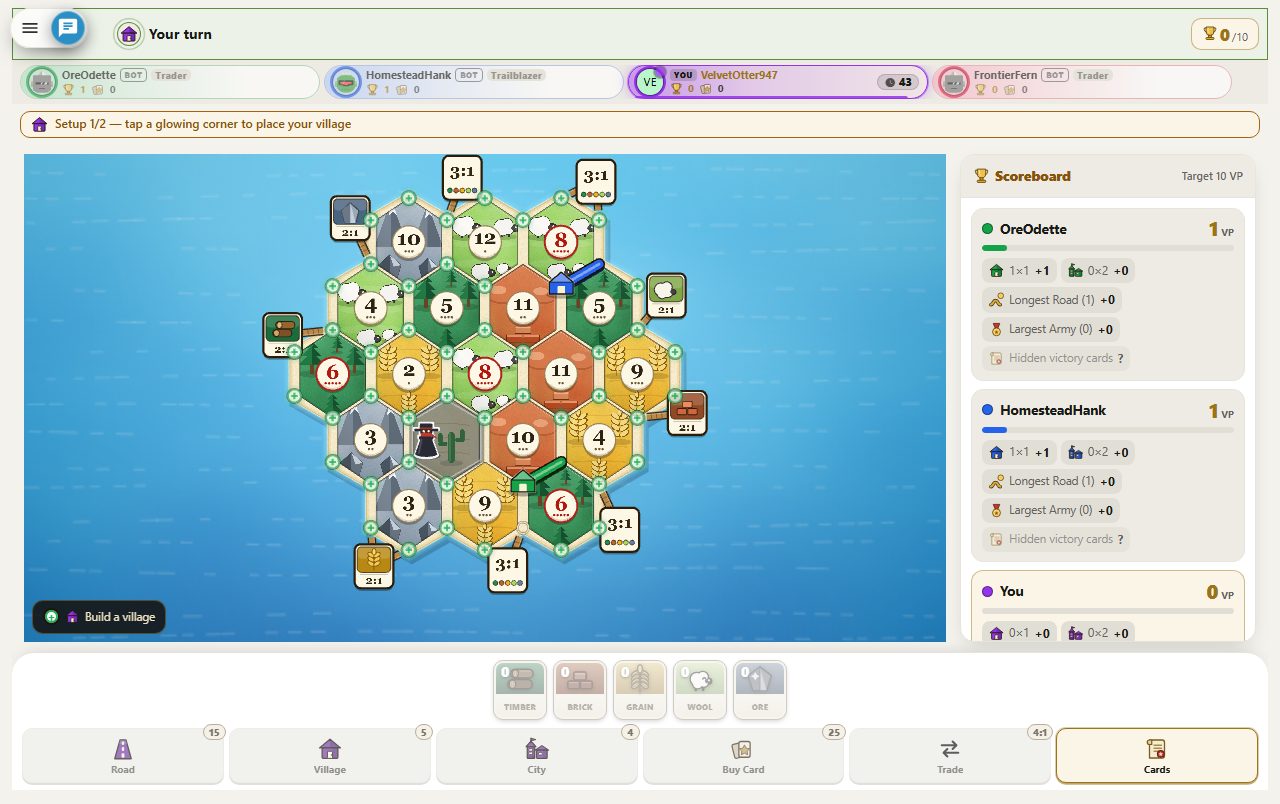
How a turn works
- Roll. You roll two six-sided dice (the classic boxed game also uses two dice). Every hex showing that sum pays 1 good to each Village and 2 to each City touching it; a hex with the Bandit on it produces nothing. Building and trading start only after the roll.
- Act. In any order and as far as you can pay: build, trade with the bank or the table, buy a Development Card and play one card per turn.
- End turn. The move clock is 180 seconds by default (90 to 600 in the room settings). If it runs out, a medium-level bot plays the rest of that turn for you. Open trade offers close when the turn ends.
Trading has two sides. The bank always gives 1 of one good for 4 of another (4:1). If you own a Village or City on one of the two corners of a coastal Trading Post, the rate improves: a generic post is 3:1 on any good, a specific post is 2:1 on its own good. Trading with players is a bid: you post a give/get offer (up to 3 open at once), every rival sees it and can accept, decline or write a price of their own, and you choose who to settle with.
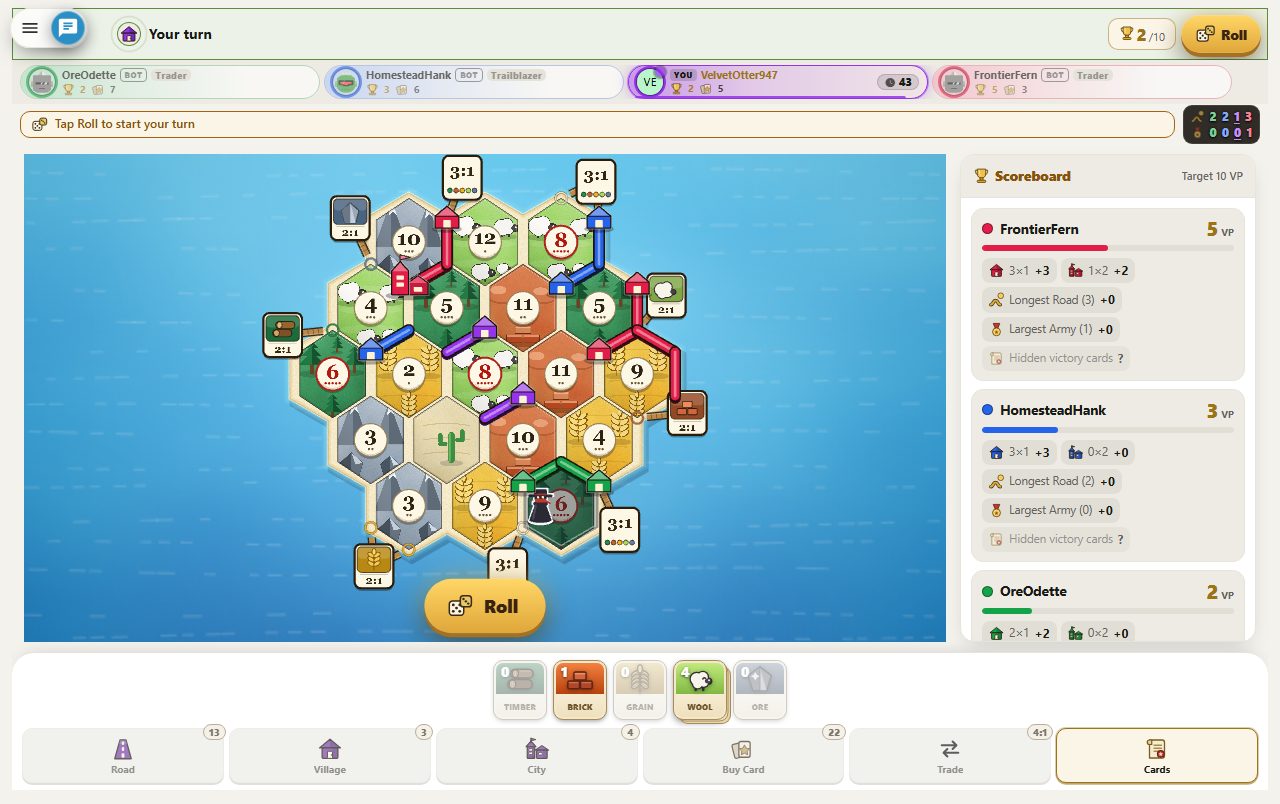
When a 7 comes up: the Bandit
In the classic boxed game, a 7 halves big hands and moves a blocking piece. In Claimridge the same idea works like this: a 7 produces nothing. First, everyone holding more than 7 cards (8 or more) discards half, rounded down, starting with the roller. Then the roller moves the Bandit to any other land hex and steals 1 card, blind, from a rival with a building there. The hand limit defaults to 7; the host can set 9 or 12, or switch discarding off. Ending a turn with a hand near the limit is expensive when a 7 shows up: spend it or trade it that turn.
What does everything cost?
| What you build | Cost | Points | Note |
|---|---|---|---|
| Road | 1 Timber + 1 Brick | 0 | Connects to your own building or road. |
| Village | 1 Timber + 1 Brick + 1 Grain + 1 Wool | 1 | Must touch your own road; neighbouring corners empty. Pays 1 good on a roll. |
| City | 2 Grain + 3 Ore | 2 | Upgrades a Village. Pays 2 goods on a roll. |
| Development Card | 1 Grain + 1 Wool + 1 Ore | – | Drawn at random; playable from your next turn. |
The Development Cards deck is 25 cards at a 2–4 seat table: 14 Gunslinger (move the Bandit and rob), 5 Victory Cards, 2 Road Master (2 free roads), 2 Supply Wagon (any 2 goods from the bank) and 2 Boom (name a good, take every copy of it from every hand). A Victory Card is never played; it counts as a hidden +1.
How the match ends
Whoever reaches the target on their own turn wins; your score is checked right after your own actions (building, playing a card, moving the Bandit, buying a card). The scoreboard everyone can read leaves hidden Victory Cards out, so the leader may be a step closer than they look, and a Victory Card drawn at the right moment can end the match on the spot. If everyone else leaves, the last player wins; if nobody's score moves for 15 rounds and the card deck is empty, the highest score wins.
Five things to notice if you know Catan
These are Claimridge's own features, not a comparison with the boxed game.
- Trading is a negotiation. Up to 3 offers stay open at once; every rival sees every offer and can accept, decline or write a price of their own, and you pick the partner.
- Two dice systems. Classic Dice (two independent dice) or a Balanced Deck that deals all 36 combinations without replacement, so every cycle of 36 rolls holds exactly six 7s.
- Six maps. Frontier Valley's small layout is a single 19-hex island and is always open. The other five bring their own rules (a plain with no Wasteland, a canyon of water splitting the land, gold fields, two boards with ships) and are played with a one-match ticket the host buys with coins; everyone at the table plays free.
- Bots. Three levels (Easy, Medium, Hard) fill empty seats and work for solo practice too.
- 2–6 seats. The boxed base game is for 3–4 players and 5–6 need an extension; Claimridge seats 2–6 in one game and sizes the board to the players who actually sat down. A guest host's room holds up to 4 seats; 5–6 need a signed-in host.
What to do now? Stop reading and try it: open a Claimridge room, add a bot on Frontier Valley and play to 10. No account or download is needed; it opens in your phone's browser with nothing to install. For every rule in detail there is the full rules guide; for your first two Villages the opening strategy guide; for solo practice playing against the computer; for the genre overview the settlement and resource-trading game guide.
CATAN® is a registered trademark of CATAN GmbH. Playgridia and Claimridge are not affiliated with, sponsored or endorsed by CATAN GmbH, its licensees or publishers. The name is used only to identify the game readers are searching for and to describe the genre; Claimridge is an independent game with its own rules, names and artwork.
Frequently Asked Questions
How many points does Catan go to?
The classic boxed game's target is 10 points. On Claimridge's default board, Frontier Valley, the default target is 10 too, but the target is a room option: at a 2–4 seat Frontier Valley table the host can pick 6, 8, 10 or 12. Whoever reaches the target on their own turn wins, and hidden Victory Cards count toward it.
What happens when you roll a 7 in Catan?
In the classic game a 7 halves big hands and moves a blocking piece. In Claimridge a 7 produces nothing: everyone holding more than 7 cards discards half (rounded down), then the roller moves the Bandit to a land hex and steals 1 card from a rival with a building there. The hand limit defaults to 7; the host can set 9 or 12, or turn discarding off.
Where are the Catan rules written, and does this post replace them?
No, it does not replace them. The boxed game's official rules are in its own rulebook. This post explains the logic of the same genre through Claimridge's own rules, on a game you can open in your browser.
Is Claimridge the same game as Catan?
No. Claimridge is a separate, independent game with its own rules, names and artwork, and it is not affiliated with CATAN GmbH. It only shares the genre: you roll dice on a hex board, collect resources, trade and build.
What do I need to try this kind of game?
No account and no download: Claimridge opens in your phone's or computer's browser as a guest. You can create a room and add a bot; a match needs at least 2 seats filled, so 1 human + 1 bot works. Frontier Valley is always open for your first match.