Property Trading Game Strategy: Which Cities to Buy
 Play Estates
The best property trading game strategy is to buy almost everything you land on early, chase the second city of a colour pair, and then build one level a turn, because a full pair doubles a city rent before you place a single house. This guide uses the World map of Estates, the default board, and every price below comes from the game tables. Rules of the turn are in the full rules guide; this one is about which tiles are worth your money.
What the World map actually costs
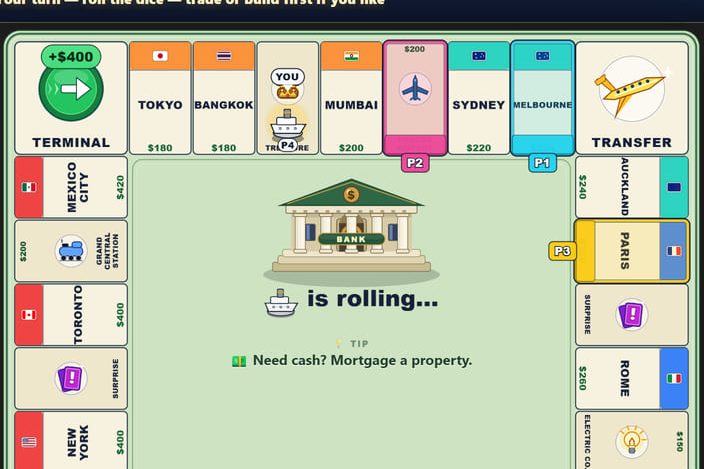
World has 18 cities in 9 colour groups, and every group is a pair of neighbours. City prices run from $160 to $430. Both cities in a pair share the same base rent and the same build cost; only the sticker price differs, by $10 to $30. The Play button above starts a quick bot match on this map.
| Colour group | Cities and prices | Pair price | Build cost per level | Rent, lone city | Rent, full pair | Rent, hotel |
|---|---|---|---|---|---|---|
| Asia | Bangkok $160, Mumbai $180 | $340 | $60 | $18 | $36 | $600 |
| Africa | Lagos $190, Marrakech $210 | $400 | $70 | $23 | $45 | $750 |
| Eastern Med | Cairo $220, Istanbul $230 | $450 | $80 | $27 | $54 | $900 |
| Oceania | Melbourne $240, Auckland $260 | $500 | $90 | $32 | $63 | $1,050 |
| Europe | Rome $270, Berlin $290 | $560 | $100 | $38 | $75 | $1,250 |
| Gulf | Doha $300, Dubai $320 | $620 | $120 | $44 | $87 | $1,450 |
| Americas | Mexico City $330, Toronto $350 | $680 | $130 | $50 | $99 | $1,650 |
| Pacific | Sydney $370, Tokyo $390 | $760 | $150 | $57 | $114 | $1,900 |
| Atlantic | Paris $410, New York $430 | $840 | $160 | $66 | $132 | $2,200 |
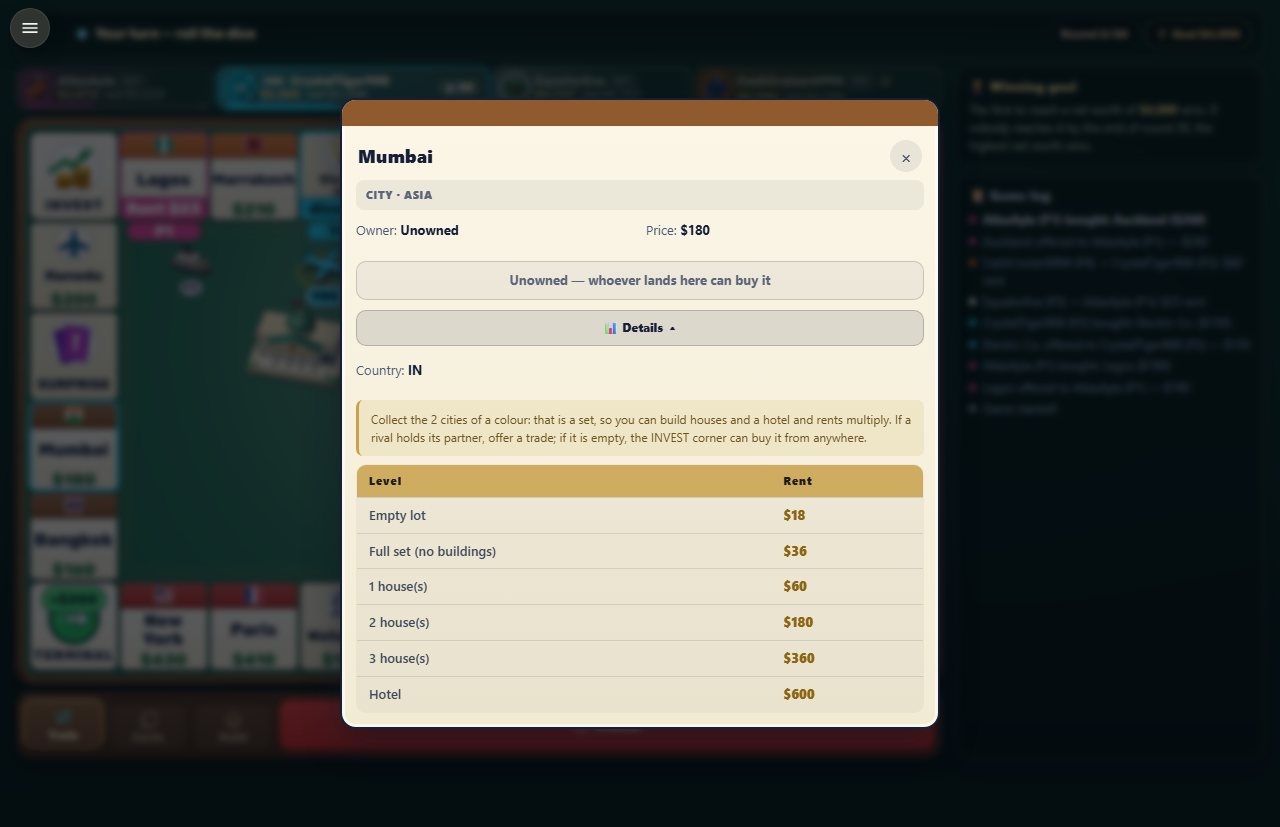
Rent for a lone city with no set is 1.5 times the base rent. Own both cities of the pair and it becomes 3 times, before any building. Houses then step the rent to 5, 15 and 30 times the base, and the hotel is 50 times. The hotel is the fourth level, and every level costs the same build cost.
Why the second city of a pair is the real purchase
Take the Pacific pair. A lone Sydney or Tokyo collects $57. Hold both and each collects $114 with no houses at all. That doubling costs nothing beyond the second sticker price, and it is the cheapest rent increase in the game. Houses cost $150 a level there and lift one city to $190, $570, $1,140 and then $1,900.
Value per dollar rises with the tier. Counting the pair price plus eight build levels (four on each city), one hotel rent comes to about $73 per $100 spent in Asia and about $104 per $100 in Atlantic. The dearest groups pay back the most per dollar once fully built, and they are also the slowest to afford.
Rules that change what a tile is worth
- One building per city per turn. A pair needs four turns to reach two hotels, so start building the turn you complete the set. A Free Build card is the exception.
- Rent is waived while the owner is in jail. The tenant pays nothing, and that applies to cities, transport hubs and utilities. Jail is a real cost for a landlord, not a safe square.
- No auction. If you skip a tile, or cannot afford it, it stays unowned for the next player to land on. Passing is cheap, but so is a rival picking it up.
- The goal is $4,000 of net worth. Cash, property at sticker price and what you built all count. The game also ends at a 30-round cap, and a first-ever quick match is capped at 15 rounds.
- The Invest corner costs 150%. It lets you buy any empty property on the board, but the property enters your net worth at its normal price, so the premium is lost from the race.
Transport and utilities
Transport hubs cost $200 each and rent a flat $50, $150, $300 or $600 for owning one to four. World has only two hubs, so the most they pay there is $150. Both utilities ($150 each) rent your last dice roll times 10, or times 30 when you own both.
What bot simulations show
These are simulations of bots playing, not human win rates. On 2026-11-10 we ran 500 four-seat matches on World with the $4,000 target and a 30-round cap, mixing easy, medium and hard bots.
- The median match lasted 12 rounds (average 12.7, 90th percentile 17, longest 23). All 500 ended on the $4,000 target, so none reached the cap.
- Win share by bot level was 10.9% easy, 30.6% medium and 33.5% hard.
- Bots offered 3,937 trades and 1,705 were accepted, about 43%.
Full pairs versus never building
We also ran 1,500 matches each of four identical bots. With four medium bots, a seat that finished with at least one full pair won 37.0% of the time against a fair share of 25%. With four easy bots, which never build, invest or trade, the same seats won 25.2%, no better than chance. Owning a pair only pays when you build on it.
Is any group a winner?
Not in this simulation. With four medium bots the rent collected per match ranged from $106 for Asia to $227 for Americas, with Pacific at $198 and Atlantic at $168. The average holdings of winning seats were flat across tiers, between 0.60 and 0.76 per group. The two dearest groups were bought least, about 1.4 times a match against about 1.6 for the cheaper tiers. Both utilities together collected $144. We found no colour that wins on its own, so we are not naming one.
So what do you do with this
Buy early, because nothing goes to auction. Treat the second city of any pair as the priority, build a level every turn once you hold it, and stay out of jail when others are collecting from you. Read the rules post if a term here is new, or see the online property trading game overview for how a room is set up.
Frequently Asked Questions
Which properties should I buy in a property trading game?
Buy most tiles early, since a skipped tile simply stays unowned and a rival can take it. Put the second city of a colour pair first, because a full pair doubles that city rent before any building. In our bot simulation no single colour won on its own.
Is it worth building houses on a full pair?
Yes. In a bot simulation of four medium bots, seats that finished with a full pair won 37.0% against a fair share of 25%. With four easy bots that never build, the same seats won only 25.2%. You can add one level per city per turn.
Do I collect rent when I am in jail?
No. Rent is waived while the owner is jailed, and the tenant pays nothing at all. That covers cities, transport hubs and utilities, so a landlord in jail earns nothing.
How long does a match last?
The default goal is $4,000 of net worth with a 30-round cap. In 500 simulated four-bot matches the median was 12 rounds and the longest was 23, and all ended on the target. Your first quick match is capped at 15 rounds.
What happens if I do not buy a property I land on?
It stays unowned and the next player who lands on it can buy it. There is no auction, so passing on a tile never gets you a better price later.